Narcissistic traits in a relationship can show up as a constant need for admiration, a lack of empathy, controlling behavior, difficulty accepting criticism, or a tendency to blame a partner for problems. These behaviors may leave you feeling unheard, confused, or emotionally drained, especially when they happen repeatedly.
However, having narcissistic traits doesn’t automatically mean someone has narcissistic personality disorder (NPD). The most important things to consider are the pattern of behavior, its impact on your well-being, and whether your partner takes responsibility for their actions.
Understanding these signs can help you recognize unhealthy relationship patterns without rushing to label someone. You’ll learn how narcissistic behaviors may appear during dating, conflict, marriage, and breakups, how they differ from ordinary relationship problems, and what you can do to protect your emotional health.
Quick Answer
Narcissistic traits in a relationship are patterns of behavior involving excessive self-importance, a strong need for validation, limited empathy, entitlement, or difficulty accepting responsibility. They may appear as dismissing a partner’s feelings, expecting special treatment, reacting angrily to criticism, shifting blame, or using affection to influence a partner’s behavior.
Not everyone who displays these traits has narcissistic personality disorder. Look at repeated behavior over time, its effect on both partners, and the person’s willingness to acknowledge harm and make lasting changes.
Narcissistic Traits in a Relationship: Overview Table
| Trait | How it may appear in a relationship | Possible effect on the partner |
| Excessive need for admiration | Regularly fishing for praise or attention | Feeling overlooked |
| Lack of empathy | Dismissing or minimizing emotional pain | Feeling misunderstood |
| Sense of entitlement | Expecting special treatment or exceptions | Feeling taken for granted |
| Difficulty accepting criticism | Responding defensively to reasonable feedback | Avoiding honest conversations |
| Blame-shifting | Making every disagreement the other person’s fault | Doubting your judgment |
| Controlling behavior | Dictating friendships, clothing, or daily choices | Losing independence |
| Need for superiority | Treating a partner as less intelligent or capable | Reduced self-confidence |
| Exploitative behavior | Taking advantage of a partner’s time or resources | Emotional or practical exhaustion |
| Jealousy and insecurity | Viewing a partner’s success as a threat | Feeling guilty about achievements |
| Conditional affection | Withdrawing warmth to punish or influence | Anxiety and uncertainty |
These behaviors don’t all carry the same meaning or severity. A single argument, selfish decision, or defensive response doesn’t establish a narcissistic pattern. The concern grows when behaviors recur, harm the relationship, and continue despite clear communication about their effects.
What Are Narcissistic Traits in a Relationship?
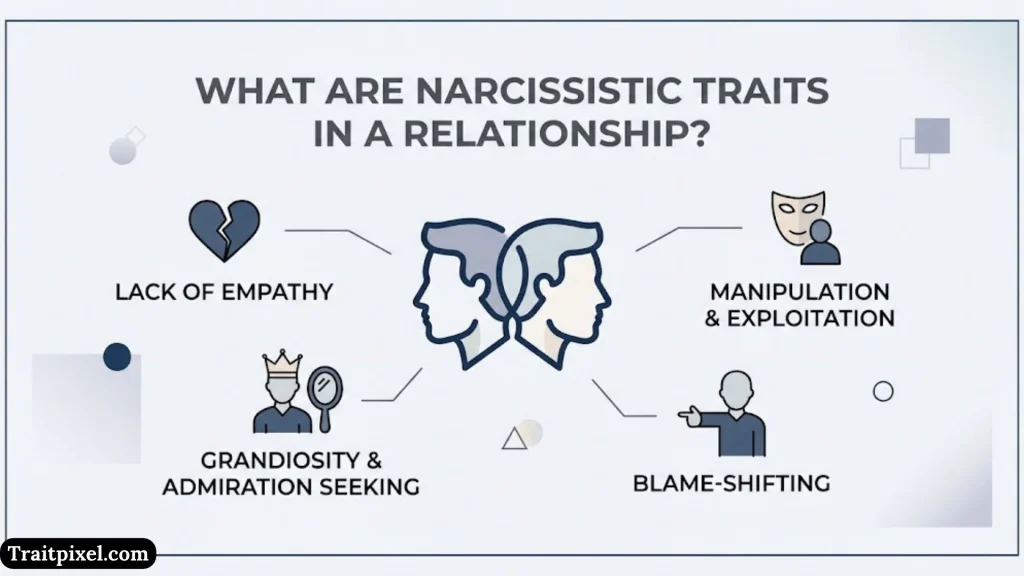
Narcissistic traits are personality tendencies associated with self-focus, a desire for admiration, feelings of superiority, entitlement, or difficulty recognizing other people’s needs. In romantic relationships, these tendencies may interfere with emotional intimacy, trust, compromise, and mutual respect.
Psychology recognizes that narcissism exists in different forms and degrees. Some people display occasional narcissistic behaviors without having a personality disorder. Others show persistent patterns that affect many areas of their lives, including intimate relationships.
The key distinction is between a behavior someone displays occasionally and a repeated pattern that shapes how they treat their partner.
For example, a person who feels overlooked during a stressful week might seek extra reassurance. That alone isn’t evidence of narcissism. But someone who routinely demands attention, dismisses their partner’s needs, and retaliates when attention shifts elsewhere may be displaying a more concerning pattern.
How Narcissistic Traits Affect Romantic Relationships
Healthy relationships allow both people to have needs, make mistakes, express emotions, and disagree without fear of punishment. Narcissistic patterns can disrupt this balance when one partner’s feelings, goals, or status consistently take priority.
You might notice that:
- Conversations repeatedly return to one person’s problems and achievements.
- Your concerns are treated as criticism or disrespect.
- You feel responsible for managing your partner’s emotions.
- Apologies rarely lead to lasting behavioral changes.
- Your successes trigger competition instead of shared happiness.
- You avoid raising reasonable concerns because of the expected reaction.
One useful question is: Can both partners be important in this relationship, even when their needs conflict? If only one person’s feelings, preferences, and goals consistently matter, the relationship may lack the mutual respect needed to remain healthy.
12 Common Signs of Narcissistic Traits in a Relationship
Narcissistic traits often become easier to recognize when you look at how someone behaves during disagreement, emotional stress, or situations that don’t go their way. The following signs can help you identify patterns, although none of them alone proves that a person has narcissistic personality disorder.
1. They Need Constant Admiration and Validation
A person with strong narcissistic traits may rely heavily on praise to maintain a positive view of themselves. They might expect frequent compliments, attention, or reassurance about their attractiveness, intelligence, career, or achievements.
In a relationship, this can create an imbalance. You may spend considerable time making your partner feel important while receiving little appreciation yourself.
Example: You congratulate your partner on a promotion, but they become irritated because you didn’t praise them enthusiastically enough. Later, when you share your own good news, they quickly change the subject.
Wanting appreciation is normal. The concern is whether admiration becomes an expectation that overrides your own emotional needs.
2. They Struggle to Show Empathy
Empathy involves recognizing another person’s feelings and responding with consideration. Someone displaying narcissistic traits may struggle to give your emotions the same importance they give their own.
They might dismiss your concerns, interrupt you, compare your problems with theirs, or offer advice when you simply need understanding.
For example, if you’re upset after a difficult day at work, your partner might respond, “You think that’s stressful? You should hear what happened to me.”
One insensitive response doesn’t necessarily reveal a deeper problem. However, repeatedly dismissing your feelings can make emotional intimacy difficult.
A useful distinction is whether your partner can recognize your pain even when they don’t fully understand it or agree with your perspective.
3. They React Poorly to Criticism
People with narcissistic tendencies may interpret feedback as an attack on their worth rather than an opportunity to improve. Even gentle suggestions can trigger defensiveness, anger, contempt, or withdrawal.
Imagine asking your partner to help more with household responsibilities. Instead of discussing a fairer arrangement, they accuse you of being ungrateful and list everything they do for you.
This reaction shifts attention away from the original issue.
Healthy partners can become defensive sometimes, but they can usually return to the conversation, consider the feedback, and discuss solutions. A persistent pattern of retaliation or hostility makes it much harder to resolve problems.
4. They Believe the Rules Should Be Different for Them
Entitlement is a central feature associated with narcissistic personality disorder. In relationships, it may appear as an expectation that a partner should accommodate their preferences without receiving the same consideration.
Examples include:
- Expecting you to cancel plans whenever they need something.
- Demanding immediate replies while ignoring your messages for hours.
- Treating household duties as your responsibility.
- Expecting forgiveness without making amends.
- Believing their career or personal goals should always take priority.
Entitlement can be subtle. Your partner might not openly demand special treatment, yet repeatedly behave as if your time, attention, and energy belong to them.
What matters: Do they recognize that your needs and boundaries carry equal weight?
5. They Shift Blame Instead of Taking Responsibility
Blame-shifting happens when someone redirects responsibility for their behavior toward another person. Rather than acknowledging what they did, they focus on what they believe you did wrong.
Consider this exchange:
You: “I felt hurt when you mocked me in front of your friends.”
Your partner: “I wouldn’t have said anything if you weren’t so sensitive.”
The original concern was their decision to mock you. Their response makes your reaction the problem instead.
Everyone makes mistakes, and explanations sometimes matter. However, an explanation becomes blame-shifting when it consistently replaces accountability.
Look for whether your partner can acknowledge a specific action, recognize its effect, apologize without adding conditions, and make a reasonable effort not to repeat it.
6. They Use Silent Treatment or Emotional Withdrawal
Taking a break during an argument can be healthy when someone needs time to calm down. The difference lies in how the break is communicated and used.
A healthy pause might sound like this: “I’m too upset to talk productively right now. Can we take an hour and come back to this?”
Punitive withdrawal looks different. A partner may refuse to acknowledge you, deliberately leave you guessing, or withhold communication until you apologize or give in.
When silence becomes a way to punish or control, it can create anxiety and pressure you to abandon your concerns just to restore peace.
Not every period of silence is manipulative. Some people withdraw because they feel overwhelmed or struggle to regulate their emotions. Look at the broader pattern, including whether they communicate their needs and eventually return to resolve the issue.
7. They Try to Control Your Choices
Controlling behavior can develop gradually. A partner might begin by expressing strong preferences about your clothing, friendships, hobbies, or schedule. Over time, those preferences may become demands.
Possible warning signs include:
- Criticizing your friends until you stop seeing them.
- Expecting access to your phone or private messages.
- Monitoring your location without freely given consent.
- Making you feel guilty for spending time independently.
- Interfering with your finances or work opportunities.
- Punishing you for making decisions without permission.
Control is not the same as expressing a concern or negotiating shared responsibilities. A healthy partner can discuss worries without claiming authority over your personal life.
If you feel afraid to make ordinary choices because of your partner’s reaction, take that seriously. Controlling behavior may indicate emotional abuse regardless of whether narcissistic traits are present.
8. They Minimize Your Achievements or Compete With You
A supportive partner can celebrate your success without feeling diminished by it. Someone with strong narcissistic traits may struggle when attention, praise, or status shifts toward you.
For example, you receive a professional award. Instead of congratulating you, your partner points out that their own achievements are more impressive or suggests you received recognition only because your manager likes you.
Other patterns may include:
- Changing the subject when you share good news.
- Taking credit for your accomplishments.
- Making jokes that undermine your confidence.
- Comparing salaries, appearance, popularity, or career progress.
- Becoming unusually critical when you succeed.
Competition can be playful and healthy when both people enjoy it. The concern is a recurring inability to let your achievements stand on their own.
9. They Alternate Between Idealization and Devaluation
Some relationships involving strong narcissistic traits follow a pattern in which a partner initially places you on a pedestal and later treats you as disappointing, inadequate, or unworthy.
Early in the relationship, they may praise everything about you, describe you as uniquely perfect, or push for intense commitment before you’ve had time to know each other well.
Later, ordinary disagreements or unmet expectations may lead to harsh criticism and contempt.
This shift can feel disorienting because you’re comparing the current relationship with the intense affection you experienced at the beginning.
However, early excitement isn’t automatically love bombing, and changing feelings don’t automatically indicate narcissism. The more concerning pattern involves excessive pressure, disregard for boundaries, and affection that appears conditional on your compliance.
10. They Have Difficulty Respecting Boundaries
A boundary describes what you will accept and what you will do to protect your well-being. Examples include needing privacy, maintaining friendships, declining sex, or reserving time for yourself.
Someone who struggles with entitlement may treat these boundaries as personal rejection.
You might hear:
- “If you loved me, you wouldn’t need privacy.”
- “Your friends are more important than I am.”
- “You can’t say no to me after everything I’ve done for you.”
- “Why do you need time alone when we’re together?”
A healthy partner may feel disappointed by a boundary, but they can still respect it.
Remember that consent matters in every relationship. No partner is entitled to your body, passwords, money, or constant availability.
11. They Use Guilt, Charm, or Pressure to Get Their Way
Manipulation involves influencing another person’s choices through pressure, deception, guilt, or other tactics that undermine their freedom to decide.
A partner might remind you of every favor they’ve done whenever you disagree. They might become unusually affectionate after a conflict but avoid discussing what happened. They could also threaten to leave whenever you refuse a request.
Not every attempt to persuade someone is manipulation. People naturally negotiate and advocate for their needs.
The warning sign is a repeated pattern in which you feel unable to say no freely, even when your decision is reasonable.
Ask yourself whether you can disagree without being punished, intimidated, or made to feel responsible for your partner’s entire emotional state.
12. Their Apologies Don’t Lead to Lasting Change
An apology matters, but what happens afterward matters more.
A partner may say, “I’m sorry you felt hurt,” while avoiding responsibility for their behavior. They might promise to change after an argument, only to repeat the same conduct a few days later.
A meaningful apology generally includes:
- Naming the behavior.
- Acknowledging its impact.
- Accepting responsibility without blaming you.
- Taking reasonable steps to repair the harm.
- Showing improvement over time.
A person can struggle with accountability for many reasons. Repeatedly empty apologies, however, make it difficult to rebuild trust.
The practical question is not whether your partner can say the right words. It’s whether their actions become more respectful and consistent.
Overt vs. Vulnerable Narcissistic Traits
Narcissistic traits don’t always look like obvious arrogance. Some people appear confident and superior, while others react to perceived rejection with shame, insecurity, or intense defensiveness.
Psychologists sometimes use the terms grandiose narcissism and vulnerable narcissism to describe different patterns studied in narcissism research. These terms are useful for understanding behavior, but they are not separate formal diagnoses of narcissistic personality disorder.
| Feature | Grandiose pattern | Vulnerable pattern |
| Typical presentation | Confident, dominant, self-important | Insecure, sensitive, easily hurt |
| Need for validation | May seek public praise and recognition | May seek reassurance or fear disapproval |
| Response to criticism | May dismiss, attack, or belittle the critic | May withdraw, feel humiliated, or become defensive |
| Relationship difficulty | May expect superiority or special treatment | May interpret disagreement as rejection |
| Possible effect on a partner | Feeling overshadowed or controlled | Feeling responsible for preventing emotional distress |
These patterns can overlap. A person may appear confident in one situation and deeply insecure in another.
Vulnerability does not automatically mean someone is narcissistic, and visible confidence does not automatically mean someone lacks empathy. The broader pattern of behavior matters more than a single presentation.
What Narcissistic Traits Look Like in Everyday Relationships
The following scenarios illustrate how recurring behavior can affect a relationship. They are hypothetical examples, not diagnostic tests.
Example 1: During an Argument
You ask your partner why they forgot an important commitment. They respond by listing your past mistakes, accusing you of attacking them, and refusing to discuss the original issue.
Possible pattern: Defensiveness and blame-shifting.
What to notice: Can the conversation eventually return to the missed commitment, or does every concern become a trial of your character?
Example 2: When You Need Emotional Support
You explain that you’re anxious about a family problem. Your partner tells you that you’re overreacting and starts talking about their own stress.
Possible pattern: Dismissing another person’s emotional needs.
What to notice: Do they make an effort to understand your feelings later, even if they struggle to respond in the moment?
Example 3: When You Spend Time With Friends
Your partner becomes upset whenever you make plans without them. They accuse you of neglecting the relationship and continue arguing until you cancel.
Possible pattern: Controlling behavior or entitlement.
What to notice: Are you free to maintain healthy relationships outside your romantic partnership?
Example 4: When You Receive Praise
Your colleagues compliment your work. Your partner responds by saying the task was easy or explaining why their own work is more important.
Possible pattern: Competition or difficulty sharing recognition.
What to notice: Can your partner celebrate your success without making it about themselves?
Example 5: When You Set a Boundary
You say you don’t want to discuss a sensitive topic in public. Your partner insists, mocks your discomfort, and accuses you of being secretive.
Possible pattern: Disregard for boundaries.
What to notice: Can you express a preference without being pressured into abandoning it?
Example 6: When They Make a Mistake
Your partner misses an important event and apologizes. Later, they acknowledge the inconvenience, make a plan to prevent it happening again, and follow through.
Possible interpretation: This is evidence of accountability rather than the repeated avoidance of responsibility associated with unhealthy patterns.
What to notice: Healthy behavior includes repair, not perfection.
Example 7: During Financial Decisions
You both earn money, but your partner expects to make every major purchase decision. They dismiss your concerns about debt while insisting that their own spending is justified.
Possible pattern: Entitlement or financial control.
What to notice: Do both partners have meaningful input and access to the financial information they need?
Example 8: After a Difficult Conversation
Your partner becomes defensive at first. Later, they return to the discussion, acknowledge your point, and ask what they can do differently.
Possible interpretation: An imperfect but potentially healthy conflict-repair process.
What to notice: The ability to reconsider a reaction and make changes is important. One defensive moment doesn’t establish a fixed personality pattern.
Example 9: When You Need Time Alone
You explain that you need an evening to rest. Your partner respects your decision, even though they would prefer to spend time together.
Possible interpretation: Respect for autonomy and emotional boundaries.
What to notice: Healthy closeness doesn’t require constant access to one another.
Example 10: When You Disagree About the Future
You discuss moving to another city. Your partner explains their concerns, listens to yours, and works with you to explore practical options.
Possible interpretation: Mutual respect and shared decision-making.
What to notice: A disagreement is not inherently unhealthy. The ability to negotiate without intimidation is what matters.
These examples highlight an important principle: judge the relationship by repeated actions, not by isolated moments or labels. The same outward behavior can have different meanings depending on its context, frequency, and impact.
Narcissistic Traits vs. Healthy Self-Confidence
Self-confidence and narcissism can look similar at first because both may involve ambition, pride, and a strong sense of personal worth. The difference becomes clearer when you examine how someone treats other people.
| Behavior | Healthy self-confidence | Concerning narcissistic pattern |
| Talking about achievements | Shares success without needing to dominate | Repeatedly seeks superiority or excessive praise |
| Receiving feedback | Considers useful criticism | Often treats feedback as an insult |
| Handling disagreement | Listens and negotiates | Insists on winning or being right |
| Showing empathy | Recognizes another person’s feelings | Repeatedly dismisses or disregards those feelings |
| Setting expectations | Respects mutual obligations | Expects special treatment |
| Sharing attention | Celebrates a partner’s achievements | Frequently competes for recognition |
| Apologizing | Accepts responsibility when appropriate | Repeatedly deflects blame |
| Respecting boundaries | Accepts another person’s right to say no | Pressures, punishes, or retaliates against refusal |
A confident person can be assertive without being controlling. Likewise, someone can feel insecure without displaying narcissistic traits.
The most revealing question is whether a person can maintain self-respect while recognizing that their partner has equal worth, independent needs, and the right to disagree.
Narcissistic Traits vs. Narcissistic Personality Disorder
Narcissistic traits and narcissistic personality disorder (NPD) are related, but they aren’t interchangeable.
NPD is a recognized mental health condition involving a persistent pattern of grandiosity, a need for admiration, and impaired empathy. A qualified mental health professional evaluates the person’s long-term behavior and functioning before making a diagnosis.
| Feature | Narcissistic traits | Narcissistic personality disorder |
| Meaning | Individual tendencies or behaviors | A diagnosable personality disorder |
| Frequency | May occur occasionally or in certain settings | Part of a persistent, pervasive pattern |
| Severity | Varies considerably | Causes clinically significant problems or impairment |
| Context | May appear in specific situations | Affects broader patterns of functioning and relationships |
| Diagnosis | No diagnosis is required to describe a behavior | Requires assessment by a qualified professional |
| Response to support | Depends on the individual and circumstances | Treatment may help, but progress varies |
Under the diagnostic criteria described in the Diagnostic and Statistical Manual of Mental Disorders, Fifth Edition, Text Revision (DSM-5-TR), NPD involves a pervasive pattern and at least five of nine specified criteria. These include grandiosity, fantasies of exceptional success or power, a belief in being special, a need for excessive admiration, entitlement, exploitation, lack of empathy, envy, and arrogant behavior.
This does not mean you should count traits in your partner and attempt to diagnose them. Clinical assessment considers the broader history, context, severity, and impact of behavior.
You also don’t need a diagnosis to recognize that a relationship is hurting you. Your partner’s conduct and your safety matter whether or not they meet the criteria for a personality disorder.
Narcissistic Traits vs. Emotional Abuse
Narcissistic traits and emotional abuse can overlap, but they describe different things.
Narcissistic traits refer to patterns of personality and behavior. Emotional abuse involves behaviors used to degrade, intimidate, isolate, manipulate, or control another person. A person may behave abusively without having NPD, and someone with narcissistic traits does not automatically engage in abuse.
| Situation | Unhealthy relationship conflict | Potential emotional abuse |
| Disagreement | Both partners become frustrated but work toward resolution | One partner uses intimidation or humiliation to force compliance |
| Communication | Someone needs time to cool down and explains the pause | Silence is repeatedly used to punish or control |
| Privacy | Partners discuss reasonable expectations | One partner demands passwords or monitors the other’s activity without consent |
| Friendships | Partners discuss concerns respectfully | One partner isolates the other from friends or family |
| Boundaries | A partner expresses disappointment but respects a refusal | A partner uses threats, guilt, or coercion to override a refusal |
| Accountability | Both partners acknowledge mistakes | One partner repeatedly blames the other for harmful behavior |
The distinction matters because you don’t have to establish why someone behaves a certain way before taking steps to protect yourself.
If a partner threatens you, coerces you sexually, monitors you, controls your finances, or deliberately isolates you, focus on your safety rather than trying to determine whether narcissism explains the behavior.
Why Do Some People Develop Narcissistic Traits?
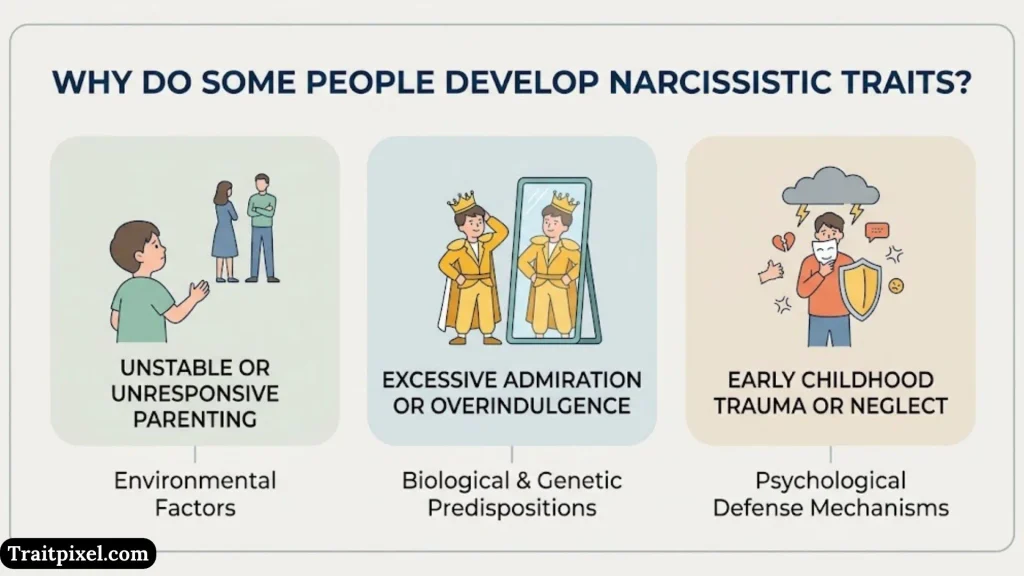
There isn’t one established cause of narcissistic personality disorder. Research suggests that personality development can involve a complex mix of genetic influences, early experiences, temperament, and environmental factors. The specific causes of NPD remain uncertain.
It’s important to separate possible influences from proven explanations. You can’t reliably determine why someone behaves narcissistically simply by hearing about their childhood or observing their relationship.
Possible Contributing Factors
Early family experiences: Some people grow up with inconsistent affection, harsh criticism, excessive praise, or unrealistic expectations. Such experiences may influence how they develop self-esteem and relate to others, but they don’t inevitably produce narcissistic traits.
Self-esteem difficulties: Some people depend heavily on external approval to feel valuable. Criticism or perceived rejection may then feel especially threatening.
Learned relationship patterns: A person may learn that anger, guilt, dominance, or blame helps them get what they want. If those strategies repeatedly succeed, they may become habitual.
Individual temperament and development: People differ in emotional sensitivity, self-regulation, and interpersonal tendencies. These differences may interact with their environment over time.
None of these possibilities excuses harmful conduct. Understanding a person’s background can provide context, but it doesn’t make you responsible for changing them.
How Narcissistic Traits Can Affect You Emotionally
A relationship involving repeated dismissal, criticism, or control may affect your confidence and emotional well-being. The impact depends on the behaviors involved, how long they continue, your support system, and other circumstances.
You might notice the following changes in yourself.
You Begin to Doubt Your Judgment
If your partner repeatedly denies your concerns, blames you for their actions, or insists that your interpretation is always wrong, you may start questioning your memory and perceptions.
Gaslighting is a term for a pattern of behavior that undermines another person’s confidence in their understanding of reality. Not every disagreement about what happened qualifies as gaslighting. Repeated denial, distortion, and manipulation are more concerning than an ordinary difference in recollection.
You Feel Responsible for Keeping the Peace
You may start choosing your words carefully, avoiding harmless topics, or abandoning your preferences because you fear an argument.
Over time, you might become more focused on preventing your partner’s anger than expressing your own needs.
You Lose Confidence in Your Own Needs
Repeated criticism can lead you to believe you’re too sensitive, demanding, or difficult to love. You may apologize for reasonable boundaries or feel guilty whenever you prioritize yourself.
A healthy relationship doesn’t require you to silence your feelings to remain acceptable to your partner.
You Become Isolated
If your partner criticizes your friends, discourages family contact, or creates conflict whenever you make independent plans, your support network may shrink.
Isolation can make it harder to evaluate the relationship clearly or find help when you need it.
You Experience Ongoing Stress
You might feel anxious before conversations, struggle to relax at home, or find yourself replaying arguments long after they end.
These reactions don’t prove that your partner has narcissistic traits. They do indicate that your emotional well-being deserves attention, particularly when the relationship repeatedly leaves you distressed or afraid.
How to Respond to Narcissistic Traits in a Relationship
You can’t force another person to become empathetic, accountable, or respectful. However, you can make decisions about your boundaries, support system, and participation in the relationship.
The right response depends on whether the behavior is occasional and repairable, persistent but safe to discuss, or threatening and controlling.
Step 1: Identify Specific Behaviors
Instead of beginning with a label such as “You’re a narcissist,” identify what happened and why it matters.
For example:
- Instead of “You never care about me,” try “When I explained why I was upset, you interrupted me and called my feelings ridiculous.”
- Instead of “You’re controlling,” try “I need to be able to see my friends without being pressured to cancel.”
- Instead of “You never take responsibility,” try “We agreed to share this task, but you blamed me when it wasn’t completed.”
Specific examples make it easier to evaluate behavior and clarify what needs to change.
You don’t need to confront your partner if doing so would put you at risk. In an abusive relationship, seeking private support and planning for safety may be more appropriate.
Step 2: Set Clear, Realistic Boundaries
A boundary describes what you will do to protect your well-being. It isn’t a rule that gives you control over another person’s behavior.
For example:
| Situation | Possible boundary |
| Insults during arguments | “I’ll continue this conversation when we can speak without insults.” |
| Pressure to share passwords | “I won’t share my private passwords.” |
| Repeated last-minute demands | “I can’t cancel my existing plans every time something comes up.” |
| Disrespect for your time | “If we agree on a time, I expect us to communicate when plans change.” |
| Punitive silence | “I’m open to taking a break, but I need us to discuss important issues when we’re both ready.” |
Choose boundaries you can realistically maintain. If your partner responds with threats or aggression, don’t put yourself in danger to prove a point.
Step 3: Watch What Happens After You Speak Up
A partner’s response to a reasonable boundary often tells you more than their response to a comfortable conversation.
Look for whether they:
- Listen without immediately attacking your character.
- Acknowledge the effect of their behavior.
- Accept that your needs may differ from theirs.
- Respect your decision even when disappointed.
- Make consistent changes without demanding constant praise.
By contrast, repeated retaliation, intimidation, blame, or temporary promises followed by the same conduct may suggest that the problem isn’t being addressed.
You don’t need to wait indefinitely for improvement.
Step 4: Keep a Clear Record of Recurring Patterns
If repeated conflicts leave you confused, consider keeping private notes about specific incidents, including what happened, how you responded, and whether the issue was resolved.
This can help you distinguish a recurring pattern from a particularly difficult day.
Only keep records if it’s safe to do so. If your partner monitors your phone, accounts, or belongings, storing notes on those devices may create additional risks.
Step 5: Protect Your Independence
Maintain connections with trusted friends, family members, and other people who respect your perspective. Continue pursuing your interests, work, education, and financial goals where possible.
If you share money, housing, children, or other major responsibilities, consider practical steps to preserve access to important documents and resources.
Independence doesn’t mean you must leave your partner. It means you retain the ability to make informed decisions about your own life.
Step 6: Consider Professional Support
Individual therapy can help you understand recurring relationship patterns, strengthen boundaries, rebuild confidence, and decide what you want to do next.
Couples therapy may be useful when both partners can participate honestly and safely. However, when coercion, intimidation, or abuse is present, joint therapy may be inappropriate or unsafe. Consider confidential individual support or a domestic violence specialist before pursuing it.
If your partner is willing to seek help, a qualified mental health professional can assess their concerns and discuss suitable treatment. Psychotherapy may help people with personality disorders develop greater insight and improve their relationships, although results vary.
Step 7: Decide Whether the Relationship Is Sustainable
You don’t have to make this decision based on a diagnostic label.
Consider these questions:
- Do I feel emotionally and physically safe?
- Can I express disagreement without fear?
- Are my boundaries respected?
- Does my partner take responsibility for their actions?
- Have meaningful changes lasted over time?
- Can we resolve conflict without humiliation or intimidation?
- Am I able to maintain my identity, friendships, and goals?
If the relationship repeatedly damages your well-being and your partner refuses to address the behavior, ending it may be a reasonable choice.
If you fear your partner’s reaction, seek confidential support and make a safety plan before taking steps to leave. You don’t have to manage a dangerous situation alone.
A Simple Decision Guide: What Should You Do Next?
Use this guide to choose a reasonable next step based on the behavior you’re experiencing.
Start with the pattern, not the label
Are you afraid, threatened, coerced, or being controlled?
Examples include threats, physical violence, sexual coercion, stalking, or financial control.
Yes
Prioritize safety. Seek confidential help and consider a safety plan. Don’t confront your partner if that could increase danger.
No
Continue to the next question.
Does the behavior happen repeatedly and remain unresolved?
No, it’s occasional
Discuss the specific incident, listen to each other, and agree on a practical change.
Yes, it’s recurring
Set clear boundaries and seek individual support if needed.
Does your partner take responsibility and make lasting changes?
Yes
Assess progress over time and decide whether trust can be rebuilt.
No
Consider whether remaining in the relationship is healthy for you.
This is a practical reflection guide, not a psychological assessment. You can seek support at any point, even if you’re uncertain how to describe what is happening.
What If You Recognize Narcissistic Traits in Yourself?
Recognizing these behaviors in yourself can be an opportunity for growth. It doesn’t mean you’re destined to repeat them, and it doesn’t automatically mean you have a personality disorder.
Start by examining how you respond when someone disagrees with you, asks for space, or receives recognition.
Useful steps include:
- Practice listening: Let your partner finish speaking before explaining your own perspective.
- Accept feedback: Ask for specific examples instead of immediately defending yourself.
- Acknowledge impact: Recognize that your intentions and the effects of your actions can differ.
- Apologize clearly: Take responsibility for what you did without adding a condition that shifts the blame.
- Respect boundaries: Accept that a partner can say no without proving they love you.
- Build emotional regulation: Learn to pause, identify your feelings, and respond without intimidation or insults.
- Seek professional help: A therapist can help you explore persistent relationship difficulties and develop healthier responses.
Change requires more than recognizing a pattern. It involves practicing different behaviors, accepting discomfort, and following through consistently.
If your partner says your behavior hurts them, you don’t have to agree with every interpretation. You can still listen carefully, ask questions, and consider whether your actions need to change.
Common Misconceptions About Narcissistic Traits
Misunderstandings about narcissism can make it harder to recognize unhealthy behavior or interpret ordinary relationship difficulties fairly.
Myth vs. Fact
| Myth | Fact |
| Anyone who loves themselves is narcissistic. | Healthy self-esteem and self-respect are not the same as narcissistic pathology. |
| Every selfish person has NPD. | Selfish behavior can occur for many reasons and doesn’t establish a personality disorder. |
| Narcissistic people are always confident. | Some people with narcissistic features experience significant insecurity or sensitivity to criticism. |
| A person who cries or feels hurt cannot be narcissistic. | Emotional distress and narcissistic traits can coexist. |
| Every argument with a narcissistic partner is abuse. | Conflict and abuse are different, although repeated intimidation or coercion requires serious attention. |
| Narcissistic traits never change. | People can develop healthier behaviors, particularly when they recognize problems and engage in meaningful work. |
| You must prove your partner has NPD before leaving. | You can end a relationship because it is unhealthy or no longer right for you. |
| Couples therapy always fixes the relationship. | Therapy is not a guarantee, and joint therapy may be unsafe when abuse or coercive control is present. |
| Setting boundaries will make a narcissistic partner change. | Boundaries clarify what you will accept; they cannot control another person’s decisions. |
| Narcissism explains every harmful action. | Behavior can have multiple causes, and a label should not replace careful assessment. |
The most important lesson is to avoid diagnosing someone from a handful of behaviors while also avoiding the opposite mistake of excusing repeated harm.
Related Traits and Behaviors You Should Understand
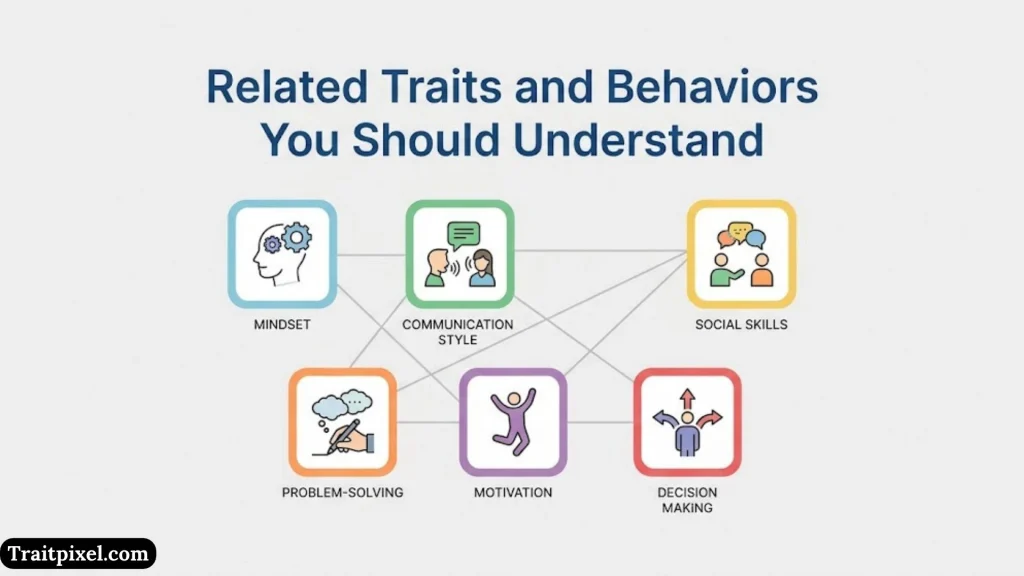
Several psychological concepts overlap with narcissistic traits. Understanding the differences can help you describe relationship problems more accurately.
Narcissism and Self-Centeredness
Self-centeredness means focusing heavily on your own needs, interests, or perspective. Narcissism can involve self-focus alongside entitlement, admiration-seeking, grandiosity, or impaired empathy.
A self-centered partner may struggle to notice your needs but still respond positively when you explain them. A persistent narcissistic pattern may involve a broader difficulty with mutuality and accountability.
Narcissism and Manipulation
Manipulation involves influencing someone through tactics that undermine their ability to make a free and informed choice.
A person doesn’t need narcissistic traits to manipulate others. Likewise, not every person with narcissistic traits deliberately manipulates their partner.
Focus on the conduct itself: Does the person respect your ability to make decisions, or do they repeatedly use guilt, deception, threats, or pressure to get their way?
Narcissism and Gaslighting
Gaslighting describes a pattern of undermining another person’s confidence in their perception or understanding of events.
For example, a partner may repeatedly deny things they said, distort past conversations, or insist that your reasonable reactions prove you’re incapable of understanding reality.
Ordinary disagreements about memory aren’t necessarily gaslighting. Look for a persistent pattern of distortion, especially when it leaves you increasingly unsure of your own judgment.
Narcissism and Love Bombing
Love bombing refers to intense attention, affection, praise, or gifts used in a way that may overwhelm another person or influence their choices.
A new relationship can naturally feel exciting and affectionate. The warning signs include pressure to commit quickly, disregard for boundaries, and affection that later becomes a tool for control.
Narcissism and Codependency
Codependency is a commonly used term for relationship patterns in which someone becomes excessively focused on another person’s needs, behavior, or approval at the expense of their own well-being.
A person in a difficult relationship may feel responsible for keeping their partner happy, preventing arguments, or fixing every problem.
This doesn’t mean they caused their partner’s behavior. Learning to maintain boundaries and preserve an independent sense of self can help restore balance.
Frequently Asked Questions
What are the biggest narcissistic traits in a relationship?
Common traits include excessive need for admiration, entitlement, grandiosity, limited empathy, difficulty accepting criticism, exploitative behavior, envy, and arrogance. In relationships, these may appear as blame-shifting, dismissing a partner’s feelings, competing for attention, or expecting special treatment. Repeated patterns matter more than isolated incidents.
How can you tell if your partner is a narcissist?
You can’t reliably determine whether your partner has narcissistic personality disorder through observation alone. Look for persistent patterns involving entitlement, admiration-seeking, impaired empathy, and difficulties with accountability. A qualified mental health professional must assess the person’s broader history and functioning to make a diagnosis.
You can still recognize harmful relationship behavior without diagnosing your partner.
Can someone have narcissistic traits without having NPD?
Yes. People can display individual narcissistic traits without meeting the diagnostic criteria for narcissistic personality disorder. Personality traits vary in degree, and occasional selfishness, defensiveness, or attention-seeking doesn’t automatically indicate a disorder.
What does a narcissistic partner do during an argument?
A partner with strong narcissistic traits may become defensive, dismiss your feelings, shift blame, insist on being right, or react poorly to criticism. However, these responses aren’t exclusive to narcissism. The more important question is whether disagreements repeatedly become hostile, one-sided, or impossible to resolve.
Do narcissistic partners know they’re hurting you?
Awareness varies. Some people recognize that their actions hurt others but struggle to tolerate criticism or accept responsibility. Others may have difficulty recognizing the impact of their behavior. You cannot reliably infer someone’s awareness from a single incident, so pay attention to how they respond when the impact is explained clearly.
Can a relationship with a narcissistic partner work?
It may be possible when both partners can participate safely, acknowledge problems, respect boundaries, and make sustained changes. However, affection alone isn’t enough to overcome repeated entitlement, contempt, manipulation, or control. You cannot repair a relationship by doing all the emotional work yourself.
Can narcissistic traits improve with therapy?
Yes, some people can improve their self-awareness, emotional regulation, empathy-related skills, and relationship behavior through appropriate psychological treatment. Progress depends on individual circumstances, treatment, and willingness to engage. Therapy doesn’t guarantee change, and you aren’t responsible for making your partner participate.
What is the difference between narcissism and emotional abuse?
Narcissism describes personality traits or, in more severe cases, a personality disorder. Emotional abuse describes harmful behavior used to intimidate, degrade, isolate, or control someone. The two can overlap, but neither automatically proves the other.
What should I do if my partner turns everything into my fault?
Keep the discussion focused on the specific issue. State what happened, how it affected you, and what you need going forward. If your partner repeatedly redirects blame, refuses accountability, or retaliates, consider setting boundaries and seeking individual support. If you fear their reaction, prioritize safety over confrontation.
Is the silent treatment a narcissistic trait?
Not necessarily. Someone may withdraw because they feel overwhelmed or need time to calm down. However, repeatedly withholding communication to punish a partner, force an apology, or gain control can be emotionally harmful. The purpose, context, and recurring pattern matter.
Can a narcissistic person genuinely love someone?
It isn’t possible to determine the depth or authenticity of someone’s love from a personality label alone. People with narcissistic traits can experience attachment and affection, but those feelings don’t necessarily translate into consistent empathy, accountability, or respect. A relationship’s health depends on how both partners treat each other, not simply on what they feel.
Should I stay with a partner who shows narcissistic traits?
There is no universal answer. Consider whether you feel safe, whether your partner respects your boundaries, and whether harmful behavior changes over time. If the relationship repeatedly damages your well-being and your partner refuses to address it, leaving may be the healthiest option. If there is abuse or a risk of retaliation, seek support and plan carefully.
How do I recover after a relationship involving narcissistic behavior?
Give yourself time to process the experience. Reconnect with supportive people, rebuild routines and interests, and practice trusting your judgment again. Individual counseling can help you understand recurring patterns and strengthen boundaries. You don’t need to prove that your former partner had NPD to acknowledge that the relationship hurt you.
Key Takeaways
- Narcissistic traits may include entitlement, excessive admiration-seeking, grandiosity, limited empathy, and difficulty accepting criticism.
- The most useful indicator is a persistent pattern of behavior, not one argument or isolated incident.
- Narcissistic traits and narcissistic personality disorder are not interchangeable.
- Narcissism and emotional abuse can overlap, but they are different concepts.
- You don’t need a clinical diagnosis to establish healthy boundaries or leave a harmful relationship.
- Meaningful change requires accountability and consistent action, not promises alone.
- Your partner’s past experiences may provide context, but they don’t excuse harmful behavior.
- Individual therapy and trusted social support can help you make informed decisions.
- If you experience threats, coercion, violence, or controlling behavior, prioritize your safety.
Conclusion
Recognizing narcissistic traits in a relationship can help you understand why certain interactions leave you feeling dismissed, criticized, controlled, or emotionally exhausted. Common warning signs include entitlement, a constant need for validation, limited empathy, blame-shifting, difficulty accepting criticism, and repeated disregard for boundaries.
Still, the goal isn’t to diagnose your partner. It’s to understand the pattern, evaluate its impact, and decide what you need to feel respected and safe.
Healthy relationships allow both people to express their needs, disagree without intimidation, take responsibility for mistakes, and celebrate each other’s growth. If those qualities are consistently missing, you have the right to seek support, set limits, and reconsider the relationship.
You can care about someone while recognizing that their behavior is hurting you. Compassion for another person doesn’t require you to sacrifice your emotional well-being.

I’m Elliot Kingsley, a British author interested in the subtle characteristics that influence how people think, communicate, and respond to the world. I write about personality traits, strengths, tendencies, and behavioural qualities in clear language. My goal is to encourage readers to understand individual differences and appreciate the complexity of human character.
Books:
- The Psychology of Personality Traits
- Character in Context