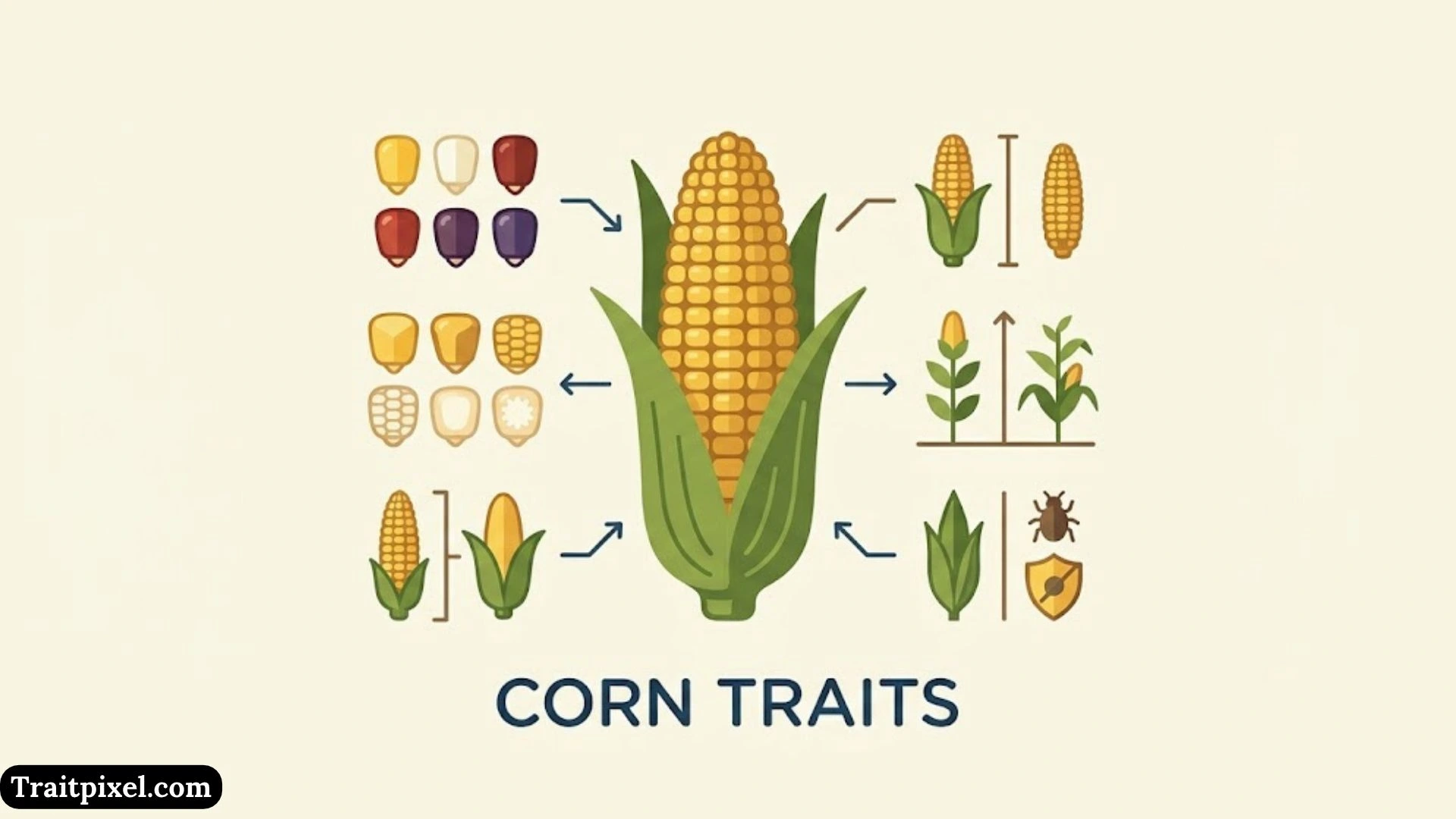
Corn traits are the physical, genetic, and biological characteristics that determine how corn plants grow, develop, reproduce, and respond to their environment. These traits include plant height, leaf shape, kernel color, ear size, maturity rate, drought tolerance, disease resistance, and grain quality. Understanding corn traits helps farmers select suitable varieties, gardeners grow healthier plants, plant breeders develop improved hybrids, and students learn how genetics influences crop development.
Corn (Zea mays), also called maize, is a major cereal crop used for human food, livestock feed, industrial products, and biofuel. Its traits vary widely among varieties because of genetic differences, environmental conditions, and interactions between genes and the growing environment.
This guide explains the main characteristics of corn, how those traits are inherited, which traits matter most in agriculture, and how to recognize differences among corn varieties.
Quick Answer
Corn traits are the inherited or environmentally influenced characteristics of a corn plant. They include physical features, such as stalk height, leaf structure, root development, ear shape, and kernel color, as well as functional traits, such as drought tolerance, disease resistance, nutrient-use efficiency, and maturity.
The main categories of corn traits are:
- Physical traits: Plant height, stalk thickness, leaf size, ear length, and kernel appearance.
- Growth traits: Germination, flowering time, maturity, and root development.
- Reproductive traits: Tassel formation, silk emergence, pollination, and kernel development.
- Genetic traits: Characteristics influenced by inherited genes, including kernel color and certain disease-resistance mechanisms.
- Agronomic traits: Features that influence crop yield, standability, adaptability, and harvest performance.
- Quality traits: Starch composition, protein content, oil content, and nutritional characteristics.
A corn plant’s final characteristics depend on its genetic makeup, growing conditions, and management practices.
Corn Traits at a Glance
| Trait category | Examples | Why it matters |
| Physical | Height, stalk strength, leaf shape | Influences plant structure and field performance |
| Root system | Root depth, branching, anchorage | Supports water uptake, nutrient absorption, and stability |
| Reproductive | Tassel, silks, ear formation | Determines successful pollination and kernel development |
| Kernel | Color, shape, size, composition | Affects food, feed, and industrial uses |
| Growth and maturity | Germination, flowering, days to maturity | Helps match a variety to the growing season |
| Stress tolerance | Drought, heat, and cold tolerance | Influences performance under environmental stress |
| Disease resistance | Resistance to specific pathogens | Can reduce crop losses and management costs |
| Genetic | Inherited color, plant architecture, resistance alleles | Supports selection and breeding |
| Agronomic | Yield potential, standability, harvest moisture | Helps determine suitability for farming systems |
| Quality | Starch, protein, oil, and specialty compounds | Determines nutritional and processing value |
What Are Corn Traits?

Corn traits are measurable or observable features of a maize plant. Some traits are easy to see, such as the color of a kernel or the height of a stalk. Others require observation over time or scientific testing, such as nitrogen-use efficiency, resistance to a particular pathogen, or the ability to maintain grain production during drought.
A trait may be controlled by one gene, several genes, or a combination of genetic and environmental factors. For example, some kernel-color patterns result from specific genes that regulate pigment production, while plant height and yield usually reflect the effects of many genes interacting with growing conditions.
Inherited Traits vs. Environmental Effects
Corn characteristics develop through the interaction of genetics and the environment. Understanding the difference helps explain why two plants of the same variety may look different.
| Factor | Meaning | Example |
| Genetic inheritance | Characteristics influenced by genes passed from parent plants | Kernel color or a genetically influenced maturity pattern |
| Environmental influence | Effects of weather, soil, water, and other growing conditions | Shorter plants caused by limited water |
| Gene-environment interaction | A genetic characteristic expressed differently under different conditions | A drought-tolerant hybrid maintaining growth better under water stress |
| Management influence | Effects of planting density, fertilization, irrigation, and crop care | Smaller ears when plants compete for limited nutrients |
| Developmental stage | Changes that occur as a plant grows | Green silks turning brown after pollination |
Key distinction: A plant’s appearance does not always reveal its genetic potential. A short plant might carry genes for tall growth but remain short because of drought, poor nutrition, root damage, or another stress.
Main Physical Traits of Corn
Corn has a recognizable structure consisting of a fibrous root system, an upright stalk, long leaves, a tassel, ear shoots, and kernels attached to a cob. Each structure has a role in plant growth and reproduction.
1. Plant Height
Plant height is the distance from the soil surface to a defined point on the plant, commonly the tassel tip at maturity. The exact height varies with the hybrid, growing environment, and measurement method.
Some varieties grow relatively short and compact, while others develop tall stalks with many elongated stem sections.
Plant height matters because it can influence:
- Light interception and canopy structure.
- Resistance to lodging, or plants falling over.
- Suitability for different planting densities.
- Harvest equipment requirements.
- The distribution of plant material between stalks, leaves, and ears.
Taller corn is not automatically more productive. A shorter hybrid with strong stalks, healthy roots, and efficient grain production may outperform a taller variety in a particular field.
2. Stalk Structure and Strength
The corn stalk supports the leaves, tassel, and ears. It also transports water, minerals, and sugars throughout the plant.
A strong stalk helps the plant remain upright during wind, rain, and the weight of developing ears. Stalk strength depends on several factors, including genetics, stem structure, root anchorage, plant health, and growing conditions.
Two important terms describe lodging:
- Root lodging: The plant leans because its roots and the surrounding soil fail to keep it upright.
- Stalk lodging: The stalk bends or breaks, often below the ear.
A corn variety with good standability can be valuable where strong winds, late-season stalk deterioration, or mechanical harvesting pose risks.
3. Leaf Shape, Size, and Orientation
Corn leaves are long, narrow, and blade-shaped, with parallel veins. They grow from nodes along the stalk and wrap around it at their bases.
Leaf traits affect how a plant captures sunlight, exchanges gases, and uses available growing space.
Important leaf characteristics include:
- Leaf length: Influences the amount of surface available for photosynthesis.
- Leaf width: Affects canopy coverage and light interception.
- Leaf angle: Determines how leaves spread or stand relative to the stalk.
- Leaf number: Influences canopy structure and the plant’s capacity to capture light.
- Leaf color: Can provide clues about plant nutrition and health, although color alone cannot establish a specific deficiency.
- Leaf health: Determines how much functional green tissue remains available for photosynthesis.
More upright leaves may allow light to penetrate deeper into a dense canopy. More horizontal leaves may capture sunlight efficiently when plants grow farther apart. The best arrangement depends on the variety, planting density, and environment.
4. Root System
Corn develops a fibrous root system with several root types. These roots anchor the plant and absorb water and nutrients.
The major root types include:
- Seminal roots: Develop from the seed and help support the young seedling.
- Nodal roots: Emerge from underground stem nodes and become the main root system as the plant develops.
- Brace roots: Form at aboveground nodes near the base of the stalk and may enter the soil to provide additional support and absorb resources.
Root traits include root depth, branching, distribution, thickness, and the ability to explore soil for water and nutrients.
These characteristics matter because a plant can appear healthy aboveground while struggling with compacted soil, poor drainage, or restricted root development. Strong root systems can improve anchorage and resource acquisition, but performance depends on soil structure, moisture, and other conditions.
5. Tassel Structure
The tassel is the branched flowering structure at the top of the corn plant. It produces pollen, which contains the male reproductive cells.
Tassel traits include:
- Overall length and branching pattern.
- Number and arrangement of branches.
- Timing of tassel emergence.
- Timing and duration of pollen shed.
- Pollen production and viability.
Tassels usually become visible near the end of vegetative growth. Pollen then disperses, primarily by wind, and may land on receptive silks emerging from nearby ears.
Tassel size alone does not indicate yield potential. Successful reproduction depends on pollen availability, the timing of pollen shed and silk emergence, and favorable conditions during pollination.
6. Ear Size and Structure
The ear is the female reproductive structure of corn. It develops from an ear shoot on the stalk and contains rows of kernels attached to the cob.
Important ear traits include:
- Ear length and diameter.
- Number of kernel rows.
- Kernels per row.
- Kernel depth and size.
- Husk coverage.
- Ear placement on the stalk.
- The proportion of potential kernels that develop successfully.
Ear characteristics are influenced by genetics and the plant’s access to water, nutrients, and sunlight. Conditions during early ear development and pollination can strongly affect the number of kernels that ultimately develop.
A large ear does not always translate into the highest field yield. Plant population, the number of harvestable ears per unit of land, kernel weight, and harvest losses also matter.
7. Kernel Color and Appearance
Corn kernels come in several colors, including yellow, white, red, blue, purple, and nearly black. Some ears contain multiple colors or patterned kernels.
Color differences arise from genetic variation affecting pigments in different kernel tissues. For example, anthocyanins contribute to many red, purple, and blue shades, while carotenoid pigments contribute to yellow and orange coloration.
Kernel traits also include:
- Shape and size.
- Hardness and texture.
- Endosperm composition.
- Oil and protein content.
- Starch characteristics.
- Surface appearance and uniformity.
Color does not reliably indicate overall nutritional quality. A colorful variety may contain useful pigments, but its nutritional composition must be assessed separately.
Corn Growth and Development Traits
Growth traits describe how corn progresses from a seed to a mature plant. They help farmers estimate when to plant, manage water and nutrients, assess crop development, and plan harvest.
Corn development is generally divided into vegetative and reproductive stages.
Vegetative Growth Stages
Vegetative stages are identified using the number of visible leaf collars, which mark the point where the leaf blade and leaf sheath meet.
| Stage | Description | Main development |
| VE | Emergence | The seedling emerges through the soil |
| V1 | First leaf collar visible | Early leaf development continues |
| V2 | Two leaf collars visible | Root and shoot growth expand |
| V3–V5 | Three to five collars visible | The young plant develops a stronger root system |
| V6–Vn | Successive leaf collars become visible | Rapid growth, stem development, and ear formation progress |
| VT | Tasseling | The tassel has emerged and pollen shed begins around this period |
The exact number of leaves and time spent in each stage vary by hybrid and growing conditions. Many commercial corn hybrids produce roughly 18–21 leaves, although the number is not fixed for every variety.
Reproductive Growth Stages
Reproductive stages describe the development of the ear and kernels after flowering begins.
| Stage | Name | Observable characteristic |
| R1 | Silking | Silks emerge from the husks |
| R2 | Blister | Young kernels resemble small blisters and contain clear fluid |
| R3 | Milk | Kernels contain milky fluid |
| R4 | Dough | Kernel contents thicken to a dough-like consistency |
| R5 | Dent | An indentation forms near the top of kernels in dent corn |
| R6 | Physiological maturity | Kernels reach maximum dry weight, and a black layer forms at the kernel base |
These stages are useful because the same weather event can affect corn differently depending on when it occurs. For instance, drought during silking can interfere with pollination, while stress during grain filling can reduce kernel weight.
Physiological maturity also differs from harvest readiness. Grain may still contain substantial moisture at R6 and require additional field drying or mechanical drying before storage.
Reproductive Traits: Pollination and Kernel Development
Corn reproduction depends on the successful transfer of pollen from the tassel to the silks and the subsequent fertilization of ovules.
Corn is generally monoecious, meaning the same plant produces separate male and female flowers. The tassel contains male flowers, while the ear contains female flowers.
Each silk connects to a potential kernel site. When a compatible pollen grain lands on a receptive silk, it can germinate and grow a pollen tube toward the ovule. Successful fertilization allows the kernel to develop.
Several reproductive traits influence this process:
- Days to tasseling: How long the plant takes to produce an emerged tassel.
- Days to silking: How long it takes for silks to appear.
- Pollen shed duration: The period during which viable pollen is released.
- Silk receptivity: The ability of silks to receive pollen and support pollen-tube growth.
- Flowering synchrony: The degree to which pollen shed overlaps with silk emergence.
- Kernel set: The proportion of potential kernels that successfully develop.
- Grain-fill duration: The period during which kernels accumulate dry matter.
Why Flowering Synchrony Matters
If pollen shed occurs before many silks emerge, some ovules may not receive pollen. Hot, dry conditions can worsen this problem by delaying silk emergence or causing silks to dry out.
Poor kernel set can also result from insufficient pollen, damaged reproductive structures, or stress that causes young kernels to stop developing.
For example, an ear may have well-developed kernels near its base but few kernels at the tip. This pattern can occur when the tip silks emerge later and fail to receive enough viable pollen, although other causes are possible.
Practical insight: When evaluating an ear with missing kernels, inspect the flowering period, silk emergence, pollen availability, and early grain-fill conditions before assuming the variety has poor genetic potential.
Genetic Traits of Corn
Genetic traits are characteristics influenced by the genes a corn plant inherits from its parents. They help explain differences among varieties and provide the foundation for conventional breeding, hybrid development, and genetic engineering.
Genotype vs. Phenotype
The terms genotype and phenotype describe two related but different concepts.
| Term | Definition | Corn example |
| Genotype | The genetic makeup of an organism, or the particular genetic variants it carries | A plant carrying alleles associated with a particular kernel-color pattern |
| Phenotype | The observable or measurable characteristics that develop | The actual color of its kernels |
| Allele | A version of a gene | Different versions of a gene affecting pigment production |
| Heritability | The proportion of observed variation in a trait, within a particular population and environment, associated with genetic differences | How strongly differences in plant height across a trial reflect genetic variation |
| Quantitative trait | A trait that varies across a range and is often influenced by many genes | Plant height or grain yield |
| Qualitative trait | A trait described by distinct categories | A particular kernel-color class |
A phenotype reflects more than genotype alone. Soil conditions, temperature, water availability, disease pressure, and other environmental factors can influence how a genetic trait develops.
Heritability also requires careful interpretation. It describes variation in a particular population under particular conditions. It does not mean that a fixed percentage of an individual corn plant’s height or yield is genetically determined.
Dominant and Recessive Traits
Dominant and recessive inheritance can help explain some corn characteristics, particularly in genetics lessons involving visible kernel colors.
A dominant allele can influence the phenotype when only one copy is present, depending on the gene and the inheritance pattern. A recessive phenotype generally appears when the relevant recessive alleles are present in the required combination.
However, not every corn trait follows a simple dominant-recessive pattern. Many characteristics, including yield, maturity, and drought response, involve multiple genes and complex interactions.
For a simple hypothetical example, consider a gene with two alleles, A and a, where A is completely dominant over a:
| Genotype | Expected phenotype |
| AA | Dominant phenotype |
| Aa | Dominant phenotype |
| aa | Recessive phenotype |
This model illustrates basic inheritance, but actual kernel pigmentation and other corn traits can involve multiple genes, regulatory interactions, and different inheritance patterns.
How Corn Traits Are Inherited

Corn plants reproduce sexually through pollination and fertilization. Each new seed receives genetic material from both parental sources, so the resulting plant may express a combination of inherited characteristics.
The process can be summarized as follows:
- Parent plants carry genetic variants. These variants influence characteristics such as kernel composition, plant architecture, and maturity.
- Pollination transfers pollen. Pollen from the male parent reaches a receptive silk.
- Fertilization forms the developing seed. The embryo receives genetic material from both parents.
- The offspring develops. Its genotype and growing conditions influence its eventual characteristics.
- Breeders evaluate the offspring. They identify plants with useful combinations of traits and select them for further breeding.
One important detail is that the tissues inside a corn kernel do not all have the same genetic origin. The embryo and endosperm form after fertilization, while the outer pericarp develops from the maternal ovary wall. This distinction helps explain why different forms of kernel pigmentation can follow different inheritance patterns.
Why Hybrid Corn Has Different Traits
Hybrid corn is produced by crossing selected parental lines to combine desirable characteristics. Breeders may seek high yield potential, strong stalks, disease resistance, suitable maturity, or improved performance under specific environmental conditions.
A hybrid can perform well because of its particular combination of genes, including effects known as heterosis or hybrid vigor.
However, a hybrid’s performance depends on the environment in which it grows. A variety selected for a long growing season may not mature reliably in a region with a short season. Likewise, a hybrid with strong disease resistance may offer limited advantages if the relevant disease is uncommon in the target field.
Agronomic Traits That Matter in Corn Production
Agronomic traits influence how effectively corn grows under field conditions and how much usable grain or forage it produces. Farmers evaluate these traits when comparing seed varieties, planning planting dates, and managing crop risks.
1. Yield Potential
Yield potential describes the production a corn variety may achieve under specified growing conditions. Actual yield depends on genetics, weather, soil, planting density, water availability, nutrient supply, pest pressure, and crop management.
Grain yield reflects several components:
- Harvestable ears per unit of land.
- Kernels per ear.
- Average kernel weight.
- The proportion of the crop successfully harvested.
These components interact. A variety that produces large ears at a low plant population may not produce the greatest yield when planted densely. Conversely, a hybrid that maintains kernel set across more plants may perform well at higher planting rates.
When comparing hybrids, use results from replicated trials across multiple locations or years whenever possible. A single high-yield result may reflect favorable local conditions rather than consistent superiority.
2. Drought Tolerance and Water-Use Efficiency
Drought tolerance describes a plant’s ability to maintain function and limit damage when water is scarce. Water-use efficiency refers to how effectively a plant uses water to produce biomass or yield, depending on the measurement.
These are related but distinct traits.
Corn may respond to water stress through differences in root development, flowering behavior, leaf function, and the timing of reproductive growth. Some hybrids maintain better kernel set during moderate stress, while others perform well when water is readily available.
Drought tolerance does not mean a variety can produce a normal crop without adequate water. Severe drought can reduce growth and yield in all varieties, and performance differences depend on the severity and timing of stress.
Practical example: If a field regularly experiences dry conditions during flowering, a farmer should consider hybrid performance under water-limited conditions, not just yield under full irrigation.
3. Heat and Cold Tolerance
Temperature affects germination, growth, flowering, pollination, and grain filling.
Cold tolerance during early development can help a variety establish under cooler conditions, although planting into cold, wet soil can still increase emergence problems and seedling disease.
Heat tolerance is particularly important around flowering. High temperatures combined with limited soil moisture can reduce pollen performance, delay silk emergence, and interfere with kernel set.
A hybrid suited to a warm region may not be the best choice for an area with a short season or cool spring soils. Match the variety’s maturity and stress-response characteristics to the local climate.
4. Disease Resistance
Disease resistance is the ability of a plant to prevent or limit infection or disease development caused by particular pathogens. Some varieties also show tolerance, meaning they can maintain better performance despite infection.
Corn diseases include:
- Gray leaf spot.
- Northern corn leaf blight.
- Common rust.
- Goss’s wilt.
- Seedling diseases.
- Stalk rots and root rots.
Resistance to one disease does not guarantee resistance to another. Farmers should identify the diseases that occur in their fields and select hybrids with suitable resistance profiles.
Crop rotation, residue management, appropriate planting practices, and field scouting can complement genetic resistance. Resistant seed is one part of an integrated management strategy, not a replacement for every other control measure.
5. Insect Resistance
Some corn varieties contain traits that protect against specific insect pests. These may come from conventional breeding or, in certain commercial products, genetic engineering.
Examples of relevant pests include corn rootworms, European corn borers, and other caterpillars that feed on corn tissues. The particular pests controlled depend on the trait or technology in the seed.
Insect-resistant traits are not universal protection against all insects. Farmers should check which pests a product targets, follow its applicable management requirements, and monitor fields for unexpected damage.
Where resistance management measures apply, following the seed provider’s current stewardship guidance helps preserve the effectiveness of the trait.
6. Herbicide Tolerance
Herbicide-tolerant corn varieties can withstand certain herbicides that would otherwise damage susceptible corn plants when used according to their labels.
This characteristic can give farmers more options for managing weeds, which compete with corn for light, water, nutrients, and space.
Herbicide tolerance is specific to the relevant crop trait and herbicide. It does not mean the crop can safely tolerate every weed-control chemical.
Farmers should follow current product labels, use appropriate application timing, and combine herbicide programs with other weed-management practices to reduce the risk of herbicide-resistant weeds developing.
7. Standability and Stay-Green Characteristics
Standability describes a plant’s ability to remain upright through maturity and harvest. Stay-green characteristics describe the retention of green plant tissue later in the growing season.
Both can be useful, but neither should be interpreted in isolation.
- Strong roots help reduce root lodging.
- Strong stalks help reduce breakage.
- Healthy leaves support photosynthesis during grain filling.
- Appropriate maturity can help the crop finish before unfavorable weather.
- Disease resistance can help preserve stalk and leaf health.
A green stalk does not necessarily mean the grain has not matured. Likewise, brown leaves do not automatically mean the crop is ready for harvest. Kernel development and moisture should be assessed separately.
8. Nutrient-Use Efficiency
Nutrient-use efficiency describes how effectively a plant acquires and uses nutrients to produce biomass or grain.
Corn needs nitrogen, phosphorus, potassium, sulfur, and several micronutrients for healthy development. Genetic differences can influence root growth, nutrient uptake, internal nutrient use, and the plant’s response to nutrient availability.
However, a variety with favorable nutrient-use traits still requires suitable soil fertility. Soil testing, appropriate fertilizer placement, and application timing remain important.
Yellowing leaves, stunted growth, or poor grain development may indicate nutrient problems, but similar symptoms can result from drought, waterlogging, root damage, or disease. Diagnose the underlying cause before changing a fertilizer program.
Corn Kernel Traits and Grain Quality
Kernel traits influence how corn is used for fresh food, dry grain, animal feed, milling, starch production, and other industrial applications. The main corn types differ in their kernel structure, sugar content, starch characteristics, and intended uses.
Types of Corn and Their Distinctive Traits
Dent corn develops a small indentation at the top of mature kernels as they dry. It is widely used for livestock feed, cornmeal, starch, and ethanol production. Its kernels contain both hard and softer starchy regions.
Flint corn has a relatively hard outer endosperm surrounding a smaller softer center. Its kernels often have a rounded, glassy appearance. Uses vary by variety and region.
Sweet corn carries genetic changes that slow the conversion of sugar into starch during kernel development. This gives the kernels their characteristic sweetness when harvested for fresh consumption.
Popcorn has a hard outer kernel structure and a suitable internal moisture level that allow pressure to build during heating. When the hull ruptures, expanding steam and softened starch help turn the kernel inside out.
Flour corn has a relatively soft, starchy endosperm that makes the kernels easier to grind. Depending on the variety, it can be used for meal, flour, and traditional foods.
Waxy corn has starch composed almost entirely of amylopectin. This composition gives its starch properties that differ from ordinary corn starch, making it useful in certain food and industrial applications.
These categories describe different kernel characteristics and uses. They do not represent a single ranking from best to worst. The appropriate type depends on the intended product.
Kernel Composition: Starch, Protein, and Oil
A mature corn kernel contains several distinct parts:
- Pericarp: The outer covering that protects the kernel.
- Endosperm: The largest part of the kernel, rich in starch and containing protein.
- Germ: The embryo, which contains oil and other nutrients.
- Tip cap: The region where the kernel attaches to the cob.
The proportions of starch, protein, oil, fiber, and other components vary with corn type, genotype, growing conditions, and analytical method.
For common dry dent corn, starch is typically the dominant component, while protein and oil make up smaller proportions. Sweet corn differs because its sugar-to-starch balance is altered by its genetics and harvest stage.
These compositional traits influence the suitability of corn for different purposes. A processor may value starch characteristics, a feed producer may focus on energy and protein composition, and a fresh-market grower may prioritize sweetness, tenderness, and eating quality.
Corn Traits for Different Agricultural Goals
The most valuable corn traits depend on what you intend to produce. A characteristic that benefits one farming system may provide little advantage in another.
| Production goal | Traits to prioritize | Why they matter |
| Grain production | Yield stability, maturity, standability, grain dry-down | Supports harvestable yield and manageable harvest timing |
| Silage | Biomass production, digestibility, maturity, stalk health | Influences forage quantity and quality |
| Sweet corn | Sweetness, tenderness, ear uniformity, disease resistance | Improves fresh-market and processing quality |
| Popcorn | Popping expansion, kernel integrity, suitable moisture characteristics | Determines processing performance |
| Dryland farming | Water-stress response, flowering stability, maturity | Helps manage limited rainfall |
| Short growing seasons | Early maturity, emergence, cold-soil performance | Improves the chance of completing development |
| Disease-prone fields | Resistance to locally important diseases | Helps limit disease losses |
| High-density planting | Standability, suitable canopy architecture, consistent ear development | Supports performance when plants compete for space |
How to Choose a Corn Variety Using Its Traits
Selecting a variety is a balancing exercise. Start with the conditions in which the crop will grow, then compare hybrids that fit those conditions.
A practical decision guide
Step 1: What is the crop for?
Grain, silage, sweet corn, popcorn, or another specialty use?
Step 2: What limits production in your field?
Short seasons, drought, wet soils, lodging, disease, or insect pressure?
Step 3: Which traits address those limits?
Compare maturity, standability, stress tolerance, resistance, and product quality.
Step 4: Check local evidence
Review replicated trial results, seed specifications, disease ratings, and recommendations from a local agricultural extension service.
The best choice is not necessarily the variety with the longest list of advertised traits. It is the variety with the most useful combination of characteristics for the intended production system.
Positive and Negative Corn Traits: What Do They Mean?
Corn traits are not inherently positive or negative in every situation. Their value depends on the growing environment, production goal, and other characteristics of the variety.
For example, early maturity can help a crop escape late-season frost, but it may limit the time available for grain filling in a long, favorable growing season. Similarly, a tall plant may capture sunlight effectively but require stronger stalks to remain upright.
| Trait | Potential benefit | Possible limitation |
| Early maturity | Reduces the risk of failing to mature before frost | May limit grain-filling time |
| Tall plant height | Can support substantial biomass production | May increase structural or harvest challenges in some conditions |
| Strong stalks | Helps reduce stalk lodging | Does not guarantee strong root anchorage |
| Upright leaves | Can improve light distribution in dense canopies | May not be ideal under every planting arrangement |
| Drought tolerance | May preserve performance under water stress | Does not eliminate the need for water |
| Disease resistance | Can reduce losses from specific diseases | May not protect against unrelated pathogens |
| High sugar content | Improves sweetness in sweet corn | Not a defining goal for grain corn |
| High starch content | Supports many feed and industrial uses | May be less desirable for certain specialty products |
| Stay-green behavior | Can help maintain photosynthesis during grain filling | Green leaves alone do not prove grain maturity |
| Rapid grain dry-down | May reduce postharvest drying requirements | Performance depends on maturity, weather, and harvest timing |
A useful rule is to evaluate traits in combination rather than choosing a variety based on one appealing characteristic.
Real-Life Examples of Corn Traits

The following scenarios show how corn traits influence decisions in farming, education, and food production.
Example 1: Identifying Kernel Color Inheritance
A student crosses two corn lines with different kernel colors and observes the offspring. The student records the colors and compares them with the expected results from a proposed genetic model.
What this demonstrates: Kernel color can help illustrate inheritance, but the student must know which genes and inheritance pattern apply before predicting exact ratios.
Example 2: Choosing Corn for a Short Growing Season
A farmer has a limited period between spring planting and the first expected fall frost. The farmer compares early- and late-maturing hybrids.
What this demonstrates: Maturity is an important adaptation trait. A variety must have enough time to reach physiological maturity and allow for practical harvest and grain drying.
Example 3: Evaluating Drought-Prone Fields
Two hybrids perform similarly under full irrigation, but their results differ in a field with limited water.
What this demonstrates: A hybrid’s ranking can change with the environment. Performance under water stress is more informative for a drought-prone field than results from well-watered conditions alone.
Example 4: Diagnosing Missing Kernels
An ear has full rows near the base but gaps near the tip. The grower examines silk emergence, weather records, and pollination conditions.
What this demonstrates: Kernel set reflects reproductive development and environmental conditions, not simply ear size or kernel-row genetics.
Example 5: Reducing Lodging Before Harvest
A grower notices that some hybrids remain upright while others develop broken stalks late in the season.
What this demonstrates: Stalk strength, root anchorage, disease pressure, and maturity can influence harvestability. Standability is especially important when harvest is delayed.
Example 6: Comparing Sweet Corn Varieties
A market gardener grows two sweet corn varieties and compares their flavor and texture at the intended harvest stage.
What this demonstrates: Kernel sugar content, maturity, and harvest timing influence eating quality. Grain-corn yield ratings alone would not identify the best fresh-market variety.
Example 7: Selecting Popcorn
A popcorn producer evaluates varieties for kernel integrity, popping expansion, and performance after proper moisture conditioning.
What this demonstrates: Specialty corn requires traits linked to its intended use. High grain yield does not automatically mean good popping quality.
Example 8: Understanding Purple Corn
A student observes purple pigmentation in a corn variety and investigates the pigments and genetic pathways responsible for its color.
What this demonstrates: Visible traits can reveal biological differences, but color alone cannot establish the complete nutritional profile or genetic background of a plant.
Example 9: Comparing Disease Resistance
A grower plants two hybrids in a region where a particular leaf disease occurs regularly. One hybrid develops less severe symptoms under comparable conditions.
What this demonstrates: Resistance ratings should be matched to the specific disease and interpreted alongside field observations and local disease pressure.
Example 10: Investigating Uneven Plant Height
A gardener notices that plants from the same seed packet have different heights. Some grow in compacted soil, while others grow in loose, well-drained soil.
What this demonstrates: Environmental differences can affect the expression of growth traits even when plants share a similar genetic background.
Example 11: Assessing Nutrient Stress
Corn leaves become pale, and plant growth slows. The farmer checks soil moisture, root health, and nutrient availability before deciding whether a deficiency exists.
What this demonstrates: Plant appearance provides clues, but it does not always identify the cause. Several stresses can produce similar symptoms.
Example 12: Comparing Kernel Composition
A feed producer evaluates corn varieties with different starch, oil, and protein characteristics.
What this demonstrates: Kernel composition can matter as much as appearance when the intended use depends on nutritional or processing properties.
Example 13: Evaluating Planting Density
A farmer compares a hybrid at different planting populations and measures yield, ear development, and lodging.
What this demonstrates: Plant architecture and standability must be evaluated at realistic planting densities. A trait that performs well at low density may respond differently when competition increases.
Example 14: Observing Stay-Green Behavior
One hybrid retains green leaves later into the season than another. The farmer checks kernel development rather than using leaf color alone to estimate maturity.
What this demonstrates: Stay-green behavior may help sustain photosynthesis, but it should not replace direct assessment of grain maturity.
Example 15: Studying Grain Dry-Down
Two hybrids reach physiological maturity at different times and lose grain moisture at different rates.
What this demonstrates: Maturity and dry-down are distinct traits. A variety that matures early does not necessarily dry down faster under every set of weather conditions.
Common Misconceptions About Corn Traits
Several misunderstandings can lead to incorrect conclusions about corn genetics, crop health, and variety selection.
Myth 1: Taller Corn Always Produces More Grain
Fact: Height is only one aspect of plant architecture. Grain yield also depends on ear number, kernel set, kernel weight, plant population, and environmental conditions.
Myth 2: Every Trait Is Controlled by One Gene
Fact: Some traits follow relatively simple inheritance patterns, but many agronomic traits are influenced by numerous genes. Yield, maturity, and drought response are common examples of complex traits.
Myth 3: Purple Corn Is Always More Nutritious Than Yellow Corn
Fact: Purple pigmentation can indicate the presence of anthocyanins, but nutritional value depends on the variety, its composition, and how the corn is prepared or processed. Color alone is not a complete nutritional assessment.
Myth 4: Drought-Tolerant Corn Does Not Need Irrigation
Fact: Drought-tolerant varieties may perform better under certain water-limited conditions, but severe water shortages can still cause substantial losses.
Myth 5: Disease Resistance Protects Against Every Disease
Fact: Resistance is generally specific to certain pathogens or disease complexes. A variety resistant to one disease may remain vulnerable to another.
Myth 6: A Dominant Trait Is Always Better
Fact: Dominance describes how alleles influence a phenotype in a particular genetic context. It does not describe whether a characteristic is beneficial, harmful, or superior.
Myth 7: High Yield Potential Guarantees High Yield
Fact: Yield potential is not a guarantee. Actual results depend on growing conditions, crop management, pest pressure, and the match between the variety and its environment.
Myth 8: Brown Silks Mean the Corn Is Fully Mature
Fact: Silks often turn brown after pollination, but this does not mean the kernels have reached physiological maturity. Kernel development continues after pollination.
Myth 9: All Kernels on an Ear Have Identical Genetic Origins
Fact: The outer pericarp is maternal tissue, while the embryo and endosperm form through fertilization. The genetic relationships among these tissues differ.
Myth 10: Genetically Modified and Conventionally Bred Corn Have No Trait Differences
Fact: Conventional breeding and genetic engineering are different approaches to developing crop characteristics. Both can produce varieties with useful traits, and the specific characteristics depend on the variety and breeding process.
Related Corn Traits and Scientific Concepts
Understanding related terms helps connect individual characteristics to the broader biology of maize.
| Related concept | Meaning | Connection to corn traits |
| Maize genetics | Study of inherited variation in maize | Explains how traits pass between generations |
| Plant phenotype | Observable or measurable characteristics | Describes the traits expressed by a plant |
| Genotype | Genetic makeup | Helps explain inherited differences |
| Heterosis | Improved performance of some hybrids compared with their parents | Important in commercial hybrid development |
| Quantitative genetics | Study of traits influenced by many genes | Helps explain yield and other complex characteristics |
| Plant breeding | Selection and crossing of plants to improve characteristics | Combines useful traits into new varieties |
| Crop adaptation | Suitability of a variety to its growing environment | Links maturity and stress response to local conditions |
| Pollination biology | Study of pollen transfer and fertilization | Explains kernel set and reproductive success |
| Grain quality | Physical and chemical characteristics of harvested grain | Influences food, feed, and industrial uses |
| Phenotypic plasticity | Ability of a genotype to express different phenotypes under different conditions | Explains variation caused by the environment |
| Agronomic performance | How a crop performs in practical production | Connects individual traits with yield and harvest outcomes |
| Molecular markers | Genetic indicators associated with particular DNA regions | Help breeders identify useful genetic variation |
How Corn Traits Support Plant Breeding
Plant breeders work to combine useful characteristics while maintaining acceptable performance across target environments.
A typical breeding process involves:
- Identifying a production problem or desired characteristic.
- Selecting parent plants that carry useful traits.
- Crossing plants to produce genetically varied offspring.
- Evaluating offspring for the target characteristics.
- Testing promising selections across locations and seasons.
- Confirming performance, stability, and other requirements before commercial release.
Breeders may use field observations, laboratory measurements, molecular markers, genomic tools, or a combination of these methods.
The objective is not simply to maximize the number of desirable traits. It is to develop a suitable combination that performs reliably under real growing conditions.
Frequently Asked Questions About Corn Traits
What are the main traits of corn?
The main traits of corn include plant height, stalk strength, leaf shape, root development, flowering time, ear size, kernel color, kernel composition, maturity, yield potential, and resistance to environmental stresses and diseases. Some traits are primarily genetic, while others are strongly influenced by growing conditions.
What are five physical characteristics of corn?
Five common physical characteristics are an upright stalk, long leaves with parallel veins, a fibrous root system, a tassel at the top of the plant, and ears containing kernels attached to a cob. Plant height, ear shape, and kernel color vary among varieties.
Are corn traits inherited?
Yes. Many corn traits are inherited through genes passed from parent plants to offspring. However, the expression of a trait can also depend on temperature, soil, water, nutrients, and other environmental factors. Complex characteristics, such as yield, often involve many genes.
What determines corn kernel color?
Kernel color depends on pigments, the genes that regulate their production, and the tissue in which the pigments occur. Yellow kernels commonly contain carotenoid pigments, while purple and blue kernels may contain anthocyanins. Other genetic factors can produce white, red, or differently patterned kernels.
What are the most important agronomic traits in corn?
Important agronomic traits include yield potential, maturity, standability, disease resistance, insect resistance, drought response, nutrient-use efficiency, and grain dry-down. The relative importance of each trait depends on the crop’s intended use and the local growing environment.
How do corn traits affect yield?
Corn traits influence yield by affecting plant establishment, light capture, water and nutrient use, flowering, kernel set, grain filling, and harvestability. For example, poor flowering synchrony can reduce the number of kernels that develop, while weak stalks can increase harvest losses.
What is the difference between corn traits and corn varieties?
Corn traits are individual characteristics, such as drought tolerance or kernel color. A corn variety or hybrid is a particular genetic type that carries a combination of traits. Two hybrids may share several characteristics while differing in maturity, disease resistance, or yield performance.
What is the difference between dent corn and sweet corn?
Dent corn is mainly grown for grain uses, including animal feed and industrial processing. Its kernels develop a characteristic indentation as they dry. Sweet corn carries genetic changes that allow more sugar to remain in the kernels during development, making it suitable for fresh eating and processing as a vegetable.
Can environmental conditions change corn traits?
Environmental conditions can change how traits are expressed. Drought may reduce plant height or kernel set, while nutrient shortages can affect leaf color and growth. However, environmental effects do not necessarily change the plant’s underlying DNA sequence.
Why do farmers compare corn traits before buying seed?
Farmers compare traits to select varieties suited to their soil, climate, planting schedule, pest pressures, and production goals. Evaluating maturity, standability, disease resistance, and local yield results can help reduce risk and improve crop management decisions.
Are corn traits the same in every hybrid?
No. Corn hybrids differ in their genetic makeup and the characteristics they express. Some mature earlier, some have stronger stalks, and others offer resistance to specific diseases or insects. Even the same hybrid can perform differently across environments.
What are quantitative traits in corn?
Quantitative traits are characteristics that vary across a range of values and are often influenced by many genes and environmental factors. Plant height, grain yield, flowering time, and kernel weight are common examples. Researchers often evaluate these traits using measurements and statistical analysis.
How can students study corn traits?
Students can compare kernel colors, measure plant height, count leaves, record flowering dates, and observe differences among plants grown under similar conditions. They can also study inheritance using established genetic crosses and compare their observations with predicted results. Controlled experiments help distinguish genetic differences from environmental effects.
Key Takeaways
- Corn traits are physical, genetic, developmental, and functional characteristics of maize plants.
- Important physical traits include plant height, stalk strength, leaf structure, roots, tassels, ears, and kernels.
- Growth and reproductive traits determine how corn develops, flowers, forms kernels, and reaches maturity.
- Genetic inheritance influences corn characteristics, but the environment also affects how those characteristics appear.
- Agronomic traits such as yield potential, drought response, maturity, and disease resistance help determine a variety’s suitability for a particular field.
- Kernel color, starch composition, sugar content, and texture influence corn’s intended use.
- No single trait guarantees high yield or superior performance in every environment.
- Farmers and breeders should evaluate combinations of traits using reliable field trials and local recommendations.
- Students can use corn to explore genetics, inheritance, plant development, and environmental influences on phenotype.
Conclusion
Corn traits explain why different maize varieties grow, reproduce, and perform differently. From visible characteristics such as stalk height and kernel color to complex features such as drought tolerance, disease resistance, and yield potential, each trait contributes to the plant’s overall biology and agricultural value.
Understanding corn traits also means recognizing that genetics and the environment work together. A variety with excellent genetic potential may not perform well if its maturity, stress tolerance, or growth habits do not match local conditions. By examining traits individually and in combination, farmers can make better seed-selection decisions, breeders can develop more useful hybrids, and students can gain a clearer understanding of plant genetics.

I’m Callum Westbrook, a British writer passionate about exploring the traits that make every individual distinctive. I examine personality, temperament, emotional qualities, and behavioural patterns, connecting them with everyday experiences. Through straightforward explanations and thoughtful insights, I hope to help readers recognise different characteristics and develop a deeper appreciation of human individuality.
Books:
- The Nature of Human Traits
- Personality, Temperament and Character