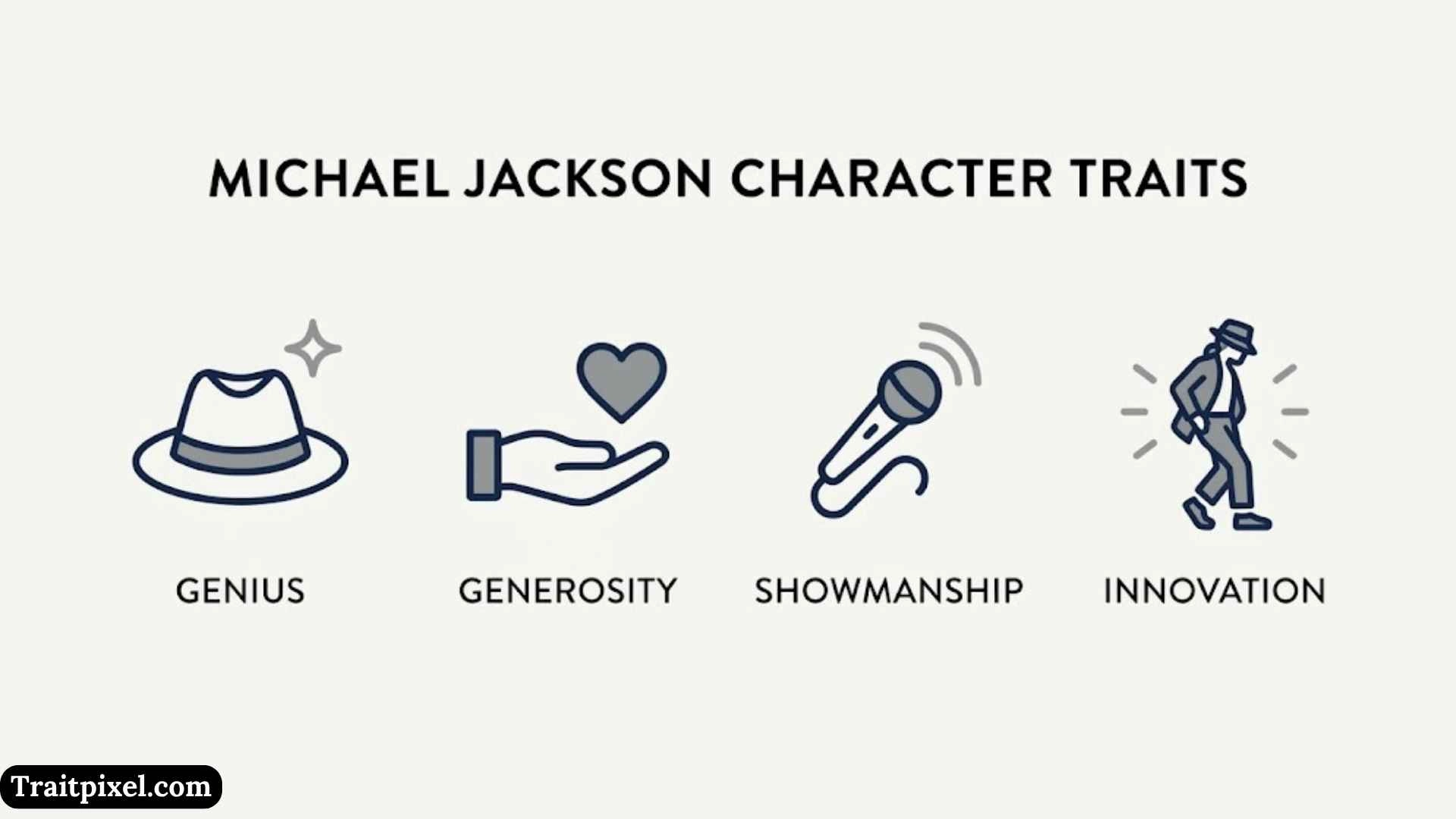
Michael Jackson’s character traits reflected a complex mix of creativity, ambition, sensitivity, discipline, and a desire to entertain people around the world. Best known as the King of Pop, he transformed popular music through his distinctive voice, innovative dance moves, memorable performances, and ambitious music videos. His public image also revealed a strong interest in artistic perfection, childhood themes, and charitable causes.
Understanding Michael Jackson’s character requires looking beyond his fame. His career offers examples of artistic curiosity, persistence, showmanship, and attention to detail, while his private life and public controversies remind us that a celebrity’s personality cannot be understood from performances alone. This article explores his defining qualities, the evidence behind them, and the difference between documented behavior and interpretations of his personality.
Quick Answer
Michael Jackson’s most recognizable character traits included creativity, ambition, perfectionism, dedication, emotional expressiveness, showmanship, sensitivity, originality, discipline, and a strong desire to entertain. His musical career also demonstrated adaptability, collaboration, and a willingness to experiment with sound, choreography, fashion, and visual storytelling.
These traits help explain his artistic influence, but they should not be treated as a complete psychological profile. Public performances, interviews, professional decisions, and charitable activities provide useful evidence of his behavior, while claims about his private thoughts or motives require more caution.
Michael Jackson Character Traits at a Glance
| Character trait | How it appeared in his career |
| Creativity | Developed distinctive music, choreography, and visual concepts. |
| Ambition | Pursued international success and artistic influence. |
| Perfectionism | Paid close attention to musical arrangements and performance details. |
| Dedication | Trained and rehearsed extensively for demanding performances. |
| Emotional expressiveness | Communicated strong feelings through vocals, movement, and lyrics. |
| Showmanship | Created memorable stage entrances, costumes, and signature moves. |
| Originality | Combined musical styles, dance, fashion, and cinematic storytelling. |
| Discipline | Worked within demanding rehearsal and production schedules. |
| Sensitivity | Explored themes of loneliness, compassion, injustice, and vulnerability in his work. |
| Innovation | Helped make music videos a major part of popular music promotion. |
| Adaptability | Evolved from a child performer into a successful solo artist. |
| Confidence | Delivered ambitious performances before large audiences. |
| Collaboration | Worked with musicians, producers, choreographers, dancers, and filmmakers. |
| Humanitarian concern | Supported charitable causes and highlighted social issues. |
| Privacy | Kept aspects of his personal life away from ordinary public scrutiny. |
These descriptions focus on observable aspects of Jackson’s career and public life. Some traits, such as creativity and showmanship, are easier to establish through his work than private qualities such as sensitivity or motivation.
1. Creativity: His Most Recognizable Trait

Creativity was one of Michael Jackson’s strongest defining qualities. He approached music as more than a recording of a song. He combined sound, movement, fashion, storytelling, and visual effects to create performances people could recognize within seconds.
His album Thriller and its title-track music video show this approach particularly well. The video combined choreography, a horror-inspired storyline, costumes, makeup, and cinematic direction. Rather than simply performing in front of a camera, Jackson helped turn the song into a visual experience.
How his creativity appeared:
- He experimented with pop, R&B, funk, rock, and dance music.
- He developed a distinctive performance style through precise movements and expressive gestures.
- He used music videos to extend the meaning of songs.
- He combined familiar influences in ways that created a recognizable artistic identity.
- He treated stage costumes and visual presentation as parts of the performance.
Example: In Beat It, music, choreography, and a story about rival street groups work together to communicate a message about conflict. The song’s impact comes from the combination of its musical energy and visual narrative.
What we can learn: Creativity often grows when you connect different skills. A musician can borrow ideas from film, a teacher can use storytelling to explain a lesson, and a business owner can combine design with practical problem-solving.
2. Ambition: The Drive to Achieve More
Ambition was another prominent characteristic of Jackson’s professional life. He moved from performing with the Jackson 5 as a child to building a successful solo career with albums that reached audiences across the world. His work on Off the Wall, Thriller, and Bad reflects a continuing effort to expand his artistic reach.
His ambition was not limited to selling records. He pursued larger productions, distinctive music videos, complex choreography, and performances that could hold the attention of enormous audiences.
Ambition can be productive when it gives someone direction and motivates steady improvement. However, ambition alone does not explain success. Talent, training, collaborators, timing, resources, and opportunity also matter.
How ambition appeared in Jackson’s career:
- Moving from group performances into solo work.
- Exploring increasingly ambitious musical and visual projects.
- Building a recognizable identity beyond his childhood success.
- Continuing to release music across several decades.
- Seeking broad international reach through recordings and tours.
Practical lesson: Set goals that challenge you without making your self-worth depend entirely on achievement. Ambition works best when you pair it with realistic planning, patience, and a willingness to learn.
3. Perfectionism: Attention to Detail
Perfectionism is often associated with Jackson because of the precision of his performances and the carefully coordinated elements of his productions. His signature dance routines, vocal delivery, costumes, and music videos show a strong emphasis on presentation and detail.
However, it is important to distinguish an observable commitment to precision from a clinical or psychological judgment about his personality. His finished work demonstrates careful artistic control, but it cannot establish how he experienced every aspect of his work privately.
Signs of artistic precision in his work included:
- Highly synchronized dance movements.
- Carefully arranged musical sections.
- Distinctive vocal phrasing and rhythmic accents.
- Coordinated lighting, costumes, and stage effects.
- Visual storytelling that complemented the music.
The moonwalk is a useful example. Its effect depends on precise foot placement, balance, timing, and body control. When performed well, the technique creates the illusion of gliding backward while the upper body appears to move naturally.
The benefit: Attention to detail can turn a good performance into a memorable one.
The risk: Perfectionism can become counterproductive when someone cannot accept mistakes, delegate tasks, or finish a project. Jackson’s artistic achievements do not, by themselves, prove that he experienced all these difficulties.
Practical lesson: Aim for high standards, but decide which details matter most. Practice deliberately, invite useful feedback, and recognize when a result is ready to share.
4. Dedication and Discipline
Jackson’s career required sustained practice, rehearsal, and physical preparation. He began performing professionally as a child with the Jackson 5 and later developed demanding solo performances involving singing, dancing, and complex stage production.
These accomplishments provide evidence of long-term professional commitment. They do not mean that every part of his life followed the same level of discipline, but they show what sustained work can contribute to an artistic career.
His dedication can be understood through several aspects of performance:
- Vocal preparation: Developing control, phrasing, and expressive delivery.
- Dance practice: Repeating movements until timing and coordination become consistent.
- Rehearsal: Learning how to perform alongside musicians, dancers, and technical crews.
- Production work: Coordinating creative ideas with the demands of recording and staging.
- Career development: Adapting his performance style as his music changed.
Example: A technically difficult dance routine rarely becomes effortless after one attempt. Repetition helps a performer improve balance, rhythm, transitions, and consistency.
Practical lesson: Discipline is not simply working for long hours. It means using your time purposefully, practicing specific skills, and building routines that support long-term progress.
5. Emotional Expressiveness
Jackson used his voice, facial expressions, gestures, and movement to communicate emotion. His performances could convey joy, excitement, vulnerability, frustration, romance, or grief without relying entirely on lyrics.
His recorded work also explored different emotional subjects. Man in the Mirror emphasizes personal responsibility and social change, while Heal the World presents a message of compassion and collective concern. Songs such as She’s Out of My Life use a more intimate emotional approach.
These artistic choices demonstrate emotional range in his performances. They do not provide a complete account of his private emotional life.
How emotional expressiveness appeared in his work:
- Changes in vocal intensity to emphasize a feeling.
- Pauses and gestures that give lyrics greater weight.
- Dance movements that reflect a song’s mood.
- Contrasts between energetic performances and quieter, reflective songs.
- Lyrics addressing love, regret, social problems, and hope.
Practical lesson: Emotional expression can make communication more meaningful. When you speak, write, or perform, match your tone to your message rather than relying on words alone.
6. Showmanship: The Ability to Hold an Audience
Showmanship was central to Jackson’s public identity. He understood how to build anticipation, direct attention, and create moments that audiences would remember long after a performance ended.
His distinctive costumes, dramatic pauses, precise choreography, and signature movements became part of his artistic identity. The moonwalk, showcased during his 1983 performance at Motown 25: Yesterday, Today, Forever, became one of his best-known moves. Although Jackson did not invent the moonwalk, his performance helped popularize it worldwide.
Showmanship involves more than being loud or dramatic. It requires an understanding of timing, audience expectations, movement, and presentation.
Examples of Jackson’s showmanship:
- Using a pause to build anticipation before a dance sequence.
- Pairing a recognizable movement with a musical accent.
- Wearing costumes that reinforced his visual identity.
- Creating elaborate performance concepts instead of relying on singing alone.
- Using facial expressions and gestures to direct the audience’s attention.
Practical lesson: In a presentation, classroom lesson, or public speech, a well-timed pause or clear visual can make a message more memorable. The key is to support the content rather than distract from it.
7. Originality and Individuality
Originality was a major part of Jackson’s artistic appeal. He drew on existing musical and dance traditions but developed a style that combined these influences into a recognizable whole.
His work brought together pop, soul, R&B, funk, rock, fashion, choreography, and cinematic storytelling. The Rock & Roll Hall of Fame recognizes his influence on the sound and visual presentation of modern pop music.
Originality does not require inventing every element from scratch. Artists often build on earlier work, learn from other performers, and transform familiar techniques through their own choices.
Jackson’s individuality appeared in several ways:
- A distinctive vocal style and use of rhythmic sounds.
- Signature dance movements and stage gestures.
- A recognizable combination of military-inspired jackets, gloves, and other visual elements.
- Music videos with clear storylines and ambitious production.
- A performance identity that remained recognizable as his music evolved.
Practical lesson: Learn the basics of your craft before trying to stand out. Originality becomes more meaningful when it reflects a clear point of view rather than difference for its own sake.
8. Sensitivity and Vulnerability in His Art
Sensitivity is often used to describe Jackson because many of his songs address loneliness, compassion, love, social injustice, and the desire for connection. His artistic work frequently made room for vulnerable emotions alongside energetic performances.
Songs such as She’s Out of My Life, Earth Song, and Will You Be There illustrate different forms of emotional vulnerability. They explore personal loss, environmental destruction, human suffering, and the need for support.
It is reasonable to discuss sensitivity as a quality expressed through his music. It would be less reliable to claim that the songs prove exactly how he felt in private or why he made every personal decision.
What this trait looks like in his artistic work:
- Expressing sadness without hiding it behind constant energy.
- Drawing attention to people experiencing hardship.
- Using music to explore complicated feelings.
- Presenting compassion as a theme worth discussing.
- Contrasting vulnerability with strength and confidence.
Practical lesson: Sensitivity can help people recognize the feelings and needs of others. In everyday life, it may appear as careful listening, thoughtful communication, or a willingness to acknowledge pain without judging it.
9. Innovation and Willingness to Experiment
Innovation means introducing new approaches or using familiar ideas in new ways. Jackson demonstrated this quality by treating recorded music, choreography, and video production as connected parts of an artistic project.
The Thriller video is a strong example. Its extended narrative, elaborate makeup, choreography, and cinematic direction helped show audiences that a music video could function as a short film rather than simply a performance clip.
His work also evolved across albums. Off the Wall leaned into disco, funk, and R&B influences, while Thriller brought together pop, rock, and R&B on a larger scale. Later releases explored additional production styles and visual approaches.
Innovation appeared through:
- Experimenting with different musical genres.
- Combining dance with narrative filmmaking.
- Exploring new ways to present songs on television.
- Working with collaborators from different creative fields.
- Changing his sound and presentation without abandoning his identity.
Practical lesson: Innovation starts with a problem or opportunity. Ask what your audience needs, study what already exists, and experiment with a better way to deliver the result.
10. Confidence and Stage Presence
Jackson’s performances demonstrated strong stage confidence. He could command attention through posture, movement, timing, and vocal delivery, even when sharing the stage with large groups of musicians and dancers.
Stage confidence, however, should not be confused with a claim about someone’s confidence in every private situation. Public performance reveals how a person presents themselves in a specific setting, not necessarily how they feel all the time.
His confidence was visible in:
- Performing demanding choreography in front of large audiences.
- Using stillness and movement to control the pace of a performance.
- Maintaining a recognizable visual identity.
- Taking on ambitious musical and theatrical projects.
- Delivering signature songs with a distinctive performance style.
Practical lesson: Confidence can grow through preparation. Practice the parts of a task that make you nervous, become familiar with the environment, and focus on communicating clearly rather than trying to appear perfect.
11. Adaptability: From Child Star to Solo Icon
Adaptability was essential to Jackson’s long career. He first became widely known as the lead singer of the Jackson 5, then established himself as a solo artist with a distinct musical identity.
His solo breakthrough with Off the Wall in 1979 marked an important step in that transition. Thriller in 1982 expanded his international influence, while Bad and Dangerous continued his development as a recording artist.
This progression required more than repeating a successful formula. It involved changes in sound, collaborators, production techniques, performance concepts, and audience expectations.
What adaptability looked like:
- Moving from a family group into solo work.
- Developing an adult artistic identity after childhood fame.
- Exploring new musical and visual approaches.
- Working with producers and artists from different backgrounds.
- Responding to changes in the music industry and popular culture.
Practical lesson: Adaptability does not mean abandoning your strengths. It means using what you already know while learning new skills that fit changing circumstances.
12. Collaboration and Creative Partnership
Although Jackson became famous as a solo performer, his achievements depended on collaboration. Producers, songwriters, musicians, choreographers, directors, dancers, engineers, and record-industry professionals helped turn his ideas into finished work.
His partnership with producer Quincy Jones was particularly important to Off the Wall, Thriller, and Bad. He also co-wrote We Are the World with Lionel Richie, bringing together music and humanitarian fundraising.
Collaboration does not diminish an artist’s individual contribution. Instead, it shows how complex creative projects rely on people with different skills.
Jackson’s career illustrates several features of effective collaboration:
- Combining songwriting with production expertise.
- Coordinating music and choreography.
- Working with directors to develop visual narratives.
- Bringing multiple performers together for a shared cause.
- Building a consistent artistic identity across a team’s work.
Practical lesson: Strong collaborators communicate clearly, respect different skills, and understand the project’s shared goal. Even highly talented individuals need other people to bring complex ideas to life.
13. Humanitarian Concern and Compassion
Jackson supported charitable initiatives and used his public platform to draw attention to humanitarian concerns. His involvement in We Are the World, which he co-wrote with Lionel Richie for the USA for Africa project, is one of the clearest examples. The project raised funds for famine relief in Africa. His career also included involvement with charitable causes and organizations serving children and people facing hardship.
His songs sometimes carried similar themes. Heal the World promotes compassion and care for others, while Man in the Mirror encourages listeners to consider personal responsibility for social change.
It is important to separate documented charitable activities from assumptions about a person’s complete moral character. Public donations and humanitarian projects provide evidence of particular actions, but no single activity tells us everything about someone.
Ways compassion appeared in Jackson’s public work:
- Participating in a major benefit song.
- Using lyrics to discuss human suffering and social responsibility.
- Supporting charitable initiatives.
- Bringing humanitarian messages into mainstream entertainment.
- Connecting music with causes beyond commercial success.
Practical lesson: Compassion becomes more useful when it leads to action. You can support a cause by volunteering, sharing accurate information, donating within your means, or helping someone in your community.
14. Imagination and a Connection to Childhood Themes
Jackson frequently incorporated fantasy, wonder, and childhood imagery into his public work. He spoke and sang about innocence, compassion, imagination, and the importance of protecting children. These themes became a recognizable part of his artistic identity.
His creative projects sometimes used supernatural characters, playful imagery, and dramatic storytelling. The Thriller video blended horror and dance, while other projects explored futuristic settings and fantasy-inspired visuals.
However, artistic interest in childhood themes does not establish a person’s psychological development or explain their private behavior. It is more accurate to discuss what appeared in the work than to infer a diagnosis or personal motive.
How imagination appeared in his art:
- Creating fantasy-driven music videos.
- Using theatrical costumes and makeup.
- Exploring themes of wonder and innocence.
- Building fictional settings around songs.
- Blending familiar emotions with unusual visual ideas.
Practical lesson: Imagination can help people approach familiar subjects from a new angle. Writers, teachers, designers, and performers can use stories and visual metaphors to make complex ideas easier to understand.
15. Privacy and a Complex Public Identity

Jackson’s public identity included a tension between extraordinary fame and a desire to keep aspects of his private life personal. His childhood fame, unusual public image, and intense media attention made it difficult to separate the performer from the person.
His life also involved serious public controversies, including allegations of child sexual abuse that he denied. These allegations, legal proceedings, and conflicting public interpretations form part of the historical record and should not be ignored when discussing his legacy. They also should not be used as a shortcut for diagnosing his personality.
Privacy is not necessarily a positive or negative character trait. It can be a personal boundary, a response to public pressure, or simply a preference. Without reliable evidence, we cannot know every reason behind Jackson’s choices.
What this aspect of his public life teaches us:
- Fame does not give the public complete access to a person’s inner life.
- Public image and private personality are not identical.
- Media coverage can shape how audiences interpret behavior.
- Controversies require careful attention to evidence and legal context.
- A balanced assessment can recognize artistic achievements without ignoring serious allegations.
Practical lesson: When evaluating a famous person, distinguish documented facts, allegations, opinions, and speculation. This approach produces a more reliable understanding than either unquestioning admiration or automatic condemnation.
Positive, Negative, and Neutral Traits of Michael Jackson
Michael Jackson’s character can be discussed more clearly by separating positive qualities, potentially challenging tendencies, and neutral characteristics. This distinction prevents us from treating every aspect of his public image as either admirable or problematic.
| Category | Traits or characteristics | Important context |
| Positive | Creativity, dedication, originality, ambition | Supported by his artistic output and professional achievements. |
| Positive | Showmanship, adaptability, collaboration | Visible in his performances, career development, and creative partnerships. |
| Positive | Compassionate themes, humanitarian involvement | Reflected in selected songs and documented charitable projects. |
| Potentially challenging | High artistic standards | Can support excellence, but excessive perfectionism can become stressful. His work alone cannot establish that it harmed him personally. |
| Potentially challenging | Strong control over artistic presentation | Can create consistency, but the consequences depend on how control affects collaborators. |
| Neutral | Privacy, theatricality, unusual fashion | These characteristics are not inherently good or bad. Their meaning depends on context. |
| Neutral | Emotional expression, interest in fantasy | These describe elements of his artistic identity rather than a complete psychological assessment. |
A key distinction is that a trait is not automatically a strength or weakness in every situation. Ambition can encourage growth, for example, but it can also become unhealthy when achievement takes priority over every other part of life.
Michael Jackson’s Character Traits Compared With Other Concepts
Several terms commonly used to describe Jackson overlap, but they do not mean exactly the same thing.
| Concept | Meaning | Example from Jackson’s career |
| Character trait | A relatively consistent quality used to describe someone’s behavior or tendencies | Dedication to developing his performance skills |
| Personality trait | A broad pattern of thinking, feeling, or behaving | Public confidence and expressive performance style |
| Talent | A developed or natural ability | Singing, dancing, and musical performance |
| Skill | An ability improved through learning and practice | Precise choreography |
| Artistic style | A recognizable way of creating or presenting work | Combining music, dance, costumes, and cinematic videos |
| Public image | How audiences perceive a person | The King of Pop persona |
| Professional habit | A repeated behavior connected to work | Rehearsing and coordinating performance elements |
These distinctions matter because talent, personality, and character are not interchangeable. Someone may have outstanding musical talent without being disciplined, while another person may show strong discipline without becoming a famous performer.
Jackson’s career demonstrates how artistic ability, professional practice, creative choices, and public presentation can reinforce one another.
10 Real-World Examples of Michael Jackson’s Character Traits
The following examples connect his documented career to broader lessons. They illustrate observable behavior rather than claiming access to his private thoughts.
1. Creativity — Developing a distinctive performance
Jackson combined music and choreography to create performances with a recognizable identity. In everyday life, creativity can mean finding a fresh way to explain an idea rather than repeating a familiar approach.
2. Ambition — Building a solo career
His transition from the Jackson 5 to solo stardom illustrates the pursuit of a larger professional goal. A student can apply the same principle by setting clear learning targets and working toward them consistently.
3. Precision — Performing the moonwalk
The moonwalk requires control, timing, and coordination. A similar approach helps an athlete refine technique or a speaker improve delivery through focused practice.
4. Emotional expression — Performing a heartfelt song
His delivery in She’s Out of My Life illustrates how vocal tone can communicate vulnerability. In conversation, listening carefully and choosing honest words can make emotional communication more meaningful.
5. Innovation — Creating Thriller
The video brought together music, choreography, makeup, and a cinematic storyline. A business can apply this principle by combining different skills to improve a product or service.
6. Collaboration — Working with Quincy Jones
Their musical partnership shows how an artist and producer can combine different strengths. At work, collaboration improves when people respect each other’s expertise and communicate clearly.
7. Adaptability — Evolving beyond childhood fame
Jackson developed a different identity as a solo artist. Similarly, a professional may need to learn new tools or approaches when their industry changes.
8. Humanitarian concern — Participating in We Are the World
The benefit song connected musical collaboration with famine relief. In everyday life, compassion becomes practical when people contribute time, resources, or skills to a meaningful cause.
9. Showmanship — Controlling stage attention
Jackson used pauses, movement, and dramatic presentation to hold an audience. A teacher or public speaker can use clear examples and well-timed pauses to keep listeners engaged.
10. Privacy — Separating public and personal life
Jackson’s fame highlights the difficulty of maintaining personal boundaries under intense scrutiny. Anyone facing public attention can benefit from deciding what to share and what to keep private.
Common Misconceptions About Michael Jackson’s Personality
Discussions of Jackson often mix established facts with assumptions about his private life. The following distinctions help keep the picture balanced.
Myth 1: His stage confidence proves he was confident everywhere
Fact: Stage presence shows how someone performs in public. It does not establish how confident that person feels in private relationships, unfamiliar situations, or moments of stress.
Myth 2: His success proves he was naturally perfect at everything
Fact: His achievements reflected artistic ability, practice, collaboration, opportunity, and years of professional development. Success does not mean someone lacks weaknesses or makes every decision correctly.
Myth 3: His songs reveal his complete personality
Fact: Songs can communicate feelings and ideas, but artistic expression is not a complete psychological record. Lyrics may reflect personal experience, imagination, collaboration, or storytelling.
Myth 4: Creativity means someone must be eccentric
Fact: Originality can appear in many ways. Some creative people have unconventional public styles, while others express originality through quiet experimentation and practical problem-solving.
Myth 5: Perfectionism is always beneficial
Fact: High standards can improve quality, but excessive perfectionism may make it difficult to finish work, accept feedback, or maintain a healthy balance. Jackson’s polished performances demonstrate precision, not necessarily every aspect of his private work habits.
Myth 6: Humanitarian work proves that a person has no flaws
Fact: Charitable actions can be meaningful without making someone morally flawless. A balanced assessment considers specific actions, documented evidence, and relevant controversies.
Myth 7: His public image tells us everything about his character
Fact: A public image is carefully shaped by performances, media coverage, interviews, and audience expectations. It can reveal useful information, but it cannot provide complete access to a person’s private life.
Myth 8: His unusual fashion and interests establish a psychological diagnosis
Fact: Clothing, artistic preferences, and unconventional behavior do not independently establish a mental health condition. Diagnosis requires appropriate clinical assessment, not speculation based on celebrity coverage.
Related Traits Worth Understanding
Michael Jackson’s character traits connect to several broader ideas that help explain how people develop skills, communicate emotions, and build a professional identity.
| Related trait or concept | How it connects |
| Artistic intelligence | Helps explain how performers work with sound, movement, rhythm, and visual ideas. |
| Intrinsic motivation | Refers to engaging in an activity because it is personally rewarding, although Jackson’s private motivations cannot be established from his career alone. |
| Emotional intelligence | Involves recognizing and responding to emotions; expressive performance alone does not establish someone’s overall emotional intelligence. |
| Resilience | Concerns responding to difficulty and adapting after setbacks. A full assessment requires evidence about specific experiences and responses. |
| Charisma | Describes the ability to attract attention or influence an audience. Jackson’s stage presence provides a clear example. |
| Conscientiousness | A broad personality dimension associated with organization, responsibility, and goal-directed behavior. His professional precision is relevant but insufficient to determine his overall level. |
| Original thinking | Involves developing new combinations of existing ideas or finding different approaches to a problem. |
| Performance discipline | Combines preparation, rehearsal, timing, and consistent execution. |
| Social responsibility | Concerns how people respond to the needs of others and contribute to their communities. |
| Personal boundaries | Help people distinguish public responsibilities from private life. |
These concepts can be useful when studying artists, leaders, athletes, or fictional characters. They also remind us not to confuse a single visible behavior with a person’s entire personality.
How to Analyze a Celebrity’s Character Traits Accurately

If you are studying Michael Jackson for a school assignment, biography, character analysis, or personal interest, use this simple decision guide.
A practical character-analysis guide
1. What evidence are you examining?
Songs, performances, interviews, career decisions, charitable work, or documented events.
2. What does the evidence directly show?
A carefully rehearsed routine supports a discussion of precision. It does not prove how someone behaves in every setting.
3. Is your interpretation supported?
Separate observable behavior from assumptions about motives, feelings, or psychological conditions.
4. Is there evidence that complicates the picture?
Consider different periods of life, conflicting accounts, collaborators’ contributions, and documented controversies.
5. Can you state the conclusion fairly?
Describe the trait, give a concrete example, explain what it suggests, and acknowledge what remains unknown.
This method produces a more credible character analysis than simply listing adjectives. It also works for historical figures, public leaders, athletes, and fictional characters.
Frequently Asked Questions
1. What are Michael Jackson’s main character traits?
Michael Jackson’s most recognizable traits included creativity, ambition, dedication, artistic precision, showmanship, originality, emotional expressiveness, adaptability, and collaboration. His public work also reflected themes of compassion and social responsibility. These descriptions are based primarily on his professional achievements and public activities rather than a complete assessment of his private personality.
2. Was Michael Jackson an introvert or an extrovert?
There is not enough reliable evidence to classify Jackson definitively as an introvert or extrovert. His energetic performances demonstrate comfort with public entertainment, but performing before an audience does not reveal how someone prefers to spend time away from work. Introversion and extroversion concern broader behavioral patterns, not just stage presence.
3. Was Michael Jackson a perfectionist?
Jackson is often described as a perfectionist because of the precision of his choreography, detailed production choices, and carefully planned performances. These features support the idea that he valued artistic quality and control. However, they do not establish the full extent of his private perfectionist tendencies or whether those tendencies caused personal difficulties.
4. What made Michael Jackson so creative?
His creativity came through the combination of music, dance, fashion, visual storytelling, and theatrical presentation. He worked with talented collaborators and drew on different musical traditions to develop a distinctive style. His career shows how experimentation and collaboration can help an artist create something recognizable and influential.
5. Was Michael Jackson a sensitive person?
His music frequently explored vulnerable emotions, compassion, loss, and social concerns. These themes support describing his artistic expression as emotionally sensitive. However, they cannot establish exactly how he felt in private or provide a complete picture of his emotional life.
6. What were Michael Jackson’s greatest strengths?
His most evident professional strengths included musical and performance ability, creative vision, dedication to his craft, adaptability, and an exceptional capacity to create memorable stage experiences. His work also demonstrated the value of collaboration, particularly through his partnerships with producers, songwriters, and other performers.
7. What were Michael Jackson’s weaknesses?
It is difficult to identify his private weaknesses with confidence without making assumptions about his personality. His public life involved intense scrutiny, serious controversies, and complex personal and professional challenges. A responsible analysis distinguishes documented events from claims about his motives or psychological characteristics.
8. How did Michael Jackson influence other performers?
Jackson helped shape modern pop performance through his combination of choreography, music videos, stage presentation, and cross-genre musical production. His work influenced how artists used visual storytelling to promote songs and create distinctive performance identities. His influence is recognized by major music institutions, including the Rock & Roll Hall of Fame.
9. Was Michael Jackson a good role model?
That depends on which aspects of his life someone is evaluating. His dedication to artistic development, creative ambition, and involvement in humanitarian projects can offer useful lessons. A balanced assessment should also acknowledge the serious allegations and controversies associated with his life rather than treating admiration for his art as approval of every aspect of his conduct.
10. What can students learn from Michael Jackson’s character traits?
Students can learn about the value of practice, creative experimentation, clear goals, adaptability, and teamwork. His career also offers a useful reminder that major achievements often involve many collaborators. The strongest lesson is to develop your abilities while maintaining realistic expectations and evaluating public figures critically.
11. Did Michael Jackson invent the moonwalk?
No. The moonwalk existed in earlier dance traditions, and other performers used related techniques before Jackson became famous for it. His 1983 performance during Motown 25 helped popularize the move internationally and made it a defining feature of his performance identity.
12. Why is Michael Jackson still studied today?
His career remains relevant because of his impact on pop music, choreography, music-video production, live performance, and popular culture. His life also raises broader questions about childhood fame, celebrity privacy, artistic influence, humanitarian work, and how audiences judge public figures.
Key Takeaways
- Creativity was central to Jackson’s combination of music, dance, fashion, and visual storytelling.
- Ambition and dedication helped him move from childhood group performances to international solo success.
- Artistic precision was evident in his choreography and carefully developed productions.
- Showmanship and originality made his performances recognizable and influential.
- Emotional expressiveness appeared in songs that explored love, vulnerability, suffering, and hope.
- Adaptability and collaboration helped him develop his sound and work with other creative professionals.
- Humanitarian involvement connected some of his public activities with social causes.
- Privacy and public image are important when distinguishing observable behavior from assumptions about his inner life.
- A balanced assessment recognizes his artistic achievements while addressing controversies and avoiding unsupported psychological claims.
Conclusion
Michael Jackson’s character traits help explain why he became one of the most influential entertainers in popular music. Creativity, ambition, dedication, precision, showmanship, and adaptability stand out most clearly when examining his career. His music also explored vulnerability, compassion, and social responsibility, while his collaborations showed how major artistic projects depend on more than one person’s talent.
The most useful way to understand Jackson is to separate his documented achievements from interpretations of his private personality. His career offers valuable lessons about practice, originality, collaboration, and artistic expression, but it does not provide a complete account of who he was in every part of his life.
His legacy is therefore best understood through both his extraordinary cultural influence and a careful, evidence-based view of the person behind the performances.

I’m Callum Westbrook, a British writer passionate about exploring the traits that make every individual distinctive. I examine personality, temperament, emotional qualities, and behavioural patterns, connecting them with everyday experiences. Through straightforward explanations and thoughtful insights, I hope to help readers recognise different characteristics and develop a deeper appreciation of human individuality.
Books:
- The Nature of Human Traits
- Personality, Temperament and Character