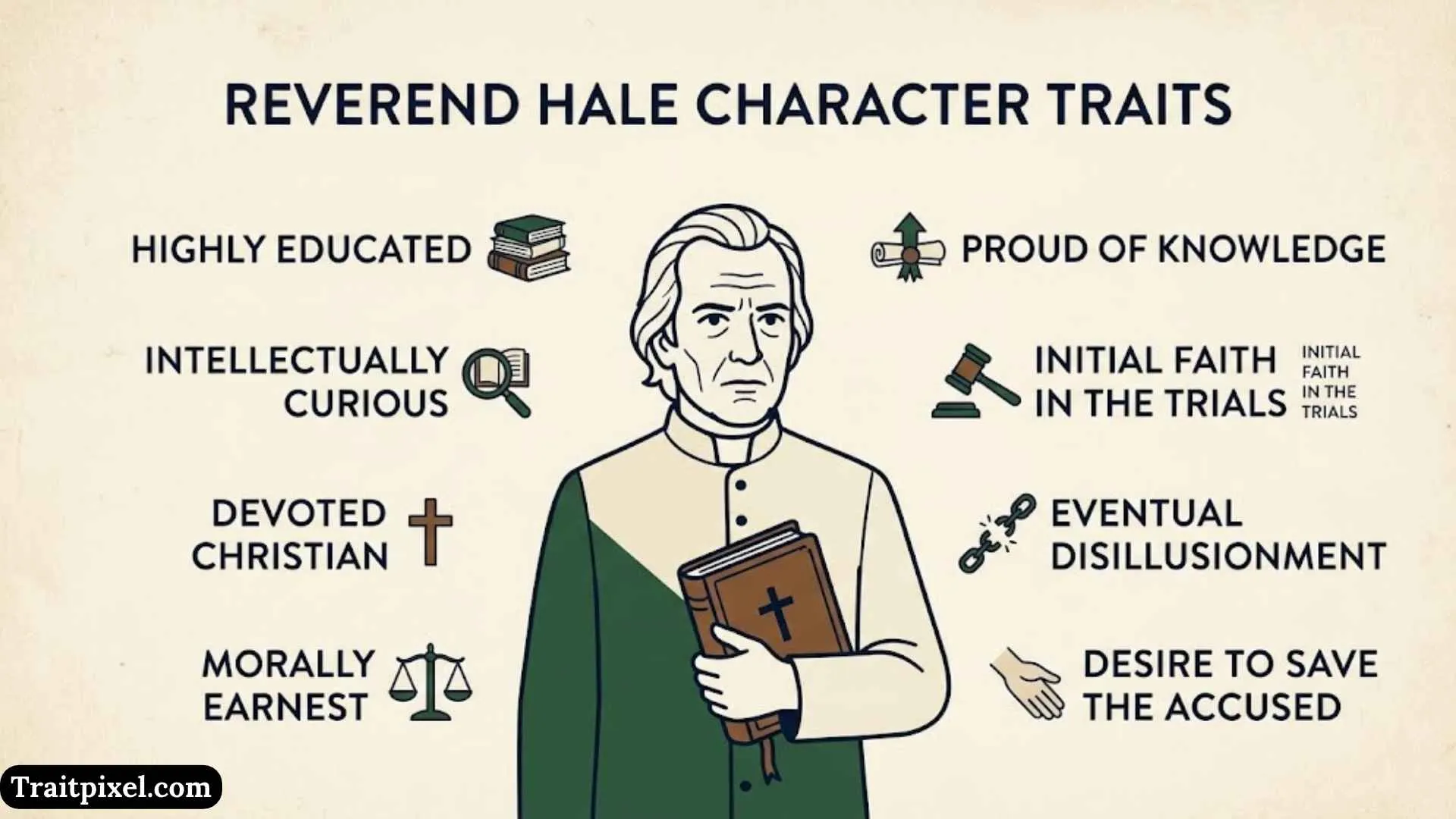
Reverend John Hale is one of the most complex characters in Arthur Miller’s play The Crucible. His main character traits include intelligence, confidence, religious devotion, pride, compassion, and a growing sense of doubt and guilt. At first, Hale believes strongly in the authority of the church and the power of his knowledge. However, the Salem witch trials force him to question his beliefs and recognize the harm caused by his actions.
Hale’s character development is central to the play’s message about truth, justice, and personal responsibility. He begins as an expert who trusts the court’s religious authority, but he eventually becomes a voice of reason who challenges the proceedings. His transformation shows how a person can learn from mistakes, admit wrongdoing, and find the courage to oppose an unjust system.
Quick Answer: What Are Reverend Hale’s Main Character Traits?
Reverend Hale is intelligent, educated, confident, religious, proud, compassionate, and increasingly remorseful. Initially, he trusts his expertise in identifying witchcraft and supports the Salem court. As he witnesses false accusations and unjust punishments, he develops skepticism, recognizes his mistakes, and tries to save innocent people. His transformation from a confident witchcraft expert into a troubled critic of the trials makes him one of the play’s most important characters.
Reverend Hale Character Traits at a Glance
| Character trait | How it appears in the play |
| Intelligent | He studies witchcraft and searches for evidence of supernatural activity. |
| Educated | He brings religious and scholarly knowledge to Salem. |
| Confident | He initially trusts his expertise and believes he can identify witchcraft. |
| Religious | He views the trials through his Puritan beliefs and understanding of evil. |
| Proud | He initially places considerable faith in his knowledge and authority. |
| Compassionate | He becomes concerned about the innocent people accused of witchcraft. |
| Skeptical | He begins questioning the court’s claims and the reliability of the accusations. |
| Remorseful | He feels responsible for helping the trials gain legitimacy. |
| Courageous | He challenges the proceedings and urges prisoners to save their lives. |
| Morally conflicted | He struggles between his religious convictions and his growing awareness of injustice. |
These traits change throughout the play. Hale’s early confidence and later remorse are especially important because they reveal how his understanding of justice develops.
Detailed Analysis of Reverend Hale’s Character Traits

1. Intelligence and Education
Reverend Hale is highly educated and takes pride in his knowledge of theology and witchcraft. His intelligence shapes his approach to Salem’s crisis, where he believes careful investigation can uncover supernatural wrongdoing.
In Act One, Hale arrives with heavy books that represent his scholarship and authority. He treats witchcraft as a subject that can be studied, classified, and investigated. His confidence suggests that he expects his learning to provide reliable answers.
However, Hale’s intelligence does not initially protect him from poor judgment. He accepts the possibility of witchcraft too readily and fails to recognize how fear and personal motives influence the accusations.
His character reveals an important distinction: having knowledge does not guarantee that someone will interpret evidence correctly.
Example: A student may understand scientific principles but still reach a false conclusion by relying on incomplete evidence. Similarly, Hale possesses knowledge but initially applies it within a flawed system of belief.
2. Confidence and Self-Assurance
Hale enters Salem with strong confidence in his abilities. He believes his expertise will help him identify the Devil’s influence and protect the community.
His confidence is understandable because people respect his education and religious position. Yet it also becomes a weakness when he assumes that his methods and beliefs are reliable without questioning their foundations.
As the trials progress, Hale encounters situations that challenge his certainty. Respected citizens face accusations despite their good reputations, and the court increasingly treats accusations as proof.
These developments force him to reconsider his assumptions.
Hale’s changing confidence illustrates how self-assurance can become dangerous when people mistake certainty for truth. Confidence helps people act decisively, but sound judgment also requires humility and a willingness to reconsider mistakes.
3. Religious Devotion
Religion strongly influences Hale’s identity, decisions, and understanding of morality. As a Puritan minister, he believes that God opposes evil and that the community must protect itself from the Devil.
At the beginning of the play, Hale interprets the strange behavior in Salem through this religious framework. He sincerely believes that investigating witchcraft will help defend the community.
His faith is genuine, but his interpretation of events is mistaken. He initially assumes that the court’s religious mission supports its actions, making it difficult for him to recognize the injustice developing around him.
As evidence of manipulation and unfair treatment accumulates, Hale faces a spiritual crisis. He must reconcile his belief in divine justice with the court’s willingness to condemn people without reliable proof.
His struggle does not simply show a loss of faith. It shows a conflict between religious authority and the moral principles that faith is supposed to uphold.
Why this trait matters: Miller uses Hale to show that sincere religious conviction can coexist with serious errors in judgment. Good intentions do not automatically make a person’s decisions just.
4. Pride and Intellectual Arrogance
Hale’s pride appears in his early belief that his specialized knowledge can expose hidden evil. He enjoys being recognized as an expert and expects his methods to help solve Salem’s problem.
This pride is not the same as deliberate cruelty. Hale does not arrive intending to destroy innocent lives. Instead, he overestimates his ability to distinguish truth from deception.
His intellectual confidence encourages him to trust established ideas about witchcraft rather than question whether the accusations are credible.
As innocent people face punishment, Hale discovers the limits of his expertise. His growing doubt forces him to confront a painful possibility: his own authority has helped strengthen a destructive process.
Hale’s pride therefore has two important dimensions:
- Positive side: He takes his responsibilities seriously and works diligently.
- Negative side: He initially trusts his knowledge more than the evidence warrants.
His character reminds readers that expertise becomes more valuable when paired with intellectual humility.
5. Compassion and Empathy
Hale gradually becomes more concerned about the suffering of Salem’s accused citizens. Although he initially participates in the investigation, he cannot ignore the human consequences once the accusations begin destroying innocent lives.
His visits to the Proctor household in Act Two reveal his growing uneasiness. He asks questions about religious practice and the household’s Christian character, reflecting his continuing commitment to the investigation. Yet his conversations also show that he is not as comfortable with the proceedings as the court’s strongest supporters.
When respected people such as Rebecca Nurse face accusations, Hale finds it increasingly difficult to accept that the court must be right.
His compassion becomes more visible in Act Three, when he challenges the proceedings and ultimately leaves the court in protest. By Act Four, he desperately tries to persuade the condemned prisoners to confess falsely so they can escape execution.
That final effort is morally complicated. Hale wants to save lives, but he encourages people to lie about something they have not done.
Hale’s compassion grows as his certainty weakens. He begins to recognize that protecting human life matters more than defending an institution simply because it claims religious authority.
6. Skepticism and Critical Thinking
Skepticism becomes one of Hale’s most important later traits. At first, he trusts the accepted explanations for witchcraft and believes the court can distinguish guilt from innocence.
However, he gradually notices contradictions between the accusations and the character of the people being condemned. His conversations with John Proctor and other Salem residents make him reconsider the reliability of the evidence.
Hale eventually recognizes that the girls’ accusations cannot be treated as unquestionable truth. He also sees that the court’s leaders are increasingly unwilling to examine evidence that challenges their decisions.
His change demonstrates that critical thinking involves more than collecting information. It requires asking whether the evidence supports a conclusion and whether alternative explanations deserve consideration.
Hale’s skepticism arrives late, but it changes his role in the play.
Instead of helping identify witches, he begins questioning whether the accused are guilty at all.
7. Remorse and Guilt
Remorse becomes Hale’s defining emotional state in the final act. He recognizes that his earlier actions helped give the witch trials religious credibility, even though he did not intend to cause suffering.
His guilt is particularly painful because he sees the consequences of his own decisions. People face death while the court refuses to acknowledge the possibility that it has made terrible mistakes.
In Act Four, Hale returns to Salem to persuade the condemned prisoners to confess. His purpose is to save their lives, but his actions also reveal how desperate he has become.
He no longer trusts the court to deliver justice. Instead, he tries to reduce the damage by encouraging prisoners to cooperate with a system he now believes is deeply unjust.
Hale’s remorse matters because it shows that recognizing wrongdoing does not automatically provide a way to repair it. He can admit his error, but he cannot reverse the deaths or restore the community to its earlier state.
Literary significance: Hale represents the painful difference between feeling responsible for injustice and successfully correcting it.
8. Moral Courage
Hale demonstrates moral courage when he begins opposing the court despite his earlier commitment to its mission.
His departure from the proceedings in Act Three marks a turning point. He can no longer support a process that disregards evidence and places innocent people in danger.
However, his courage is not entirely consistent. In Act Four, he urges the condemned to confess falsely, believing that survival matters more than maintaining an untrue accusation against themselves.
This decision reveals the limits of his moral certainty. Hale wants to protect life, but he struggles to determine what justice requires when the available choices all involve serious harm.
His courage is therefore different from John Proctor’s. Proctor ultimately refuses to surrender his integrity through a false confession, while Hale prioritizes keeping the prisoners alive.
Neither response is emotionally simple. Miller uses their disagreement to explore the tension between survival, conscience, and truth.
9. Responsibility and Accountability
Hale’s development shows a growing awareness of personal responsibility. At first, he acts as an expert investigating a perceived spiritual threat. As the trials expand, he realizes that his participation has helped legitimize the accusations.
He cannot simply blame Abigail Williams, the judges, or Salem’s religious culture. Although these forces contribute to the tragedy, Hale must also face his own role in the events.
His guilt drives him to return to Salem and intervene, even after he has lost confidence in the court.
Yet accountability remains incomplete. Hale tries to save prisoners through false confessions rather than directly undoing the system’s decisions. His actions reveal both a sincere desire to make amends and the limits of his response.
This makes him a useful example of a broader moral problem: people may recognize their part in wrongdoing but still struggle to choose the right way forward.
10. Inner Conflict and Emotional Vulnerability
Hale experiences a profound internal conflict between his religious beliefs, his professional identity, and his growing understanding of justice.
At the beginning, these elements appear to support one another. He believes his knowledge serves God, and he expects the investigation to protect Salem.
Later, the same commitments pull him in different directions. His religious convictions make him take accusations seriously, while his conscience tells him that innocent people are suffering. His professional authority initially encourages him to support the trials, but his judgment eventually tells him to resist them.
By Act Four, Hale appears emotionally broken by the consequences of the trials. He feels responsible for suffering he cannot undo and desperately seeks a way to save those who remain alive.
His vulnerability makes him more than a symbol of changing beliefs. He becomes a tragic figure whose growing understanding arrives after much of the damage has already occurred.
How Reverend Hale Changes Throughout The Crucible

Reverend Hale undergoes one of the play’s most significant character transformations. His journey moves from confidence in his expertise to doubt, guilt, and desperate attempts to save innocent people.
Act One: The Confident Expert
Hale arrives in Salem believing his education and religious knowledge can identify witchcraft. He trusts his expertise and initially helps the investigation gain momentum.
Act Two: The Troubled Investigator
Hale begins to feel uneasy as accusations reach respected members of the community. He still gives the court considerable authority, but his confidence is weakening.
Act Three: The Disillusioned Dissenter
Hale recognizes serious flaws in the proceedings. He challenges the court’s decisions and leaves when he can no longer support its actions.
Act Four: The Guilt-Ridden Pleader
Hale returns to save the condemned by urging them to confess falsely. His priority has shifted from proving witchcraft to preserving human life.
Character Development by Act
| Act | Hale’s dominant traits | What changes |
| Act One | Confident, scholarly, religious, proud | He believes he can identify supernatural evil. |
| Act Two | Concerned, questioning, cautious | He becomes troubled by accusations against respected citizens. |
| Act Three | Skeptical, courageous, morally conflicted | He challenges the court and withdraws his support. |
| Act Four | Remorseful, desperate, compassionate | He focuses on saving lives, even through false confessions. |
The key to understanding Hale is that his basic motivation remains relatively consistent: he wants to oppose evil and protect the community. What changes is his understanding of where evil operates and how easily authority can mistake accusation for truth.
Reverend Hale’s Strengths and Weaknesses
Hale’s greatest strengths are his intelligence, dedication, compassion, and eventual willingness to question authority. His weaknesses include excessive confidence, misplaced trust, and difficulty deciding how to respond once he recognizes injustice.
| Strengths | Weaknesses |
| Values education and careful investigation | Overestimates the reliability of his expertise |
| Takes his religious duties seriously | Interprets events through a narrow religious framework |
| Develops empathy for the accused | Initially accepts the court’s assumptions |
| Eventually challenges unjust proceedings | Recognizes the truth only after serious harm occurs |
| Accepts some responsibility for his actions | Struggles to find a morally satisfying way to make amends |
| Wants to preserve human life | Encourages false confessions to achieve that goal |
These strengths and weaknesses often overlap. His dedication makes him eager to investigate witchcraft, but that same dedication encourages him to trust a flawed process. His compassion eventually motivates him to protect prisoners, yet his desperation leads him to recommend dishonesty.
This complexity makes Hale more believable than a character who is entirely good or entirely bad.
Reverend Hale vs. Other Characters in The Crucible
Comparing Hale with John Proctor, Reverend Parris, and Deputy Governor Danforth helps clarify his personality and moral development.
| Character | Dominant traits | Relationship to authority | Key difference from Hale |
| Reverend Hale | Intellectual, religious, conflicted, remorseful | Initially trusts authority, then questions it | Changes his position as he recognizes injustice. |
| John Proctor | Independent, flawed, principled, courageous | Challenges authority when it threatens truth | Ultimately refuses a false confession to preserve his integrity. |
| Reverend Parris | Insecure, defensive, status-conscious | Tries to protect his position and reputation | Often prioritizes personal security over justice. |
| Deputy Governor Danforth | Authoritative, rigid, confident | Defends the court and its legitimacy | Resists reconsidering the court’s decisions even when serious doubts emerge. |
Reverend Hale vs. John Proctor
Hale and Proctor both recognize the injustice of the trials, but they respond differently.
Hale initially trusts established religious authority and later struggles with the consequences. Proctor is suspicious of the proceedings and ultimately refuses to sacrifice his integrity by falsely confessing.
Their contrasting choices raise an important question: Is it better to survive by compromising the truth, or to preserve one’s principles even at great personal cost?
Miller does not make this conflict emotionally easy. Hale wants to save lives, while Proctor believes that a false confession would destroy something essential about his identity.
Reverend Hale vs. Reverend Parris
Both men are ministers, but their motivations differ.
Hale begins with sincere confidence in his scholarly and religious mission. When he realizes that the proceedings are unjust, he turns against them and feels responsible for the damage.
Parris, by contrast, frequently worries about his reputation, position, and personal safety. Although he eventually becomes concerned about the consequences of the trials, his fears often center on his own security.
The comparison highlights Hale’s willingness to reconsider his beliefs, even when doing so causes him intense personal distress.
Reverend Hale vs. Deputy Governor Danforth
Hale and Danforth represent two different responses to authority and evidence.
Danforth treats challenges to the court as threats to its legitimacy. Hale eventually recognizes that refusing to reconsider the court’s decisions only deepens the injustice.
Their conflict illustrates a central theme of the play: authority cannot guarantee justice when leaders refuse to question their own judgments.
Hale’s transformation does not make every later decision correct, but it shows that changing one’s position in response to evidence is a necessary part of moral judgment.
Important Reverend Hale Quotes and What They Reveal
Hale’s dialogue offers clear evidence of his changing beliefs. The following brief quotations and paraphrased moments illustrate his personality across the play. Page numbers vary by edition.
| Quote or key moment | Trait revealed | Explanation |
| Hale describes his books as being “weighted with authority.” | Confidence and pride | He arrives with a strong sense of his expertise and professional status. |
| Hale insists that he intends to expose the Devil’s presence. | Religious devotion and determination | He sees the investigation as a serious spiritual responsibility. |
| Hale expresses concern when respected citizens face accusations. | Compassion and doubt | The accusations challenge his assumptions about the investigation. |
| Hale withdraws from the court in Act Three. | Moral courage and skepticism | He refuses to continue supporting proceedings he believes are unjust. |
| Hale cries that he bears responsibility for the deaths. | Remorse and guilt | He recognizes his role in legitimizing the trials. |
| Hale urges Elizabeth to persuade John to confess. | Compassion and moral conflict | He wants John to survive, even if that requires a false confession. |
How to Analyze Hale’s Quotes in an Essay
When using a quotation as evidence, explain both its immediate meaning and its connection to Hale’s development.
For example:
Claim: Reverend Hale becomes increasingly aware of his moral responsibility.
Evidence: In Act Four, Hale expresses guilt over the bloodshed caused by the trials.
Analysis: His language reveals that he no longer sees himself as a detached investigator. He recognizes that his earlier confidence helped legitimize the court’s actions. His remorse shows that intellectual authority carries moral consequences when people rely on it to make decisions about others’ lives.
This approach is stronger than simply labeling Hale as guilty or compassionate. It explains how Miller develops the trait through dialogue and action.
What Does Reverend Hale Symbolize?
Reverend Hale symbolizes the dangers of misplaced certainty, the possibility of moral awakening, and the painful consequences of delayed accountability.
His character serves several literary purposes.
- The limits of expertise: Hale’s education does not prevent him from making serious mistakes.
- The danger of unchecked authority: His early support helps give legitimacy to a flawed investigation.
- The possibility of change: He eventually questions the assumptions he once defended.
- The cost of delayed recognition: His change of heart comes after the trials have caused substantial suffering.
- The conflict between truth and survival: His efforts to save prisoners reveal how desperation can complicate moral choices.
Hale also helps develop the play’s theme of mass hysteria. Salem’s fear encourages people to accept accusations without sufficient evidence. Even an educated minister becomes vulnerable when his assumptions align with the community’s panic.
His transformation suggests that recognizing injustice requires more than intelligence. It requires the courage to question accepted beliefs, acknowledge mistakes, and act before the damage becomes irreversible.
How to Write a Character Analysis of Reverend Hale
A strong character analysis should explain how Hale’s traits develop, not merely list adjectives describing him.
Follow these steps when writing a school assignment or literature essay.
- Start with a clear claim. Explain that Hale changes from a confident witchcraft expert into a remorseful critic of the trials.
- Identify his early traits. Discuss his education, religious devotion, confidence, and pride.
- Use specific events as evidence. Analyze his arrival in Salem, his visit to the Proctors, and his response to the court.
- Explain the turning point. Show how the growing contradictions in the accusations weaken his trust in the proceedings.
- Examine his final choices. Discuss why he encourages false confessions and how this decision reveals his desperation.
- Connect his development to the themes. Explain what Hale reveals about authority, justice, guilt, and moral responsibility.
Sample Character Analysis Paragraph
Reverend Hale is a complex character in Arthur Miller’s The Crucible because he develops from a confident religious expert into a remorseful opponent of the witch trials. At the beginning of the play, Hale trusts his education and believes he can identify supernatural evil. However, as respected members of Salem face accusations, he begins to question the reliability of the proceedings. His decision to leave the court in Act Three demonstrates his growing moral courage, while his desperate efforts to save the condemned in Act Four reveal his guilt and compassion. Through Hale’s transformation, Miller shows that intelligence and good intentions cannot prevent injustice when people trust authority without examining the evidence.
This paragraph works because it presents a clear argument, uses events from different acts, and connects Hale’s development to the play’s larger meaning.
Common Misconceptions About Reverend Hale

Several misunderstandings can lead readers to oversimplify Hale’s character. Examining these misconceptions helps explain why his transformation matters.
Misconception 1: Reverend Hale Is Evil
Fact: Hale is not presented as a deliberately malicious character. He sincerely believes he is protecting Salem from supernatural evil. His mistakes arise from misplaced confidence, flawed assumptions, and his initial trust in the court.
His good intentions do not erase his responsibility, however. His participation helps legitimize the trials and contributes to the suffering of innocent people.
Misconception 2: Hale Is Always Confident
Fact: Hale’s confidence changes dramatically throughout the play. He begins with strong faith in his expertise, becomes increasingly uncertain, and eventually feels overwhelmed by guilt.
His changing attitude reveals how experience can challenge even deeply held convictions.
Misconception 3: Hale Completely Abandons His Religion
Fact: Hale experiences a crisis of faith and questions the relationship between religious authority and justice. However, his distress does not necessarily mean he abandons religion altogether.
His central struggle concerns how his beliefs should guide him when the court’s actions contradict his understanding of moral responsibility.
Misconception 4: Hale’s Final Actions Are Completely Heroic
Fact: Hale returns to Salem because he wants to save lives, but he urges prisoners to confess falsely. His actions are compassionate and understandable, yet they remain morally complicated.
He hopes to prevent executions, but false confessions could also reinforce the court’s unjust conclusions.
Misconception 5: Hale Changes Only Because He Feels Guilty
Fact: Guilt plays an important role, but his transformation also involves new doubts about the evidence and the court’s methods.
He begins to recognize that the accusations are unreliable and that the authorities are unwilling to reconsider their decisions. His remorse follows from both his growing understanding and his recognition of his own responsibility.
Related Character Traits and Literary Concepts
Understanding related concepts helps explain Hale’s personality more precisely.
| Related concept | Meaning | Connection to Hale |
| Intellectual humility | Recognizing the limits of one’s knowledge | Hale gradually learns that expertise does not guarantee correct conclusions. |
| Cognitive bias | A pattern of thinking that can distort judgment | His initial assumptions influence how he interprets the accusations. |
| Confirmation bias | Favoring evidence that supports existing beliefs | Hale initially interprets events within his belief in witchcraft. |
| Moral responsibility | Accountability for the consequences of one’s actions | He recognizes that his participation helped legitimize the trials. |
| Cognitive dissonance | Discomfort caused by conflicting beliefs or actions | Hale struggles when his religious ideals conflict with the court’s conduct. |
| Moral courage | Acting according to one’s convictions despite personal risk | He challenges the proceedings after recognizing their injustice. |
| Remorse | Deep regret over one’s actions | He feels responsible for the suffering caused by the trials. |
| Mass hysteria | Collective fear and behavior that spread through a group | Salem’s panic influences Hale’s early judgment and the wider community. |
These concepts are useful for literary analysis because they explain the mechanisms behind Hale’s decisions rather than simply describing his emotions.
Frequently Asked Questions
What are Reverend Hale’s five main character traits?
Reverend Hale’s five main traits are intelligence, confidence, religious devotion, compassion, and remorse. He begins as a confident expert who trusts his knowledge of witchcraft. As the trials progress, he becomes skeptical of the accusations and feels guilty about his role in the injustice.
Is Reverend Hale a good or bad character?
Hale is best understood as a morally complex character. He sincerely wants to protect Salem, but his early confidence and trust in the court contribute to the persecution of innocent people. His later efforts to challenge the proceedings show his capacity for moral growth, although his final choices remain complicated.
How does Reverend Hale change in The Crucible?
Hale changes from a confident witchcraft investigator into a disillusioned minister who questions the court. In Act One, he trusts his expertise. By Act Three, he rejects the proceedings, and in Act Four, he tries to save condemned prisoners through false confessions.
Why is Reverend Hale proud?
Hale takes pride in his education, specialized knowledge, and ability to investigate witchcraft. His confidence initially makes him an authoritative figure in Salem. However, his pride also prevents him from recognizing the limitations of his knowledge and assumptions early enough.
Why does Reverend Hale feel guilty?
Hale feels guilty because he realizes that his participation helped give legitimacy to the witch trials. He understands that innocent people have suffered while the court refuses to acknowledge its mistakes. His remorse motivates him to return to Salem and attempt to save the remaining prisoners.
Is Reverend Hale courageous?
Yes, Hale demonstrates moral courage when he challenges the court and withdraws his support in Act Three. However, his courage is complicated by his later decision to encourage false confessions. He wants to save lives, but he struggles to balance survival with truth and integrity.
What is Reverend Hale’s greatest weakness?
Hale’s greatest weakness is his initial overconfidence in his expertise and the court’s authority. He assumes that his knowledge will help him identify witchcraft accurately, yet he fails to question the reliability of the accusations soon enough. This weakness contributes to the tragedy he later regrets.
What is Reverend Hale’s greatest strength?
His greatest strength is his willingness to reconsider his beliefs. Once he recognizes the injustice, he challenges the proceedings and attempts to protect the accused. Although his response comes too late to prevent much of the harm, his changing judgment distinguishes him from characters who refuse to acknowledge their mistakes.
What does Reverend Hale represent in the play?
Hale represents the dangers of misplaced certainty, the possibility of moral awakening, and the consequences of delayed accountability. Through his transformation, Arthur Miller shows how intelligent and well-intentioned people can contribute to injustice when they fail to question accepted beliefs.
How is Reverend Hale different from John Proctor?
Hale initially trusts religious and legal authority, while Proctor becomes increasingly critical of the court. Both recognize the injustice of the trials, but they respond differently. Hale urges false confessions to preserve lives, whereas Proctor ultimately refuses to surrender his integrity through a false confession.
What is Reverend Hale’s role in the Salem witch trials?
Within the play, Hale is summoned to investigate suspected witchcraft. His expertise lends credibility to the investigation, and he initially supports the search for witches. As the accusations escalate, he questions the evidence, challenges the court, and tries to prevent further executions.
What lesson can readers learn from Reverend Hale?
Hale’s character teaches readers to question assumptions, evaluate evidence, and remain open to changing their minds. It also shows that good intentions do not remove responsibility for harmful decisions. Recognizing a mistake matters, but acting promptly to correct it matters just as much.
Key Takeaways About Reverend Hale
- Intelligence: Hale’s education makes him an authority on witchcraft, but it does not guarantee sound judgment.
- Confidence: His early self-assurance becomes a weakness when he trusts his expertise too readily.
- Religious devotion: His faith shapes his actions and later contributes to his moral conflict.
- Compassion: He increasingly recognizes the suffering of the accused and tries to save their lives.
- Skepticism: He eventually questions the accusations and the court’s refusal to reconsider its decisions.
- Remorse: He feels responsible for helping legitimize the trials.
- Moral courage: He challenges the court when he can no longer support its proceedings.
- Character development: His movement from certainty to doubt makes him one of the play’s most important examples of moral change.
- Central lesson: Intelligence and good intentions cannot replace critical thinking, reliable evidence, and personal accountability.
Conclusion
Reverend Hale’s character traits make him one of the most complex figures in Arthur Miller’s The Crucible. He begins as an intelligent, confident, and deeply religious minister who believes he can identify witchcraft and protect Salem. However, the injustice of the trials forces him to question his assumptions and recognize the consequences of his decisions.
His compassion, skepticism, and remorse become more prominent as his confidence fades. Although he eventually challenges the court and tries to save innocent people, his efforts cannot undo the damage already caused.
Ultimately, Reverend Hale’s defining trait is his capacity to change when his beliefs no longer match the evidence before him. His journey warns readers about the dangers of unchecked authority, misplaced certainty, and delayed accountability. It also demonstrates that recognizing a mistake is an important step toward moral growth, even when making things right proves difficult.

I’m Elliot Kingsley, a British author interested in the subtle characteristics that influence how people think, communicate, and respond to the world. I write about personality traits, strengths, tendencies, and behavioural qualities in clear language. My goal is to encourage readers to understand individual differences and appreciate the complexity of human character.
Books:
- The Psychology of Personality Traits
- Character in Context