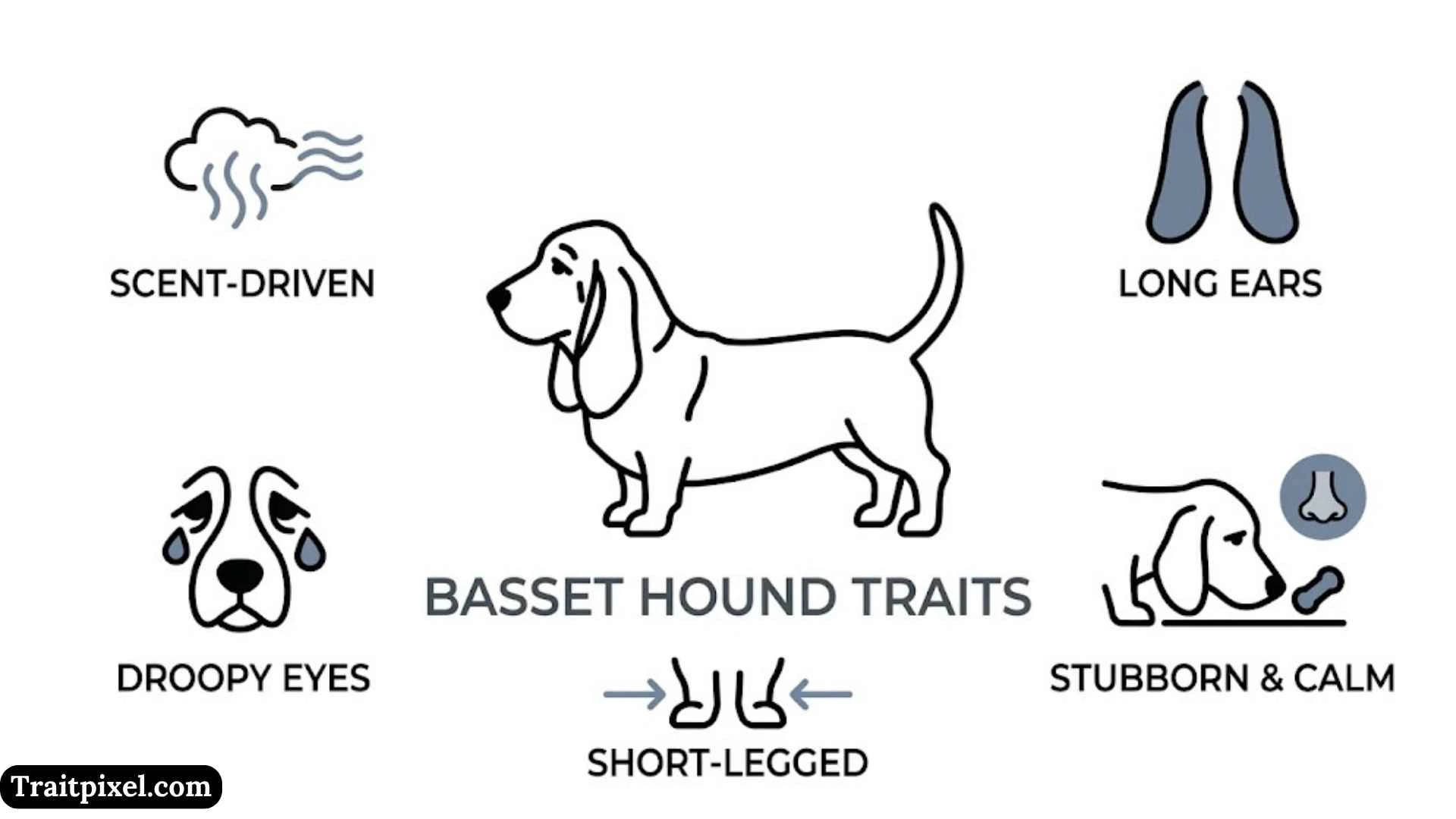
Basset Hound traits make this breed easy to recognize and lovable to many dog owners. Known for their long, floppy ears, droopy eyes, short legs, and powerful sense of smell, Basset Hounds are generally gentle, affectionate, and good-natured dogs. They were bred to follow scents, so their calm appearance can hide a determined, independent hunting instinct.
Understanding Basset Hound traits helps you decide whether this breed fits your home, family, and lifestyle. These dogs often enjoy companionship and relaxed family time, but they can also be stubborn, vocal, and easily distracted by interesting smells. Their body shape also calls for thoughtful exercise, weight management, and routine health care.
Quick Answer
The main Basset Hound traits include a gentle temperament, affection, patience, independence, scent-driven curiosity, a strong sense of smell, and a distinctive deep bark or bay. Basset Hounds typically have short legs, long ears, loose facial skin, and a sturdy body. They often make friendly family companions, but training can take patience because they may follow a scent instead of responding immediately to a command.
They usually do best with consistent, reward-based training, moderate daily exercise, regular ear care, and a healthy diet. Individual personalities vary, so early socialization, health, breeding, and life experiences also influence behavior.
Basset Hound Traits at a Glance
| Trait | Typical characteristic |
| Temperament | Gentle, friendly, and often easygoing |
| Affection | Enjoys companionship and family interaction |
| Intelligence | Capable problem-solver with a strong instinct to follow scents |
| Trainability | Learns with patience but can be independent |
| Energy level | Generally moderate, with regular exercise needs |
| Exercise needs | Daily walks and opportunities for supervised sniffing |
| Vocal behavior | May bark, howl, or bay when excited or following a scent |
| Social behavior | Often sociable when properly introduced and socialized |
| Grooming | Short coat, regular brushing, and routine ear and skin care |
| Size | Medium-sized dog with a low, heavy-set body |
| Prey and scent drive | Strong tendency to investigate and follow smells |
| Watchdog behavior | May alert owners with its voice but is not typically a guard dog |
| Apartment suitability | Can adapt if exercise, training, and noise needs are managed |
| Family compatibility | Often good with considerate children and suitable pets |
| Common challenges | Stubbornness, scent distraction, weight gain, and ear problems |
These are general breed tendencies, not guarantees. A particular Basset Hound may be more energetic, quieter, more independent, or more outgoing than the typical description suggests.
What Is a Basset Hound?

A Basset Hound is a scent hound developed to track small game, especially rabbits and hares, by following their scent along the ground. The breed originated in France, and its name comes from the French word bas, meaning low, which refers to its short-legged build.
Basset Hounds later became popular hunting companions in Britain and other countries. Their powerful noses, endurance, and ability to work at a steady pace made them useful for ground tracking.
Today, many Basset Hounds live primarily as companion dogs. However, their original hunting purpose still shapes their behavior. A Basset Hound may ignore a familiar command when a fascinating scent captures its attention. That response often reflects instinct and competing motivation rather than a lack of intelligence.
Why their history matters
Understanding the breed’s background makes everyday behavior easier to interpret.
- Sniffing: Tracking smells is a natural activity, not simply a distraction.
- Persistence: A Basset Hound may keep investigating a scent even when its owner wants to move on.
- Vocalizing: Baying and barking can be part of how scent hounds communicate during tracking.
- Independent decisions: Hounds were developed to work on a trail, which helps explain why they may not respond instantly to every command.
- Endurance: Their traditional working role involved sustained movement, although modern exercise should suit the individual dog’s health and body condition.
A Basset Hound’s instincts are easier to manage when owners provide safe ways to sniff, explore, and use their minds.
Physical Traits of a Basset Hound
Basset Hounds have a distinctive body shape that reflects their history as scent-tracking dogs. They are low to the ground, heavily built for their height, and equipped with long ears and a strong nose.
According to the American Kennel Club breed information, adult Basset Hounds generally stand up to 15 inches tall at the shoulder and weigh about 40–65 pounds. Individual dogs vary, and healthy weight depends on body structure and condition.
1. Short legs and a long body
Their short, powerful legs and long body are among their most recognizable physical traits. This build helps them move close to the ground while following scent trails.
However, short legs do not mean a Basset Hound is weak or unable to walk. The breed was developed for steady movement and endurance rather than speed. Owners should avoid repeatedly encouraging high jumps or strenuous activities that put unnecessary stress on the back and joints.
2. Long, floppy ears
Basset Hounds have low-set, pendulous ears that can reach toward the end of the nose. Their ears are part of the breed’s distinctive appearance and may help direct scent toward the nose as the dog tracks.
These ears also need regular care. Limited airflow and moisture can contribute to ear problems, so check them routinely and clean them with a veterinarian-recommended product when needed.
3. Droopy eyes and facial wrinkles
Their loose facial skin, prominent brow, and soft-looking eyes create the familiar mournful expression. Although this appearance can make them look sad, it does not reliably indicate their emotional state.
Check around the eyes and skin folds for redness, discharge, odor, or irritation. Persistent symptoms deserve veterinary attention rather than repeated cleaning alone.
4. Strong nose and scenting ability
A Basset Hound’s powerful sense of smell is one of its defining functional traits. The breed was developed to locate and follow animal scents, so sniffing is often more rewarding to the dog than walking directly beside its owner.
Allowing safe sniffing time can make walks more enriching. A secure leash is especially important because a Basset Hound may continue following an interesting trail even when called.
5. Short, smooth coat
The breed’s coat is short and relatively easy to maintain, but Basset Hounds still shed. Weekly brushing usually helps remove loose hair and keep the coat in good condition.
Their coat may come in combinations of black, white, and tan, as well as other recognized hound colors. Coat color does not reliably predict personality or trainability.
Basset Hound Temperament and Personality
Basset Hounds are generally calm, sociable, and good-natured. They often enjoy being around familiar people and can settle comfortably at home after a walk. However, their independent scent-hound instincts mean they may not always respond as quickly as more handler-focused breeds.
The most useful way to understand their temperament is to consider both sides: they can be relaxed companions indoors and persistent explorers outdoors.
Are Basset Hounds affectionate?
Yes, many Basset Hounds form close bonds with their families. They may follow their owners from room to room, rest nearby, or seek attention when they feel comfortable.
Affection does not always look like constant excitement. Some Bassets prefer quiet companionship, while others are more demonstrative. Let the individual dog choose how much physical contact it enjoys, especially around unfamiliar people.
Are Basset Hounds friendly with strangers?
Many are friendly or calmly curious around new people, but social behavior varies. Early, positive introductions can help a puppy become comfortable with different people, sounds, places, and experiences.
Do not assume every Basset Hound will welcome every stranger. Give the dog space, watch its body language, and avoid forcing interactions.
Are Basset Hounds good with children?
Basset Hounds can make good family companions, especially in homes where children understand how to treat dogs respectfully. Their generally mild temperament can be an advantage, but no breed is automatically safe in every situation.
Teach children to:
- Avoid pulling the dog’s ears, tail, or loose skin.
- Leave the dog alone while eating or sleeping.
- Approach calmly instead of climbing on the dog.
- Recognize signs of discomfort, such as turning away, stiffening, or trying to leave.
- Ask an adult before interacting with an unfamiliar dog.
Always supervise young children around dogs. A friendly dog can still react defensively when hurt, frightened, or overwhelmed.
Do Basset Hounds get along with other pets?
Many Basset Hounds enjoy the company of other dogs, partly because the breed has a history of working in packs. Some can also live successfully with cats and other household pets.
However, their hunting background matters. A Basset Hound may be more interested in chasing a small animal that runs away. Introduce pets gradually, supervise early interactions, and provide separate safe spaces.
Are Basset Hounds lazy?
Basset Hounds often enjoy resting, but calling them lazy misses an important part of their nature. They may be low-key at home while showing considerable persistence when exploring outdoors.
A dog that spends most of the day sleeping but receives little exercise or mental stimulation may become alternative or bored. Regular walks, sniffing games, and short training sessions help meet its needs without requiring intense athletic activity.
Positive and Challenging Basset Hound Traits
Basset Hound traits bring several benefits to family life, but some can create challenges if owners do not understand the breed.
| Trait | Potential benefit | Possible challenge |
| Gentle temperament | Often makes a pleasant companion | Still needs boundaries and supervision |
| Affectionate nature | Builds strong family bonds | May struggle when left alone for long periods |
| Strong sense of smell | Enjoys tracking and scent games | Can become distracted on walks |
| Independence | Can work through a scent trail | May respond slowly to commands |
| Persistence | Keeps trying to solve a problem | Can remain focused on unwanted behavior |
| Vocal nature | Can alert owners to activity | Barking or baying may disturb neighbors |
| Moderate activity needs | Often suits a relaxed household | Still needs daily movement and enrichment |
| Short coat | Requires less coat maintenance than many long-haired breeds | Sheds and still needs regular brushing |
| Sociability | May enjoy other dogs and family members | Compatibility with individual animals varies |
| Food motivation | Treats can support training | Excessive treats can lead to weight gain |
What are the disadvantages of owning a Basset Hound?
The main challenges are not usually a lack of affection or intelligence. Instead, owners must be ready for a scent-driven dog that may vocalize, shed, drool, and require careful health management.
Consider these factors before choosing the breed:
- Training takes patience. A Basset may prioritize a scent over a familiar command.
- Recall can be unreliable. Off-leash freedom is risky in unsecured areas.
- Noise can be an issue. Baying and barking may be difficult in buildings with thin walls.
- Weight needs monitoring. Extra weight can place added strain on the back and joints.
- Ear and skin care take time. Long ears and skin folds need routine checks.
- Companionship matters. Some Bassets become distressed when left alone for extended periods.
These challenges are manageable for many owners, but they should be part of the decision before bringing a dog home.
How Intelligent Are Basset Hounds?
Basset Hounds can learn commands, solve problems, and remember routines. Their training difficulties often come from competing motivations, especially the urge to follow a scent.
A dog that ignores a command while investigating a smell may not have failed to understand it. The environment may simply be more rewarding than the instruction.
How to train a Basset Hound effectively
- Use valuable rewards. Small, appealing treats can make training more rewarding.
- Keep sessions short. Brief sessions help maintain attention and limit frustration.
- Practice in quiet areas first. Build reliability before introducing stronger distractions.
- Reward the behavior you want. Mark and reward a response as soon as it happens.
- Use a consistent cue. Everyone in the household should use the same words for the same behaviors.
- Increase difficulty gradually. Practice around mild distractions before moving to busy environments.
- Never rely on recall alone outdoors. Use a leash or a secure fenced area until recall is dependable in that setting.
Avoid harsh punishment. It can damage trust and may make training more difficult. Reward-based methods help the dog understand which behaviors lead to positive outcomes.
A practical example
Imagine your Basset Hound stops during a walk because it has found an interesting scent. Pulling the leash repeatedly may lead to frustration for both of you.
Instead, wait for a brief moment of attention, reward the dog for checking in, and then encourage it to move forward. You can also schedule short sniffing breaks so the dog has opportunities to explore without controlling the entire walk.
The goal is not to eliminate the dog’s instincts. It is to teach the dog how to manage them safely.
Exercise Needs and Daily Activity
Basset Hounds need regular, moderate exercise to maintain a healthy weight, support mobility, and stay mentally engaged. Most enjoy daily walks at a comfortable pace, with plenty of opportunities to sniff and explore.
Their short legs and heavy bodies make sensible exercise planning important. Puppies, adults, and senior dogs have different needs, so adjust activity to your dog’s age, fitness, and veterinary advice.
How much exercise does a Basset Hound need?
Many healthy adult Basset Hounds do well with daily walks and additional low-impact activities. The exact amount depends on the individual dog, weather, body condition, and health.
A balanced daily routine may include:
- A morning walk with time to investigate scents.
- Short training sessions using food rewards.
- Indoor scent games or puzzle feeders.
- A second walk or gentle play session later in the day.
- Quiet rest between activities.
Avoid forcing a Basset Hound to run long distances or repeatedly jump from furniture. Because the breed has a long back and short legs, ask your veterinarian about appropriate exercise if your dog has mobility problems or a history of back pain.
Activities Basset Hounds often enjoy
Sniff walks
Let your dog investigate safe smells instead of expecting every walk to happen at a brisk pace. Sniffing provides mental stimulation and gives the breed an appropriate outlet for its natural instincts.
Find-the-treat games
Hide a few pieces of your dog’s daily food in easy-to-find locations. Let it use its nose to locate them, then gradually make the game more challenging.
Food puzzles
Puzzle feeders and supervised scent activities give your dog something to work on indoors. Start with simple puzzles so your dog learns how to succeed without becoming frustrated.
Supervised social walks
Calm walks with a compatible dog can provide exercise and social contact. Choose suitable companions and allow both dogs to interact at their own pace.
Grooming and Everyday Care

Basset Hounds have short coats, but they still need regular grooming. Their ears, facial folds, nails, teeth, and weight deserve particular attention.
Coat care and shedding
Brush your Basset Hound about once a week to remove loose hair and distribute natural oils. More frequent brushing may help during heavier shedding periods.
Bathe your dog when needed with a dog-safe shampoo. Dry the skin thoroughly, especially around any folds, to reduce moisture buildup and irritation.
Ear cleaning
Long, hanging ears can trap moisture and debris. Check them regularly for redness, odor, discharge, or excessive wax.
- Use a veterinarian-approved ear cleaner.
- Follow your veterinarian’s instructions for cleaning frequency.
- Avoid inserting cotton swabs deep into the ear canal.
- Arrange a veterinary examination if your dog repeatedly scratches its ears or shakes its head.
Ear cleaning should not replace treatment for an infection. If the ear appears painful or inflamed, seek veterinary advice.
Nail trimming and dental care
Trim nails regularly so they do not become overgrown or interfere with comfortable movement. If you hear nails clicking on hard floors, check whether they need attention.
Brush your dog’s teeth with a toothbrush and toothpaste made for dogs. Routine dental care helps reduce plaque buildup and supports oral health.
Weight management
Basset Hounds can gain weight when food intake exceeds their activity needs. Extra weight is particularly concerning for a dog with a long back and heavy frame.
To manage weight:
- Measure meals instead of guessing portions.
- Count training treats as part of the daily food allowance.
- Keep fresh water available.
- Monitor body condition rather than relying only on the scale.
- Ask your veterinarian to recommend a suitable diet and target weight.
A healthy Basset Hound should have a visible waist when viewed from above and ribs that can be felt without excessive pressure. Your veterinarian can help assess the correct body condition for your dog.
Common Basset Hound Health Concerns
Basset Hounds can live happy, active lives, but their body structure and inherited risks make preventive care important. Potential concerns include ear infections, skin-fold irritation, joint problems, eye conditions, obesity, and intervertebral disc disease.
Not every Basset Hound will develop these problems. Good breeding practices, healthy weight, routine veterinary care, and early attention to symptoms can help manage risk.
| Health concern | Why it matters | What owners can do |
| Ear infections | Hanging ears can trap moisture and debris | Inspect ears regularly and seek advice for irritation or odor |
| Skin-fold dermatitis | Moisture and friction can irritate folded skin | Keep folds clean and dry; report persistent redness |
| Intervertebral disc disease (IVDD) | Spinal disc problems can cause pain and nerve damage | Maintain a healthy weight and seek prompt care for back pain |
| Hip or elbow dysplasia | Joint abnormalities can affect movement | Ask about appropriate screening and investigate persistent limping |
| Eye problems, including glaucoma | Some eye conditions can threaten vision | Arrange prompt veterinary assessment for eye pain, redness, or sudden changes |
| Obesity | Extra weight increases strain on the body | Measure food portions and maintain appropriate exercise |
| Gastric dilatation-volvulus (GDV) | Bloat with stomach twisting is a life-threatening emergency | Know the warning signs and seek emergency care if suspected |
Important: Sudden severe back pain, weakness, difficulty walking, or paralysis requires urgent veterinary assessment. A swollen abdomen accompanied by restlessness, repeated unsuccessful attempts to vomit, or collapse may indicate GDV and also requires emergency care.
For breed-specific guidance, consult a veterinarian familiar with Basset Hounds. Prospective owners should also ask breeders about relevant health screening for the parents.
Are Basset Hounds Good Family Dogs?
Basset Hounds can be excellent family companions for households that understand their temperament and care needs. They are often gentle, sociable, and happy to spend time with their people.
However, their suitability depends on the family’s lifestyle rather than breed reputation alone.
Best homes for Basset Hounds
A Basset Hound may be a good match if your household:
- Enjoys relaxed walks and outdoor sniffing activities.
- Can provide consistent training without expecting instant obedience.
- Has time for daily companionship.
- Can manage barking or baying appropriately.
- Is prepared for shedding, drooling, and regular grooming.
- Can provide veterinary care and maintain a healthy diet.
Homes that may find the breed challenging
Think carefully before choosing a Basset Hound if you need a very quiet dog, want reliable off-leash recall in open spaces, or expect a pet to exercise intensely for long periods.
A household that leaves a dog alone for most of the day may also struggle if the individual dog has difficulty coping with separation. Gradual independence training and appropriate enrichment can help, but some dogs need additional support.
Basset Hound vs. Beagle: What Is the Difference?
Basset Hounds and Beagles are both scent hounds. They share curiosity, food motivation, vocal tendencies, and a strong interest in tracking smells. Their body structure, activity patterns, and typical size differ.
| Feature | Basset Hound | Beagle |
| Body shape | Low, long, and heavy-set | More compact and proportionate in height and length |
| Legs | Very short relative to the body | Longer relative to body size |
| Typical energy | Often relaxed indoors, with regular exercise needs | Often more active and playful |
| Scent drive | Strong | Strong |
| Training | Benefits from patience and food rewards | Also benefits from consistency and food rewards |
| Vocalization | Can produce a deep, ringing bay | Can bark, howl, and bay |
| Grooming | Short coat; regular brushing and ear care | Short coat; regular brushing and ear care |
| Exercise approach | Moderate walks and sniffing activities suited to body condition | Regular walks, play, and scent activities |
| Main consideration | Back and joint care, weight, and ear health | Exercise, scent distraction, and weight management |
Neither breed is universally easier to own. A Beagle may suit a more active household, while a Basset Hound may appeal to someone who prefers a more relaxed companion. Both need exercise, training, enrichment, and supervision.
How to Choose the Right Basset Hound for Your Home

Choosing an individual dog requires more than matching a breed description. Consider the dog’s health, temperament, early experiences, and your ability to meet its needs.
Use this quick decision guide:
Is a Basset Hound right for you?
Can you manage a dog that may bark or bay?
Yes, some vocalizing is manageable.
No, I need a very quiet dog.
Are you comfortable with patient, consistent training?
Yes, I can train with rewards and repetition.
I need fast obedience and reliable recall.
What activity level suits your household?
Moderate walks, sniffing, and gentle play.
Long, intense runs and strenuous activity.
How much companionship can you provide?
Regular interaction and gradual alone-time training.
The dog would be alone for most of the day.
Assess my fit
Before adopting or buying a puppy, meet the dog if possible and ask about its behavior, health history, and socialization. If you choose a breeder, look for responsible practices and appropriate health screening. Adoption organizations can also help match you with a dog whose temperament fits your household.
Common Misconceptions About Basset Hound Traits
Several assumptions about this breed can lead to poor care or unrealistic expectations.
Myth 1: Basset Hounds are too lazy to need exercise
Fact: They often enjoy resting, but regular movement is important for fitness, weight control, and mental well-being.
Myth 2: A stubborn Basset Hound is not intelligent
Fact: Independent scent work is part of the breed’s history. A Basset may understand a cue but find a scent more rewarding at that moment.
Myth 3: Short coats do not shed
Fact: Basset Hounds shed despite their short, smooth coats. Weekly brushing helps control loose hair.
Myth 4: Their sad-looking eyes mean they are unhappy
Fact: Their facial structure creates a naturally solemn expression. Judge mood by body language and behavior, not appearance alone.
Myth 5: Friendly dogs never need supervision
Fact: Every dog needs safe introductions, training, and supervision around children and unfamiliar animals.
Myth 6: Short legs make jumping harmless
Fact: Their long backs and body structure call for sensible movement habits. Avoid encouraging repeated high jumps and discuss mobility concerns with your veterinarian.
Myth 7: Basset Hounds can safely walk off leash anywhere
Fact: Their scent drive can lead them away from their owners. Use a leash in unsecured areas and practice recall in controlled settings.
Related Traits and Behaviors
Understanding related canine traits helps owners make sense of everyday behavior.
| Related concept | Meaning for Basset Hound owners |
| Scent drive | The motivation to investigate and follow smells |
| Independence | A tendency to make decisions without constantly checking with a handler |
| Food motivation | Interest in food that can support reward-based training |
| Socialization | Positive exposure to people, animals, places, and experiences |
| Enrichment | Activities that provide mental stimulation and appropriate outlets for natural behavior |
| Recall | The dog’s ability to return when called |
| Body condition | An assessment of whether the dog carries an appropriate amount of body fat |
| Breed predisposition | A higher likelihood of certain traits or health conditions, not a guarantee that they will occur |
These concepts are useful because they connect the dog’s natural tendencies with practical care. For example, a strong scent drive suggests using sniffing games for enrichment, while food motivation can make short training sessions more rewarding.
Frequently Asked Questions About Basset Hound Traits
Are Basset Hounds good for first-time dog owners?
They can be, provided the owner understands their training needs, exercise requirements, and health considerations. First-time owners should be ready for scent distractions, vocal behavior, and consistent grooming. A reputable trainer or veterinary professional can provide helpful support.
Do Basset Hounds bark a lot?
Basset Hounds can be vocal and may bark, howl, or bay. Individual dogs differ, and vocalization can increase with excitement, boredom, scent tracking, or attention-seeking. Consistent training and enough enrichment may help manage excessive noise.
Are Basset Hounds easy to train?
They can learn basic obedience, but training often requires patience. Reward-based methods, short sessions, and gradual practice around distractions are generally more useful than expecting immediate responses.
Do Basset Hounds like to cuddle?
Many enjoy resting close to their owners and receiving affection. Others prefer being nearby without constant physical contact. Respect the dog’s comfort and let its behavior guide how you interact.
Can Basset Hounds live in apartments?
Yes, some can adapt to apartment living if they receive daily walks, enrichment, companionship, and suitable training. Noise is an important consideration because baying may disturb neighbors.
Are Basset Hounds good with cats?
Some live peacefully with cats, especially after gradual introductions. However, individual temperament and early experiences matter, and their hunting instincts can affect how they respond to small animals. Supervise interactions and provide safe escape areas for the cat.
Do Basset Hounds need a lot of grooming?
Their short coats need relatively simple care, but regular brushing, nail trimming, dental hygiene, ear checks, and attention to skin folds remain important. They may also shed more than prospective owners expect.
What is the biggest challenge of owning a Basset Hound?
For many owners, the main challenges are scent-driven independence, vocalization, and maintaining healthy weight. Ear care and potential back or joint problems also require attention. The difficulty depends on the individual dog and the owner’s expectations.
Are Basset Hounds aggressive?
The breed is generally known for a mild temperament, but individual behavior varies. Fear, pain, poor socialization, and stressful situations can affect any dog’s behavior. Seek professional guidance if a dog shows repeated growling, snapping, or other concerning signs.
How long do Basset Hounds live?
The American Kennel Club lists a typical life expectancy of around 12–13 years. Individual lifespan varies with genetics, health, body condition, and veterinary care. Regular checkups and preventive care can help support a dog’s well-being throughout its life.
Key Takeaways
- Basset Hounds are generally gentle, affectionate, and good-natured.
- Their strongest instincts include scent tracking, persistence, and independent exploration.
- Short legs, a long body, long ears, and loose facial skin define their appearance.
- They need regular moderate exercise, mental enrichment, and reward-based training.
- Vocalization, shedding, drooling, and scent distractions may challenge some households.
- Regular ear care, healthy weight management, and veterinary checkups are important.
- Many Basset Hounds do well with families and other pets when introductions and supervision are appropriate.
- Individual temperament, health, and early experiences matter as much as breed tendencies.
Conclusion
Basset Hound traits combine a gentle temperament with a determined hunting instinct. These dogs are often affectionate, relaxed companions, yet their strong noses, independent thinking, and vocal nature can make everyday training interesting.
The best way to enjoy life with a Basset Hound is to work with its natural behavior rather than fight it. Provide safe sniffing opportunities, use consistent reward-based training, maintain a healthy weight, and pay attention to ear, skin, and back health. With realistic expectations and thoughtful care, a Basset Hound can become a wonderful companion.

I’m Elliot Kingsley, a British author interested in the subtle characteristics that influence how people think, communicate, and respond to the world. I write about personality traits, strengths, tendencies, and behavioural qualities in clear language. My goal is to encourage readers to understand individual differences and appreciate the complexity of human character.
Books:
- The Psychology of Personality Traits
- Character in Context