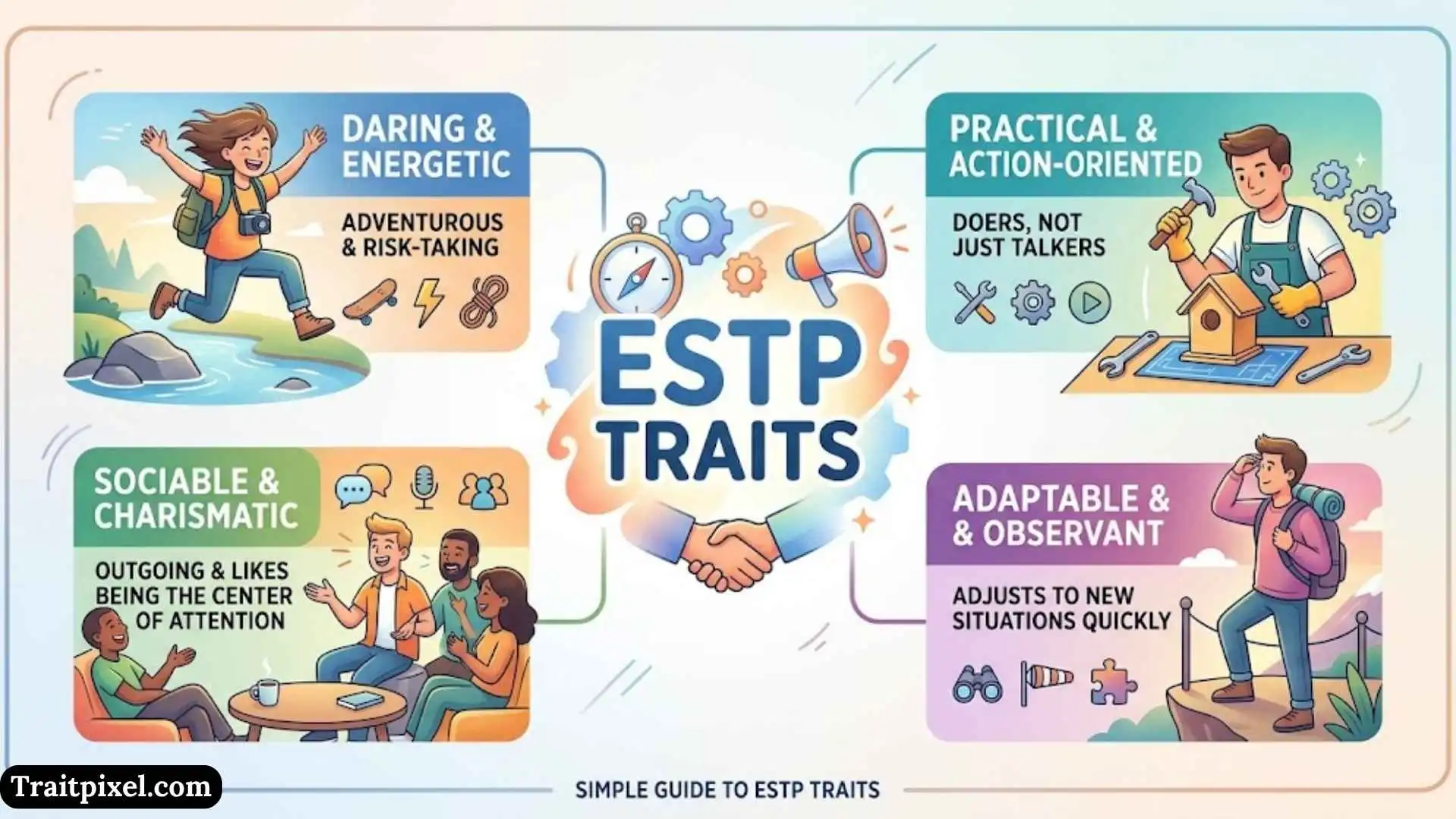
ESTP traits describe the energetic, practical, action-oriented qualities associated with the ESTP personality type in the Myers-Briggs Type Indicator (MBTI) framework.
Often called the Entrepreneur or Persuader, an ESTP tends to enjoy new experiences, respond quickly to challenges, think on their feet, and interact confidently with others. ESTPs often prefer hands-on learning and real-world problem-solving over lengthy theories or rigid plans.
However, their behavior varies with experience, personal values, and circumstances. Understanding ESTP personality traits can help you recognize their strengths, manage their challenges, and build better relationships at work, school, and home.
ESTP Traits: Quick Answer
ESTPs are commonly described as outgoing, observant, logical, adaptable, spontaneous, persuasive, and action-oriented. In the MBTI framework, ESTP stands for Extraverted, Sensing, Thinking, and Perceiving. These four preferences describe how a person may direct their attention, take in information, make decisions, and approach daily life.
Typical ESTP characteristics include:
- Practical thinking: Focuses on facts, immediate problems, and workable solutions.
- Social confidence: Often enjoys interacting with people and responding in the moment.
- Adaptability: Adjusts quickly when plans change or unexpected problems arise.
- Risk tolerance: May feel comfortable trying unfamiliar activities or making quick decisions.
- Persuasiveness: Can use confidence, observation, and clear communication to influence others.
- Spontaneity: Prefers flexibility and freedom over overly detailed schedules.
- Direct communication: Often values honest, straightforward conversations.
- Action orientation: Prefers testing an idea in practice rather than discussing it endlessly.
These are tendencies described by a personality framework, not rules that apply to every person with an ESTP result. An ESTP can be thoughtful, cautious, sensitive, or highly organized, depending on the situation.
ESTP Personality Traits at a Glance
| Category | Common ESTP tendency |
| Personality type | Extraverted, Sensing, Thinking, Perceiving |
| Common nickname | Entrepreneur or Persuader |
| Main focus | Present circumstances and practical results |
| Information preference | Concrete facts and direct observation |
| Decision-making preference | Logic, evidence, and practical consequences |
| Lifestyle preference | Flexibility, spontaneity, and action |
| Social style | Engaging, confident, and responsive |
| Learning style | Hands-on practice and experimentation |
| Key strengths | Adaptability, resourcefulness, observation, and quick thinking |
| Potential challenges | Impatience, impulsiveness, and overlooking long-term consequences |
| Relationship style | Often playful, direct, and experience-oriented |
| Workplace preference | Active environments with autonomy and visible results |
The table summarizes common descriptions within the MBTI model. It should not be used to judge someone’s character, abilities, or suitability for a job without considering their actual behavior and skills.
What Does ESTP Mean?
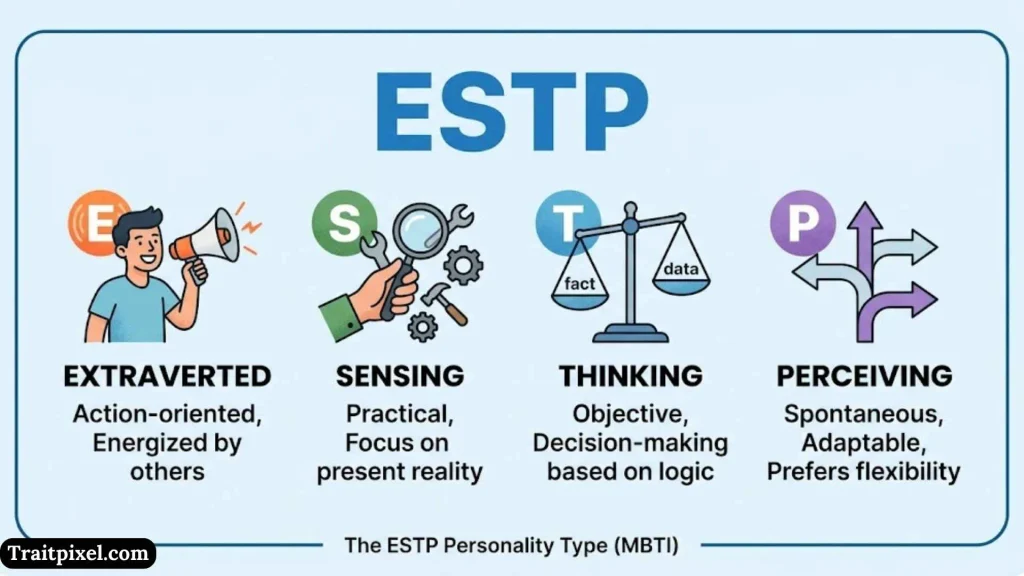
ESTP is one of the 16 personality types in the Myers-Briggs framework. Each letter represents a preference in one of four areas.
E
Extraversion
ESTPs are described as people who often engage with the outside world, interact with others, and respond actively to their surroundings.
S
Sensing
They tend to favor concrete information, observable facts, present experiences, and details they can verify directly.
T
Thinking
They tend to emphasize logic, consistency, and practical consequences when making decisions, although emotions and personal values still matter.
P
Perceiving
They tend to prefer keeping options open, adapting as new information appears, and responding flexibly instead of following a fixed plan.
Together, these preferences help explain why ESTPs are often portrayed as practical problem-solvers who enjoy active environments. For example, when a group project encounters an unexpected obstacle, an ESTP might quickly identify what is going wrong, test a solution, and adjust the plan as the team learns more.
The four letters do not mean that every ESTP is highly extroverted, ignores emotions, or dislikes planning. They describe preferences within a particular personality model rather than absolute abilities or fixed behaviors.
15 Core ESTP Personality Traits
ESTPs are often described as energetic, realistic, independent, and responsive to their surroundings. Their most recognizable traits involve how they gather information, make decisions, handle uncertainty, and interact with people.
These 15 characteristics explain how an ESTP personality may appear in everyday situations. Not every ESTP will display all of them equally.
1. Action-Oriented
ESTPs often prefer taking action to spending too much time discussing what might happen. They learn by trying things, observing results, and making adjustments.
For example, an ESTP organizing a community event might begin contacting vendors and assigning tasks instead of spending hours debating the perfect plan. This approach can create momentum, especially when a deadline is close.
Potential challenge: Acting too quickly can lead to missed details or avoidable mistakes. Pausing briefly to check important facts helps balance speed with good judgment.
2. Adaptable and Flexible
Adaptability is one of the most commonly associated ESTP traits. People with this preference may feel comfortable changing direction when circumstances shift.
Imagine a salesperson preparing for an important meeting. When the client raises an unexpected objection, the salesperson changes the presentation and addresses the concern directly rather than sticking rigidly to the original script.
This flexibility can be useful in customer service, emergency response, negotiations, and other situations where new information arrives quickly.
Potential challenge: Constantly changing direction can make long-term projects harder to complete. Flexibility works best when the main goal stays clear.
3. Observant
ESTPs are often described as attentive to concrete details, immediate circumstances, and visible changes in their surroundings.
They might notice that a customer seems confused by a product demonstration, that a teammate is struggling with a task, or that a familiar machine is making an unusual sound.
This attention to the present can support practical problem-solving because it helps a person respond to what is actually happening rather than relying entirely on assumptions.
Potential challenge: Focusing on immediate details can sometimes draw attention away from distant possibilities or underlying causes.
4. Confident
Many ESTP descriptions emphasize confidence when dealing with unfamiliar people, making decisions, or handling practical challenges.
An ESTP student might volunteer to demonstrate an experiment in front of the class. An ESTP employee might offer to speak with an unhappy customer because they feel comfortable handling the conversation.
However, confidence does not necessarily mean someone never feels anxious. It can simply mean they are willing to act despite uncertainty.
Potential challenge: Confidence becomes less helpful when someone assumes they cannot be wrong or dismisses useful feedback.
5. Sociable and Engaging
ESTPs often enjoy active interaction and may feel energized by conversations, group activities, and shared experiences.
They might introduce themselves to new colleagues, keep a group discussion moving, or use humor to make an unfamiliar environment feel more comfortable.
Their social confidence can help them build connections quickly, especially in settings that reward responsiveness and communication.
Potential challenge: A strong focus on interaction can sometimes leave quieter people feeling overlooked. Asking questions and giving others time to speak creates more balanced conversations.
6. Practical
Practical thinking means focusing on what can be done with the information, tools, and resources available.
When a household appliance stops working, an ESTP might check the power supply, inspect the obvious connections, and test simple solutions before considering more complicated explanations.
This preference can be valuable in technical work, operations, entrepreneurship, and hands-on learning.
Potential challenge: An immediate solution may fix today’s problem without addressing the cause. Considering the longer-term consequences helps prevent recurring issues.
7. Logical and Analytical
The Thinking preference suggests a tendency to emphasize consistency, evidence, and practical consequences when making decisions.
For example, an ESTP team leader deciding between two suppliers might compare price, reliability, delivery time, and product quality instead of choosing based only on personal preference.
This does not mean ESTPs lack empathy. They can care deeply about other people while still wanting decisions to make practical sense.
Potential challenge: A logically sound decision may still hurt someone’s feelings if it is communicated without tact. Good judgment considers both the decision and its human impact.
8. Spontaneous
ESTPs often appreciate freedom to respond to opportunities as they arise.
A spontaneous ESTP might suggest a weekend road trip, try a new sport, or change a dinner plan after discovering an interesting restaurant.
Spontaneity can make life exciting and help people remain open to unexpected opportunities.
Potential challenge: Last-minute decisions can affect budgets, schedules, and other people’s commitments. Checking practical constraints before making plans helps preserve spontaneity without creating unnecessary stress.
9. Resourceful
Resourcefulness involves finding workable solutions with the resources already available.
Suppose a presentation loses its internet connection moments before it begins. A resourceful ESTP might switch to downloaded slides, use printed notes, or demonstrate the product directly.
Rather than treating every obstacle as a reason to stop, they may look for another route toward the same outcome.
Potential challenge: Improvisation is not always a substitute for preparation. High-stakes tasks still need reliable backup plans.
10. Persuasive
ESTPs may be comfortable presenting ideas, negotiating, reading reactions, and responding to objections in real time.
For instance, a small-business owner might explain a product’s benefits, notice a customer’s hesitation, and adapt the explanation to address the customer’s specific needs.
This can make persuasive communication a useful strength in sales, leadership, and negotiation.
Potential challenge: Persuasion becomes counterproductive when it turns into pressure. Listening carefully and respecting another person’s decision are essential parts of ethical influence.
11. Competitive
Some ESTPs enjoy challenges that provide clear goals, immediate feedback, or measurable results.
They may enjoy sports, sales targets, timed tasks, strategic games, or opportunities to improve their performance.
Competition can motivate effort and encourage quick learning when a person treats mistakes as useful feedback.
Potential challenge: An excessive focus on winning can damage relationships or make ordinary disagreements feel like contests.
12. Independent
ESTPs often value having room to make decisions and solve problems in their own way.
An independent ESTP employee might prefer being given a clear objective and the freedom to decide how to reach it rather than receiving instructions for every step.
This can encourage initiative and ownership.
Potential challenge: Independence does not eliminate the need for coordination. Communicating progress and asking for support can make individual effort more effective.
13. Direct and Straightforward
ESTPs are often associated with clear, immediate communication. They may prefer saying what they mean instead of relying on hints or indirect messages.
For example, a colleague might say, “The report needs stronger evidence in the second section,” rather than offering vague criticism that leaves the writer guessing.
Direct feedback can save time and clarify expectations.
Potential challenge: Honesty without consideration can sound harsh. A useful approach is to state the problem clearly while explaining how to improve it.
14. Present-Focused
ESTPs are commonly described as paying close attention to what is happening now.
They may enjoy live events, practical activities, conversations, physical challenges, and situations where their choices produce immediate results.
This present-focused tendency can help them react quickly when circumstances change.
Potential challenge: Immediate rewards can become more attractive than long-term benefits. Saving money, maintaining routines, and preparing for future responsibilities may require deliberate effort.
15. Adventurous and Open to Experience
ESTPs may enjoy exploring unfamiliar environments, learning new skills, testing ideas, or taking on challenges that involve uncertainty.
One person might try rock climbing, while another experiments with a new business idea or volunteers for an unfamiliar assignment.
Adventure does not have to involve extreme sports or dangerous behavior. It can simply mean being willing to step beyond familiar routines.
Potential challenge: Novelty can sometimes overshadow consistency. Choosing adventures that fit personal responsibilities and risk limits helps keep exploration constructive.
Positive ESTP Traits: Strengths That Make a Difference
The strongest ESTP qualities often appear when a situation requires fast thinking, direct communication, and practical action. These strengths can help ESTPs contribute meaningfully to teams, relationships, and everyday problem-solving.
| ESTP strength | How it helps | Example |
| Quick thinking | Supports rapid responses to changing situations | Finding an alternative when a delivery fails |
| Adaptability | Makes it easier to handle unexpected changes | Revising a work plan after new information arrives |
| Practical judgment | Focuses attention on workable solutions | Testing a simple fix before replacing equipment |
| Social confidence | Helps initiate conversations and build connections | Welcoming a new colleague |
| Resourcefulness | Encourages creative use of available tools | Finding a low-cost way to complete a project |
| Persuasiveness | Helps explain ideas and negotiate agreements | Addressing a customer’s concerns |
| Courage to act | Reduces hesitation when action is needed | Volunteering to lead a demonstration |
| Real-time observation | Helps identify immediate problems | Noticing confusion during a presentation |
| Flexibility | Keeps options open when circumstances change | Adjusting a travel itinerary after a delay |
| Resilience in action | Encourages trying another approach after a setback | Revising a failed sales pitch |
Why these strengths matter
ESTP strengths are particularly useful when a situation rewards responsiveness rather than extensive advance planning. For example, a busy event coordinator may need to rearrange seating, redirect staff, and resolve a guest’s complaint within minutes.
A person who can observe the situation, communicate clearly, and make sensible adjustments may handle that pressure effectively.
However, personality preferences alone do not guarantee success. Experience, technical knowledge, emotional maturity, and sound judgment also influence performance. An adaptable person still needs the skills required for the task.
Negative ESTP Traits: Common Weaknesses and Challenges
The same tendencies that make ESTPs effective in some situations can cause problems when taken too far. Their potential weaknesses are not inevitable flaws. They are patterns worth recognizing and managing.
1. Impulsiveness
A preference for action can sometimes lead to decisions made before all the important facts are available.
An ESTP might purchase an expensive item because it looks appealing or accept a commitment without checking their schedule.
How to improve: Use a short pause before decisions involving money, safety, or major commitments. Ask, “What could go wrong, and what information am I missing?”
2. Impatience
ESTPs may become frustrated when progress feels slow, discussions seem repetitive, or people spend too long considering options.
For example, an ESTP working on a group assignment may want to start immediately while other members are still comparing approaches.
How to improve: Agree on a reasonable decision deadline. Give important discussions enough time to uncover risks without allowing them to continue indefinitely.
3. Difficulty With Long-Term Planning
Planning far ahead can feel less engaging than solving an immediate problem. This may lead to rushed preparation or missed deadlines.
A student might understand the material well but delay studying until the night before an exam.
How to improve: Break long-term goals into short tasks with specific deadlines. A visible checklist can make future responsibilities feel more concrete.
4. Avoiding Routine
Repeated administrative tasks may feel less stimulating than activities that involve variety, people, or problem-solving.
An ESTP business owner might enjoy meeting customers but postpone invoices, inventory records, or expense tracking.
How to improve: Schedule routine work in short blocks, automate repetitive tasks where possible, and connect each task to a practical result.
5. Blunt Communication
Being straightforward can be useful, but overly direct feedback may leave others feeling criticized or dismissed.
For example, saying “That idea makes no sense” can end a discussion without explaining what needs to change.
How to improve: Describe the specific concern and suggest a solution. “I think the cost is too high for our budget. Could we compare two cheaper options?” communicates the same issue more constructively.
6. Underestimating Risk
Confidence and comfort with uncertainty can sometimes encourage unnecessary risks.
An ESTP might agree to a physically demanding activity without checking safety requirements or launch a business idea without estimating its costs.
How to improve: Separate calculated risks from avoidable risks. Consider the possible consequences, the likelihood of failure, and whether you can afford the loss.
7. Discomfort With Abstract Discussions
An ESTP may prefer concrete examples and practical outcomes over conversations that remain theoretical for a long time.
For instance, someone discussing a broad strategy might hear, “Let’s test one approach and see what happens.”
That response can be useful, but some problems require careful analysis before experimentation.
How to improve: Ask how a theory applies to the real situation. Then consider whether testing it is safe, ethical, and practical.
8. Overlooking Emotional Signals
A person who focuses heavily on facts and solutions may not always recognize when someone needs emotional support first.
If a friend shares a disappointment, an ESTP might immediately suggest three ways to fix the problem.
The friend may actually want to feel heard before discussing solutions.
How to improve: Ask, “Do you want advice, or would you rather talk about what happened?” This small question can prevent many misunderstandings.
9. Seeking Stimulation
ESTPs may be drawn to novelty, excitement, and fast-moving environments. When everyday life becomes repetitive, they may seek new activities or distractions.
This tendency can interfere with steady progress if every interesting opportunity takes priority over an existing commitment.
How to improve: Build variety into important routines. For example, rotate workout activities or set milestones for a long project so progress feels more engaging.
10. Resisting Excessive Control
ESTPs may dislike being micromanaged or forced to follow procedures that seem unnecessary.
A manager who specifies every minor action may frustrate an employee who prefers autonomy.
How to improve: Explain which rules are essential, ask for flexibility where appropriate, and agree on measurable results. Independence works best when combined with accountability.
How ESTP Traits Affect Different Areas of Life
ESTP characteristics do not appear in isolation. Their effect depends on the environment, the expectations of other people, and the individual’s level of experience.
ESTP Traits in Everyday Life
In daily life, ESTPs may prefer practical activities, spontaneous plans, and direct solutions to immediate problems.
They might organize a last-minute outing, troubleshoot a household issue, or help a neighbor move furniture without spending much time discussing the task.
Their willingness to act can make them useful when something needs to get done. However, daily responsibilities also include less exciting tasks, such as budgeting, scheduling appointments, and keeping commitments.
A practical balance is to leave room for spontaneity while maintaining a few dependable routines.
ESTP Traits at School and College
ESTP students may enjoy classes that involve experiments, demonstrations, group activities, practical assignments, or real-world problem-solving.
For example, a student studying business might understand pricing more easily by running a small mock shop than by reading several abstract examples.
They may also contribute energy to group projects and respond well to immediate feedback.
Potential challenges include:
- Putting off assignments that seem repetitive.
- Losing interest in lengthy lectures without practical examples.
- Rushing through written work.
- Underestimating how much preparation an exam requires.
Study strategy: Use short study sessions, practice questions, demonstrations, and real-world examples. Break major assignments into smaller deadlines and leave time to review work before submission.
These are possible preferences, not limits on academic ability. ESTPs can succeed in theoretical subjects when they find effective ways to engage with the material.
ESTP Traits at Work
ESTPs may enjoy work that involves people, practical decisions, changing conditions, and visible results. They often appreciate roles where they can take initiative rather than wait for constant instructions.
They may contribute by resolving customer concerns, negotiating agreements, identifying operational problems, or adapting when a project changes direction.
However, professional success also requires skills that personality descriptions cannot measure, including technical competence, reliability, teamwork, and industry knowledge.
A useful approach for an ESTP employee is to combine quick execution with clear documentation. After solving an immediate problem, record what happened, what worked, and what should be done differently next time.
ESTP Traits in Leadership
An ESTP leader may be energetic, responsive, and willing to make decisions when a team faces uncertainty.
For example, if an event loses its scheduled venue, the leader might quickly contact alternatives, assign team members to specific tasks, and keep stakeholders informed.
This action-oriented style can help a team regain momentum.
The risk is that quick decisions can leave team members feeling excluded or create confusion when the leader changes direction without explaining why.
Strong leadership combines initiative with listening, clear expectations, and follow-through. An ESTP leader can preserve flexibility while explaining the team’s priorities and inviting feedback before major decisions.
ESTP Traits in Business and Entrepreneurship
The Entrepreneur nickname reflects the image of an ESTP as someone who enjoys action, opportunity, negotiation, and practical experimentation. It does not mean every ESTP is destined to start a company.
An ESTP entrepreneur might enjoy talking with customers, testing a product, negotiating with suppliers, or changing a sales approach based on customer reactions.
Those activities can help a business respond to market needs. Yet a successful business also depends on financial planning, compliance, operations, customer retention, and consistent execution.
A practical system is to pair each new opportunity with three questions:
- What problem does this opportunity solve?
- What will it cost in money, time, and effort?
- How will I measure whether it is working?
This preserves an entrepreneurial willingness to experiment while reducing avoidable mistakes.
ESTP Traits in Friendships

ESTPs may express friendship through shared activities, humor, direct conversations, and practical help.
An ESTP friend might suggest a spontaneous outing, help someone move into a new apartment, or encourage a friend to try an activity they have been avoiding.
These actions can make friendships lively and supportive.
Still, not every friend wants advice or an activity when they are struggling. Sometimes the best response is to listen without trying to fix anything immediately.
Reliability matters, too. Following through on plans helps show that a friendship is more than entertainment and spontaneous gestures.
ESTP Traits in Romantic Relationships
In romantic relationships, an ESTP may enjoy shared experiences, playful conversation, physical affection, and a partner who communicates openly.
They might plan an unexpected date, suggest learning a new skill together, or show care by helping their partner solve a practical problem.
However, people differ widely in how they express affection. An ESTP label does not determine someone’s emotional depth, commitment, or relationship needs.
Potential areas of tension include:
- One partner wanting more advance planning.
- Different preferences for social activity and quiet time.
- A mismatch between problem-solving and emotional support.
- Difficulty discussing long-term expectations.
- One partner interpreting direct feedback as criticism.
Relationship tip: Talk openly about commitment, personal space, finances, future plans, and emotional needs. Ask your partner what support looks like to them rather than assuming that your preferred way of showing care will meet every need.
ESTP Traits in Family Life
Within a family, an ESTP may be the person who organizes an activity, handles an unexpected practical problem, or encourages everyone to get involved.
They may also value independence and prefer solving certain problems without excessive interference.
Family relationships can become strained if spontaneous decisions affect shared responsibilities or if practical advice replaces emotional understanding.
A helpful approach is to agree on shared commitments in advance while leaving room for flexible family activities.
ESTP Traits Under Stress
Stress can change how anyone behaves. An ESTP who usually seems confident and adaptable may become impatient, unusually withdrawn, defensive, or preoccupied with problems when overwhelmed.
Within some MBTI interpretations, ESTPs under significant stress may become more focused on negative future possibilities or consequences they normally overlook. This is a framework-based interpretation, not a clinical diagnosis or a universal pattern.
Common stressors may include excessive micromanagement, repetitive work, prolonged uncertainty, unresolved conflict, or too many competing commitments.
Helpful strategies include:
- Take a short break before responding to a frustrating situation.
- Identify the one problem that needs attention first.
- Separate facts from assumptions about what might happen.
- Discuss concerns with someone you trust.
- Make a realistic plan for the next step rather than trying to solve everything at once.
If stress becomes persistent or seriously affects daily life, consider support from a qualified mental health professional rather than relying on a personality label to explain it.
ESTP Cognitive Functions: How This Personality Type Thinks
The MBTI framework also describes personality types through cognitive functions. These functions offer another way to understand the preferences associated with ESTP behavior.
In the traditional function model, ESTPs are associated with four functions: Extraverted Sensing, Introverted Thinking, Extraverted Feeling, and Introverted Intuition.
| Cognitive function | Role in the model | How it may appear in an ESTP |
| Extraverted Sensing (Se) | Notices and responds to the external environment | Quickly observes changes and reacts to immediate opportunities |
| Introverted Thinking (Ti) | Analyzes information internally | Examines how something works and looks for logical explanations |
| Extraverted Feeling (Fe) | Responds to social expectations and interpersonal dynamics | Adjusts communication based on other people’s reactions |
| Introverted Intuition (Ni) | Looks for underlying patterns and future implications | Considers possible outcomes, sometimes with less confidence under stress |
Dominant function: Extraverted Sensing
Extraverted Sensing is considered the dominant function for ESTPs in this model. It emphasizes awareness of the immediate environment and responsiveness to concrete information.
An ESTP might notice a change in a customer’s tone, spot a practical opportunity, or respond quickly when a plan goes wrong.
Auxiliary function: Introverted Thinking
Introverted Thinking is described as supporting the ESTP’s ability to analyze information and make sense of how things work.
For example, an ESTP mechanic might notice a problem while inspecting an engine and then work through possible causes before making a repair.
Tertiary function: Extraverted Feeling
Extraverted Feeling relates to awareness of social expectations, interpersonal harmony, and other people’s responses.
It helps explain why an ESTP can be both direct and socially engaging. The way this function develops varies from person to person.
Inferior function: Introverted Intuition
Introverted Intuition is traditionally considered the least preferred function in the ESTP model. It involves interpreting patterns and considering broader future possibilities.
An ESTP may be more comfortable responding to immediate evidence than exploring distant hypothetical outcomes. With experience, however, they can develop stronger long-term planning and pattern recognition.
Important distinction: Cognitive functions are part of a theoretical interpretation of MBTI personality types. They should not be treated as separate brain systems, clinical findings, or scientifically established explanations for every behavior.
ESTP vs. Other Personality Types
ESTPs are often confused with other personality types because several types share their sociability, practicality, or flexibility. Comparing the underlying preferences can help clarify the differences.
ESTP vs. ESFP
ESTPs and ESFPs share Extraversion, Sensing, and Perceiving. Both may enjoy active experiences, adapt to changing circumstances, and engage readily with others.
The main distinction in the MBTI framework is the Thinking–Feeling preference.
| Feature | ESTP | ESFP |
| Decision preference | Logic, consistency, practical consequences | Personal values and human impact |
| Typical focus | What works and what makes sense | What feels meaningful and how people are affected |
| Problem-solving | May prioritize efficient solutions | May prioritize solutions that respect individual needs |
| Social approach | Often direct and pragmatic | Often expressive and personally responsive |
An ESTP and an ESFP can both care about people and make logical decisions. The difference concerns their preferred approach, not whether one type has more empathy or intelligence.
ESTP vs. ENTP
ESTPs and ENTPs are both often described as energetic, adaptable, and comfortable exploring possibilities. Their main difference is the Sensing–Intuition preference.
| Feature | ESTP | ENTP |
| Information preference | Concrete facts and immediate observations | Patterns, possibilities, and conceptual connections |
| Typical approach | Test a practical solution | Explore alternative explanations and ideas |
| Learning preference | Hands-on experimentation | Conceptual exploration and intellectual debate |
| Potential blind spot | Overlooking broader possibilities | Overlooking practical details |
For example, when considering a new business idea, an ESTP might test a small version of the product with customers. An ENTP might first explore several business models and imagine different ways the idea could develop.
Both approaches can be useful, and either type can combine practical experimentation with abstract thinking.
ESTP vs. ISTP
ESTPs and ISTPs share Sensing, Thinking, and Perceiving. Both are often described as practical, analytical, and responsive to real-world problems.
Their main distinction is Extraversion versus Introversion.
| Feature | ESTP | ISTP |
| Preferred engagement | Often interacts actively with the outside world | Often prefers more independent engagement |
| Problem-solving style | May think aloud and involve others | May prefer analyzing a problem privately first |
| Social energy | Often seeks active interaction | Often values quiet time and autonomy |
| Shared tendencies | Practical thinking, flexibility, and troubleshooting | Practical thinking, flexibility, and troubleshooting |
An ESTP mechanic might discuss a problem with colleagues while testing possible solutions. An ISTP mechanic might prefer inspecting the equipment independently before sharing a conclusion.
These are illustrative tendencies rather than rules about how either type must behave.
ESTP vs. ENTJ
ESTPs and ENTJs can both appear confident, decisive, and comfortable taking charge. However, the MBTI framework describes different preferences in how they approach information and structure.
| Feature | ESTP | ENTJ |
| Main emphasis | Immediate circumstances and practical action | Long-term direction and organized execution |
| Approach to change | Adjusts in response to current conditions | May organize changes around broader objectives |
| Planning preference | Often favors flexibility | Often favors structure and defined goals |
| Decision style | Pragmatic and responsive | Strategic and results-oriented |
An ESTP might adapt a sales strategy during a customer meeting. An ENTJ might focus on creating a long-term sales system with targets, processes, and performance reviews.
Neither style is inherently better. Effective performance depends on the demands of the situation.
Real-Life Examples of ESTP Traits
The following scenarios show how ESTP-associated preferences might appear in different settings. They are illustrative examples, not verified case studies or claims that all ESTPs behave the same way.
1. At a restaurant: A customer receives the wrong meal. An ESTP server quickly apologizes, contacts the kitchen, and offers a practical solution.
2. During a road trip: A road closes unexpectedly. An ESTP traveler checks the available routes and chooses a workable alternative instead of abandoning the trip.
3. In a classroom: A science experiment produces an unexpected result. An ESTP student checks the equipment and repeats the test to see what happened.
4. At work: A colleague struggles with a software tool. An ESTP employee demonstrates a practical shortcut rather than giving a lengthy theoretical explanation.
5. In sales: A customer hesitates over a purchase. An ESTP salesperson asks what concerns them and adapts the presentation to address those concerns.
6. In sports: A team falls behind during a game. An ESTP player responds energetically, communicates with teammates, and looks for an immediate opportunity to recover.
7. In a friendship: A friend feels bored and wants to get out of the house. An ESTP friend suggests an activity and helps make the plan happen.
8. During a family emergency: A pipe begins leaking. An ESTP family member locates the shutoff valve, limits the immediate damage, and arranges a repair.
9. In entrepreneurship: A small shop experiences a drop in customer visits. An ESTP owner tests a new promotion and observes whether customers respond.
10. In a group project: Two teammates disagree about how to proceed. An ESTP member suggests trying a small version of each approach and comparing the results.
11. During a presentation: The projector stops working. An ESTP presenter switches to verbal explanations and uses available notes to continue.
12. In a relationship: A partner is disappointed about a difficult day. An ESTP may initially suggest practical solutions, then learn to ask whether the partner wants advice or simply wants to be heard.
13. While shopping: A product is unavailable. An ESTP shopper compares the available alternatives and chooses one that meets the same practical need.
14. At a community event: Attendance suddenly increases. An ESTP volunteer rearranges the queue and redirects people to prevent confusion.
15. While learning a skill: A person wants to learn photography. An ESTP learner may start taking pictures immediately, reviewing the results and adjusting settings as they go.
16. Managing personal finances: An unexpected expense appears. An ESTP may quickly identify which discretionary purchases can be reduced, although a regular budget helps prevent repeated surprises.
17. Handling feedback: A manager points out a mistake. A developing ESTP employee may learn to focus on the specific correction instead of reacting defensively.
18. Planning a vacation: A preferred activity is canceled. An ESTP traveler finds another attraction nearby and makes the most of the remaining time.
These examples highlight an important principle: the same preference can produce different outcomes depending on how a person uses it. Quick action can solve a problem efficiently, but it works best when paired with sound judgment, consideration for others, and appropriate planning.
Common Misconceptions About ESTP Traits
Online personality descriptions sometimes turn broad tendencies into absolute claims. The following distinctions offer a more balanced understanding.
| Myth | Reality |
| ESTPs are always extroverted and talkative. | They may prefer external engagement but can still enjoy quiet time or feel socially tired. |
| ESTPs do not have deep emotions. | A preference for logical decision-making does not mean someone lacks feelings or empathy. |
| ESTPs are naturally reckless. | Risk tolerance varies, and practical thinking can support careful risk assessment. |
| ESTPs cannot plan for the future. | They may prefer flexibility, but they can develop strong planning habits. |
| ESTPs dislike all theory. | Practical examples may appeal to them, but they can understand and enjoy abstract ideas. |
| ESTPs are always natural leaders. | Leadership depends on skills, experience, communication, judgment, and context. |
| ESTPs are born entrepreneurs. | The nickname reflects a type description, not a prediction of career choice or business success. |
| ESTPs are bad at relationships. | Relationship quality depends on communication, compatibility, emotional awareness, and effort. |
| ESTPs are always confident. | Confidence can vary with experience, stress, and the situation. |
| Every ESTP behaves the same way. | Individual personality, culture, upbringing, values, and life experience create important differences. |
Are ESTPs emotionally intelligent?
An ESTP personality preference does not establish a person’s emotional intelligence. Some ESTPs may quickly recognize social cues and respond effectively, while others may need to practice listening, empathy, and emotional communication.
Emotional intelligence involves recognizing emotions, understanding their effects, and responding appropriately. These abilities can be developed regardless of personality type.
Are ESTPs impulsive by nature?
ESTPs are often described as action-oriented, but action orientation and impulsiveness are not identical.
Taking quick action after assessing a situation can be effective. Acting without considering consequences can be harmful. The important distinction is whether a person responds rapidly with adequate judgment or simply reacts without thinking.
Can an ESTP be introverted sometimes?
Yes. The E in ESTP represents a preference in the MBTI framework, not a requirement to be outgoing in every setting.
Someone who identifies as an ESTP may enjoy social activities but still need privacy, prefer one-on-one conversations, or behave quietly in unfamiliar environments.
How to Develop ESTP Strengths and Improve Weaknesses
ESTP traits can become more useful when a person deliberately balances immediate action with reflection and follow-through.
The goal is not to change an entire personality. It is to develop habits that make strengths more dependable.
1. Use a pause-before-action rule
Before making an important decision, take a moment to identify the goal, the available evidence, and the possible consequences.
For low-risk choices, a quick decision may be enough. For major purchases, safety issues, or career changes, a more careful review is appropriate.
2. Make long-term goals concrete
If a distant goal feels difficult to engage with, turn it into visible, manageable actions.
For example, rather than setting a vague goal to improve fitness, schedule three workouts this week and record each completed session.
Specific actions make progress easier to observe.
3. Practice active listening
When someone raises a concern, listen to the entire explanation before offering a solution.
A useful sequence is:
- Let the person finish speaking.
- Summarize the main concern.
- Ask whether you understood correctly.
- Find out whether they want advice, practical help, or emotional support.
This approach improves communication without requiring you to abandon a direct style.
4. Build a simple planning system
You do not need an elaborate planner to become more organized. A calendar, short task list, and weekly review may be enough.
Record important deadlines, recurring responsibilities, and commitments involving other people. Review the list regularly so spontaneous opportunities do not repeatedly displace essential tasks.
5. Improve follow-through
Starting a project is only one part of completing it.
Before moving to something new, identify the next concrete step, set a deadline, and decide how you will know the task is finished.
If a project no longer makes sense, make a deliberate decision to change direction rather than leaving it unfinished without explanation.
6. Learn from mistakes without overreacting
When an action produces a poor result, review what happened.
Ask yourself:
- What did I expect to happen?
- What actually happened?
- Which information did I overlook?
- What will I change next time?
This turns experience into useful learning rather than simply moving on to the next activity.
7. Match your approach to the situation
Different situations require different responses.
| Situation | Useful approach |
| A minor problem needs an immediate fix | Act quickly and review the result |
| A major financial decision is involved | Compare options, costs, and risks |
| Someone is upset | Listen before offering solutions |
| A project has a distant deadline | Break it into smaller milestones |
| A team needs direction | Set clear priorities and invite relevant input |
| An unfamiliar risk appears | Gather essential information before committing |
The most effective response is not always the fastest one. Knowing when to act, when to pause, and when to ask for help is a valuable skill for any personality type.
Are ESTP Traits Scientifically Proven?

ESTP traits come from the Myers-Briggs Type Indicator framework, which organizes personality preferences into 16 types. The framework can provide a useful vocabulary for discussing differences, but its descriptions should not be confused with a complete scientific account of personality.
The American Psychological Association explains that psychological assessments need to be evaluated for reliability, validity, and appropriate use. Personality measures also differ in the strength of their evidence and the purposes for which they are suitable.
The MBTI’s official research materials describe evidence supporting its assessment instruments. At the same time, personality researchers have raised questions about dividing continuous personality differences into distinct categories and about how well type profiles predict specific outcomes.
A balanced interpretation includes three points:
- Useful for reflection: ESTP descriptions may help people identify preferred ways of working, communicating, and approaching decisions.
- Limited as a prediction tool: An ESTP result cannot reliably establish someone’s future success, relationship compatibility, intelligence, or suitability for a particular career.
- Not a clinical diagnosis: ESTP is not a mental health condition and should not be used to diagnose personality disorders or other psychological conditions.
If you want to understand personality from a broader research perspective, the Big Five model is another important framework. It describes personality through five broad dimensions: openness to experience, conscientiousness, extraversion, agreeableness, and neuroticism. Unlike the MBTI’s four-letter categories, the Big Five generally represents traits along continuous scales.
Neither framework captures every aspect of a person. A useful personality assessment should support reflection, not replace direct evidence about someone’s behavior, skills, values, and circumstances.
Related Personality Traits and Concepts
Understanding related concepts can make ESTP descriptions easier to interpret.
- Extraversion: A broad personality dimension involving social engagement, assertiveness, and activity. It is related to the E preference but is not identical to the MBTI category.
- Practical intelligence: The ability to apply knowledge and judgment to real-world situations. It is not exclusive to ESTPs.
- Adaptability: The ability to adjust to changing circumstances, expectations, or information.
- Assertiveness: Expressing opinions, needs, and boundaries clearly. Healthy assertiveness differs from aggression.
- Impulsivity: Acting with limited consideration of consequences. This should not be assumed from an ESTP label alone.
- Emotional intelligence: Recognizing, understanding, and responding to emotions.
- Risk tolerance: A person’s willingness to accept uncertainty or possible loss in pursuit of an outcome.
- The Big Five personality model: A widely researched framework for describing individual differences across five broad personality dimensions.
- Cognitive functions: A theoretical MBTI-related model that describes how different personality types may process information and make decisions.
These concepts overlap in everyday descriptions, but they are not interchangeable. For example, an adaptable person is not necessarily impulsive, and an assertive person is not necessarily extroverted.
Frequently Asked Questions About ESTP Traits
What are the main ESTP traits?
The most commonly associated ESTP traits include practicality, adaptability, social confidence, directness, resourcefulness, spontaneity, and quick decision-making. Potential challenges include impatience, impulsiveness, and difficulty maintaining interest in repetitive tasks. These tendencies vary from person to person.
What are the strengths of an ESTP personality?
Commonly described ESTP strengths include quick thinking, observation, practical problem-solving, flexibility, persuasion, and responsiveness to changing situations. These qualities can be useful in active workplaces, negotiations, hands-on learning, and everyday problem-solving.
What are the weaknesses of ESTPs?
Potential ESTP weaknesses include acting too quickly, overlooking long-term consequences, becoming impatient with slow processes, and communicating too bluntly. These are possible tendencies, not inevitable flaws. Planning systems, active listening, and deliberate decision-making can help address them.
Are ESTPs rare?
The answer depends on the population, assessment, and source used. Personality-type frequency estimates should not be treated as universal facts because results can vary across samples and assessment methods. A type label also does not determine an individual’s uniqueness or value.
Are ESTPs good leaders?
ESTPs may bring decisiveness, practical judgment, confidence, and adaptability to leadership roles. These qualities can help during fast-moving situations. Effective leadership also requires listening, planning, accountability, and the ability to consider the needs of a team.
What careers suit ESTPs?
ESTPs may enjoy careers that involve active problem-solving, customer interaction, negotiation, practical tasks, or changing circumstances. Potential options include sales, business development, emergency response, hospitality, operations, skilled trades, and certain entrepreneurial roles.
These are possibilities rather than scientifically guaranteed career matches. Interests, qualifications, abilities, working conditions, and personal values should guide career decisions more than a four-letter personality result.
How do ESTPs behave in relationships?
ESTPs may show affection through shared experiences, practical support, humor, and direct communication. They may appreciate partners who communicate openly and allow room for independence. Healthy relationships still require emotional understanding, commitment, and respect for each partner’s needs.
Do ESTPs fall in love easily?
An ESTP label cannot determine how quickly someone develops romantic feelings. Some people form connections quickly, while others need time and trust. Attraction, attachment, personal values, and relationship experience all influence how love develops.
How do ESTPs handle conflict?
An ESTP may prefer addressing a disagreement directly and looking for a practical resolution. This can help resolve problems efficiently, but rushing to a solution may leave emotional concerns unaddressed. Listening first and clarifying the issue can lead to a better outcome.
Can ESTPs be introverted or shy?
Yes. An ESTP result does not mean someone is outgoing in every situation. A person may prefer external engagement overall while feeling shy with unfamiliar people, needing time alone, or avoiding certain social settings.
Are ESTPs good at school?
ESTPs can succeed academically across many subjects. Hands-on activities and practical examples may be engaging for some, but academic performance also depends on preparation, motivation, teaching methods, available resources, and subject-specific skills.
How can an ESTP improve emotional intelligence?
An ESTP can practice listening without interrupting, identifying emotional cues, asking clarifying questions, and considering how words may affect others. Pausing before giving advice and asking what kind of support someone needs are useful starting points.
What is the difference between ESTP and ESFP?
Both types share Extraversion, Sensing, and Perceiving. The main difference is the Thinking–Feeling preference: ESTPs are described as tending toward logic and practical consequences, while ESFPs are described as tending toward personal values and interpersonal impact. Both types can be logical and empathetic.
What is the difference between ESTP and ISTP?
The main distinction is Extraversion versus Introversion. ESTPs are generally described as more oriented toward active engagement with the external environment, while ISTPs are generally described as more inclined toward independent analysis. Both types share Sensing, Thinking, and Perceiving preferences.
Can ESTP traits change over time?
A person’s preferences, habits, and behavior can change with experience, environment, responsibilities, and deliberate effort. Someone who identifies as an ESTP may develop stronger planning, emotional awareness, or patience without needing to abandon their natural strengths.
Is ESTP a mental health diagnosis?
No. ESTP is a personality type within the MBTI framework, not a psychiatric diagnosis. It cannot determine whether someone has a mental health condition, and personality-type descriptions should not replace a qualified professional’s assessment when clinical concerns arise.
Key Takeaways About ESTP Traits
- ESTP stands for Extraverted, Sensing, Thinking, and Perceiving.
- ESTPs are commonly described as practical, observant, adaptable, energetic, and action-oriented.
- Their potential strengths include resourcefulness, quick thinking, social confidence, and practical problem-solving.
- Common challenges may include impulsiveness, impatience, blunt communication, and overlooking long-term plans.
- ESTP tendencies can appear differently in friendships, romantic relationships, school, business, and leadership.
- ESTPs can develop stronger planning, emotional communication, and follow-through through practice.
- MBTI descriptions can support self-reflection, but they do not define a person’s entire personality or predict their future.
- Real behavior, personal values, skills, and circumstances matter more than a personality label when making important decisions.
Conclusion
ESTP traits are commonly associated with practicality, adaptability, confidence, spontaneity, and a preference for taking action. These characteristics can help someone respond to unexpected challenges, connect with others, and find workable solutions in real-world situations.
However, understanding ESTP personality traits also means recognizing their potential challenges. Acting quickly can be useful, but thoughtful planning matters. Direct communication can save time, but empathy helps maintain trust. Independence can encourage initiative, but collaboration and accountability remain important.
The most useful way to apply the ESTP framework is to treat it as a starting point for self-awareness rather than a fixed description of who someone must be. By recognizing personal strengths, addressing recurring challenges, and remaining open to feedback, an individual can develop habits that support healthier relationships, better decisions, and more effective work.

I’m Elliot Kingsley, a British author interested in the subtle characteristics that influence how people think, communicate, and respond to the world. I write about personality traits, strengths, tendencies, and behavioural qualities in clear language. My goal is to encourage readers to understand individual differences and appreciate the complexity of human character.
Books:
- The Psychology of Personality Traits
- Character in Context