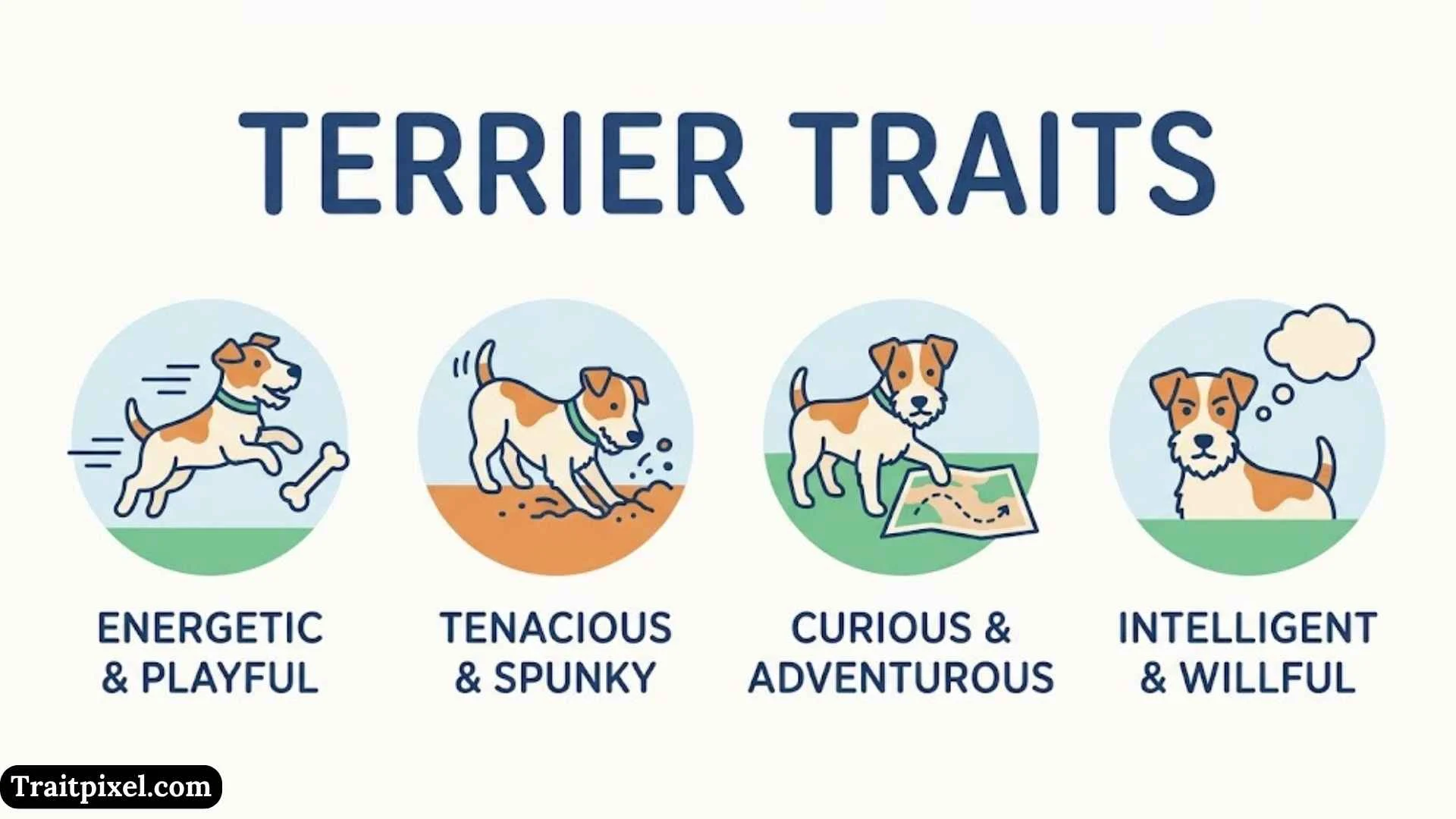
Terrier traits include confidence, energy, curiosity, determination, and a strong instinct to chase small animals. Originally bred for tasks such as hunting vermin and working underground, terriers often have bold personalities despite their relatively small size. However, not every terrier behaves the same way. Breed, genetics, socialization, training, and daily activity all influence an individual dog’s temperament.
Understanding terrier characteristics can help you choose the right dog, prevent unwanted behaviors, and build a stronger bond with your pet. Whether you’re considering a Jack Russell Terrier, a Yorkshire Terrier, a Border Terrier, or a larger breed such as an Airedale Terrier, knowing what makes these dogs different will help you meet their needs.
Quick Answer
What are the main terrier traits?
Terriers are generally energetic, alert, curious, independent, courageous, and determined dogs. Many have a strong prey drive, enjoy digging, and need regular exercise and mental stimulation. They can be affectionate and playful companions, but some may bark frequently, chase smaller animals, or challenge unfamiliar dogs. Their exact temperament depends on the breed, individual personality, upbringing, and environment.
Terrier Traits at a Glance
| Trait | Typical Characteristics | What It Means for Owners |
| Energy | Active and enthusiastic | Provide daily exercise and play |
| Intelligence | Quick to learn and investigate | Use varied, reward-based training |
| Independence | Often willing to act on their own | Build reliable recall and focus |
| Courage | Bold and confident | Supervise interactions and manage risks |
| Prey drive | May chase rodents, squirrels, or rabbits | Use secure fencing and a leash when needed |
| Curiosity | Interested in sights, sounds, and scents | Offer sniffing games and exploration |
| Determination | Persistent when pursuing a goal | Make training clear and consistent |
| Alertness | Often quick to notice unusual activity | Teach calm responses to noises and visitors |
| Affection | Many enjoy close relationships with their families | Provide attention and positive interaction |
| Vocal behavior | Some bark, whine, or make other sounds frequently | Reward quiet behavior and address triggers |
| Digging | Common in many terrier lines | Provide an approved digging area |
| Playfulness | Often enthusiastic and entertaining | Schedule interactive games and enrichment |
These are common tendencies, not guarantees. Terrier breeds and individual dogs can differ substantially.
What Makes Terriers Different From Other Dogs?

Terriers stand out because of their working-dog heritage. Many were developed to locate, pursue, and catch rodents or other small animals. Some worked above ground, while others entered burrows to flush out prey.
The word terrier comes from the Latin terra, meaning earth. This reflects the work of many early terriers, which hunted animals underground. Their original jobs help explain several behaviors owners still see today.
For example, a terrier that digs under a garden fence may be following an instinct rather than deliberately misbehaving. A dog that suddenly chases a squirrel may be responding to movement that triggers its prey drive.
These instincts don’t make terriers difficult by nature. They simply mean that successful ownership involves understanding what motivates the dog and providing suitable outlets for its energy.
The Main Personality Traits of Terriers
Terriers commonly combine confidence, curiosity, independence, and enthusiasm. These qualities make them entertaining companions, but they can also create challenges when their needs aren’t met.
High Energy and Enthusiasm
Many terriers are active dogs that enjoy movement, play, and exploration. They may be ready for another game shortly after a walk, especially if the outing offered little opportunity to sniff or investigate.
A short walk around the block might meet some physical needs, but it may not provide enough stimulation for a particularly energetic individual.
How this trait appears in everyday life:
- Running excitedly toward a favorite toy.
- Investigating every interesting scent during walks.
- Seeking games with family members.
- Becoming restless when left without activities.
- Learning agility exercises or other active games quickly.
How to manage it: Combine walks with sniffing opportunities, interactive play, short training sessions, and appropriate rest. Exercise needs vary by breed, age, health, and individual temperament.
Intelligence and Curiosity
Terriers often learn quickly and enjoy figuring things out. However, intelligence doesn’t always translate into immediate obedience.
A terrier may understand a cue perfectly but find chasing a moving leaf more rewarding at that moment. The challenge is not necessarily teaching the behavior. It’s making the desired behavior worthwhile when distractions compete for the dog’s attention.
Try these activities:
- Hide treats around a room for supervised scent games.
- Teach simple tricks such as spin, touch, or paw.
- Use food puzzles appropriate for your dog’s skill level.
- Practice basic commands in different environments.
- Introduce new toys and rotate familiar ones to maintain interest.
Keep sessions short and rewarding. Repeatedly drilling the same exercise can become boring for a dog that enjoys variety.
Independence and Stubbornness
Independent thinking is a familiar terrier characteristic. Many were bred to work at a distance from people, making decisions while pursuing prey.
This background can explain why some terriers don’t respond as reliably as their owners expect. It doesn’t mean every terrier is stubborn, unintelligent, or impossible to train.
A more useful approach is to identify the competing motivation.
Suppose your terrier ignores a recall cue while sniffing a rabbit trail. Calling louder may not solve the problem. Practicing recalls with controlled distractions and offering a valuable reward can build a more reliable response.
Training tip: Reward the behavior you want, gradually increase difficulty, and avoid giving a cue repeatedly when your dog hasn’t learned to respond reliably in that situation.
Courage and Confidence
Many terriers have a bold attitude that seems larger than their physical size. They may investigate unfamiliar sounds, approach new objects, or stand their ground around much larger dogs.
Confidence can be helpful during training and exploration, but it shouldn’t be confused with fearlessness. Even a confident terrier can feel uncomfortable, frightened, or overwhelmed.
Watch the dog’s entire body language rather than interpreting every bark or forward movement as bravery. A stiff posture, avoidance, tucked tail, or repeated attempts to escape may signal discomfort.
Introduce new people, places, sounds, and animals gradually. Let your dog observe from a comfortable distance instead of forcing interactions.
Strong Prey Drive
Prey drive is the tendency to notice, pursue, or capture moving animals. It is especially relevant to terriers because many were bred to hunt small prey.
You might notice this trait when your dog:
- Fixates on squirrels or rabbits.
- Chases a ball with intense concentration.
- Tracks rodents by scent.
- Digs around holes or beneath shrubs.
- Becomes highly focused when a small animal runs past.
Prey drive varies among breeds and individuals. It also differs from aggression: a dog can chase an animal without showing hostility toward people.
Safety matters: Use a leash or secure enclosed area when necessary. Practice recall, but don’t rely on training alone to prevent a highly motivated dog from chasing wildlife or escaping through an open gate.
Alertness and Vocal Behavior
Terriers often notice movement, sounds, and changes in their surroundings. Some make enthusiastic watchdogs because they quickly alert their families to unfamiliar activity.
However, alert barking can become excessive when a dog reacts to passing pedestrians, delivery workers, other dogs, or noises outside.
First, identify the trigger. Then reward calm observation, teach a cue such as “quiet,” and reduce exposure when the dog becomes overwhelmed. Punishing barking can increase fear or frustration rather than address the underlying cause.
Affection and Loyalty
Many terriers form strong relationships with their families. They may follow their favorite person from room to room, curl up nearby after play, or bring toys to initiate interaction.
Still, affection looks different from dog to dog. Some enjoy frequent cuddling, while others prefer playing beside their owners or relaxing nearby without being touched.
Respecting these preferences helps build trust. Allow your dog to approach voluntarily, and supervise interactions with children so that everyone handles the animal gently.
Determination and Persistence
Terriers can be remarkably persistent when something captures their attention. This trait once helped them complete demanding hunting tasks and can now support activities such as scent work, agility, and trick training.
The same persistence may create problems if a dog learns that scratching a door, barking, or pushing past a barrier eventually produces the desired result.
Set clear boundaries and reward alternative behaviors. For example, teach your terrier to sit quietly before a door opens rather than allowing repeated jumping to become the routine.
Positive Terrier Traits: What Owners Love
Terriers can make lively, engaging companions because their natural tendencies often translate into useful and enjoyable behaviors.
| Positive trait | Everyday benefit |
| Playfulness | Encourages interactive games and family activities |
| Alertness | Helps the dog notice changes in its surroundings |
| Curiosity | Makes exploration and scent games rewarding |
| Courage | Can support confidence in unfamiliar situations |
| Intelligence | Helps with learning cues and solving puzzles |
| Determination | Supports persistence in structured activities |
| Affection | Encourages close relationships with family members |
| Adaptability | Some terriers adjust well to different homes when their needs are met |
| Enthusiasm | Makes training and play engaging |
| Versatility | Many can participate in several dog sports and enrichment activities |
These strengths become most useful when owners channel them appropriately. An alert dog can learn to settle after noticing a sound. A determined dog can learn to search for hidden treats instead of digging up flower beds.
The goal isn’t to eliminate a terrier’s personality. It’s to help the dog express its natural tendencies in safe, acceptable ways.
Challenging Terrier Traits and How to Manage Them
Some common terrier behaviors can frustrate owners, particularly when the dog’s daily routine doesn’t provide enough stimulation or clear guidance.
| Challenging behavior | Possible reason | Practical response |
| Digging | Hunting instincts, boredom, exploration, or discomfort | Offer an approved digging area and investigate the cause |
| Excessive barking | Alerting, excitement, fear, or frustration | Identify triggers and reward calm behavior |
| Chasing small animals | Prey drive and movement sensitivity | Use secure management and practice controlled training |
| Pulling on the leash | Excitement, scents, or a desire to explore | Reward loose-leash walking and practice in quiet areas |
| Ignoring recall | Distractions are more rewarding than returning | Train with gradually increasing distractions |
| Chewing household objects | Exploration, unmet needs, or stress | Provide suitable chews and supervise access |
| Reactivity toward dogs | Fear, frustration, previous experiences, or individual temperament | Increase distance and seek qualified behavior support if needed |
| Restlessness | Insufficient activity, difficulty settling, or other unmet needs | Balance enrichment with calm routines and adequate rest |
| Jumping on visitors | Excitement or learned attention-seeking | Reward four paws on the floor and teach a greeting routine |
| Escaping from the yard | Curiosity, prey drive, or attempts to reach something | Secure fencing and supervise outdoor time |
A key distinction is that a behavior’s cause matters more than its appearance. Digging may reflect a normal hunting instinct, but persistent digging near a fence could also indicate an attempt to escape. Barking might be excitement, fear, frustration, or a response to something outside.
If a behavior appears suddenly, becomes intense, or comes with signs of pain or distress, consult a veterinarian. For persistent aggression, severe anxiety, or dangerous chasing, a qualified reward-based trainer or veterinary behavior professional can help develop an individualized plan.
How Terrier Traits Vary by Breed
Terrier is a broad group, not a single temperament. Differences in size, breeding purpose, coat, activity level, and individual history can affect which characteristics stand out.
The American Kennel Club recognizes many distinct terrier breeds, each with its own breed standard and expected temperament. Even dogs within the same breed can differ.
Jack Russell Terrier Traits
Typical profile: energetic, alert, athletic, and determined
Jack Russell Terriers are known for their lively nature and strong working instincts. Many enjoy running, chasing toys, digging, and solving challenges.
They can be rewarding companions for people who enjoy training and active play. However, their energy and prey drive may make them difficult to manage in homes where exercise, supervision, and enrichment are limited.
Yorkshire Terrier Traits
Typical profile: confident, lively, affectionate, and alert
Yorkshire Terriers are small dogs with plenty of personality. Many bond closely with their families and can be surprisingly bold around unfamiliar sounds or larger dogs.
Their small size doesn’t eliminate the need for training or exercise. Owners should also handle them carefully and provide coat care suited to their long, fine hair.
Border Terrier Traits
Typical profile: affectionate, adaptable, spirited, and hardworking
Border Terriers were developed as working dogs and often combine enthusiasm with a friendly, engaging nature.
Some individuals may be easiergoing than more intense terrier breeds, but they still need exercise, training, and opportunities to explore. Their hunting background also makes careful management around small animals important.
West Highland White Terrier Traits
Typical profile: confident, lively, independent, and curious
West Highland White Terriers, often called Westies, are compact dogs with a bold temperament. Many enjoy exploring and playing while remaining closely involved in family life.
Their confidence can make them entertaining companions, although barking, digging, and chasing may require training and management.
Scottish Terrier Traits
Typical profile: independent, dignified, alert, and determined
Scottish Terriers are often described as self-assured dogs with an independent streak. Some are reserved with unfamiliar people and selective about how they interact.
They tend to benefit from patient training, consistent routines, and respectful socialization. Owners shouldn’t assume that a quiet or dignified appearance means the dog needs little activity.
Airedale Terrier Traits
Typical profile: confident, intelligent, athletic, and versatile
The Airedale Terrier is much larger than many familiar terrier breeds. Its size and athletic ability can make it well suited to active households prepared to provide structured exercise and training.
Large terriers need the same thoughtful management as smaller ones, but their strength can make leash skills and polite greetings especially important.
Bull Terrier Traits
Typical profile: playful, strong, energetic, and often comical
Bull Terriers are known for their distinctive appearance and playful personalities. Many enjoy close interaction with their families and can be enthusiastic participants in games.
Their muscular build makes early leash training, impulse control, and supervised play useful. Individual dogs vary in how they respond to unfamiliar animals and people.
Staffordshire Bull Terrier Traits
Typical profile: muscular, affectionate, energetic, and people-oriented
Staffordshire Bull Terriers are often devoted to their families and enjoy interactive play. Their strength means that training and appropriate supervision matter, particularly around children and other pets.
Breed labels alone cannot predict whether an individual dog will be comfortable around other animals. Assess the dog’s history, behavior, and responses rather than relying on assumptions.
Rat Terrier Traits
Typical profile: alert, intelligent, agile, and curious
Rat Terriers were developed for vermin control and often retain a strong interest in investigating and chasing small animals.
Many enjoy active games and learning new tasks. Their combination of curiosity and athletic ability makes secure outdoor spaces and recall practice especially useful.
Miniature Schnauzer Traits
Typical profile: alert, spirited, intelligent, and often vocal
Miniature Schnauzers are commonly associated with alertness and an energetic personality. Although often grouped with terrier-like dogs in everyday conversation, the American Kennel Club places the Miniature Schnauzer in its Working Group, not its Terrier Group.
They share some behaviors people associate with terriers, including interest in their surroundings and a tendency to alert their families, but breed classification and individual temperament should be considered separately.
Physical Traits Commonly Seen in Terriers
Terrier physical characteristics vary widely. Some are tiny and lightweight, while others are powerful, medium-sized dogs. Their coat texture, body shape, leg length, and facial features reflect the jobs their ancestors performed.
Common physical features include:
- Compact, muscular bodies: Many terriers have sturdy frames that support digging, running, and quick movement.
- Strong jaws: Some breeds have powerful jaws suited to gripping and carrying prey.
- Alert expressions: Bright eyes, responsive ears, and quick head movements often reflect their curiosity.
- Wiry or rough coats: Several breeds have weather-resistant coats that historically helped protect them during outdoor work.
- Short legs: Some working terriers have relatively short legs that helped them move through confined spaces.
- Longer, athletic legs: Other terriers were developed for speed and stamina when working above ground.
Not every terrier has all these features. Yorkshire Terriers, for example, have a silky coat, while many Border Terriers have a dense, wiry outer coat.
Do All Terriers Have the Same Coat?
No. Terrier coats range from smooth and short to long, silky, curly, or wiry.
Coat type affects maintenance, but it doesn’t reliably predict temperament. A low-shedding or wiry-coated terrier can still be energetic, curious, and determined.
Some wire-coated breeds benefit from hand-stripping to maintain their traditional coat texture. Others are commonly clipped by pet owners. Ask a groomer familiar with your breed about the appropriate routine.
Are Terriers Good Family Dogs?

Terriers can make wonderful family pets when their temperament and needs match the household. Many are affectionate, playful, and eager to participate in family activities.
However, the terrier label alone cannot tell you whether a particular dog will be suitable for your family. Age, socialization, previous experiences, individual temperament, and training all matter.
Terriers and Children
Some terriers enjoy playing with children, especially when interactions are calm and respectful. Others may become uncomfortable with rough handling, loud noises, or unpredictable movements.
For a safer relationship:
- Supervise every interaction between dogs and young children.
- Teach children not to pull ears or tails, climb on dogs, or disturb them while eating.
- Give the dog a quiet place where nobody bothers it.
- Teach children to recognize when a dog wants space.
- Reward calm behavior around children.
Never assume that a small dog is automatically safe for young children. Small terriers can be easily injured by accidental falls or rough handling.
Terriers and Other Dogs
Compatibility varies. Some terriers enjoy canine companions, while others may react strongly to unfamiliar dogs or become competitive around resources.
Early, positive socialization can help dogs learn appropriate responses, but it doesn’t guarantee that every terrier will enjoy every dog.
Introduce dogs gradually, use appropriate supervision, and avoid forcing face-to-face greetings. If your terrier has a history of fighting or serious reactivity, seek help from a qualified professional.
Terriers and Cats
A terrier can sometimes live successfully with a cat, particularly when introductions are carefully managed. However, a strong prey drive may make some individuals unsafe around cats or other small pets.
Consider the dog’s known history, behavior around moving animals, and ability to disengage from distractions. Provide cats with escape routes and separate spaces, and never leave animals together unsupervised when safety is uncertain.
How to Train a Terrier Successfully
Terriers often respond well to reward-based training that makes learning interesting and worthwhile. Their independence and strong interests can make repetitive drills less effective, so focus on short sessions, clear cues, and rewards your dog values.
The RSPCA recommends reward-based methods that reinforce desirable behavior and support a positive relationship between dogs and their handlers.
Teach These Five Essential Skills
Reliable recall
Teach your terrier to return when called, beginning indoors or in a secure area. Use high-value rewards and increase distractions gradually. Keep your dog leashed in unsafe or open areas until recall is dependable.
Loose-leash walking
Reward your dog for walking beside you without pulling. Practice in quiet places before moving to areas with more scents, people, and animals.
Impulse control
Teach cues such as “wait,” “leave it,” and “settle.” These skills help your dog pause before rushing through a door, grabbing an object, or pursuing a distraction.
Calm behavior
Reward your terrier for resting quietly, watching distractions without reacting, and greeting people with all four paws on the floor.
Focus around distractions
Practice asking for eye contact or a simple cue before rewarding your dog. Start at a distance where your terrier can still pay attention.
Common Terrier Training Mistakes
Even motivated owners can accidentally reinforce unwanted behaviors.
| Mistake | Why it can backfire | Better approach |
| Repeating commands many times | The dog may learn that the first cue doesn’t matter | Give a clear cue and make success achievable |
| Punishing digging | It doesn’t address the underlying motivation | Provide suitable digging opportunities |
| Allowing uncontrolled chasing | Chasing can become rewarding in itself | Manage access to prey and train alternative behaviors |
| Using long, repetitive sessions | The dog may lose interest | Use short sessions with variety |
| Expecting perfect recall too early | Distractions may overwhelm the dog’s current skill level | Increase difficulty in small steps |
| Forcing social interactions | The dog may become more fearful or reactive | Allow space and reward calm observation |
Consistency matters. Everyone in the household should follow the same basic rules and reward the same desired behaviors.
How Much Exercise Does a Terrier Need?
Most active terriers need regular physical exercise and mental enrichment, but there is no single exercise schedule suitable for every breed.
A young, athletic Jack Russell Terrier may need substantially more activity than an older dog with health limitations. A smaller terrier still needs appropriate movement and opportunities to explore.
Instead of focusing only on minutes walked, consider whether your dog can exercise, sniff, play, learn, and settle comfortably afterward.
A Sample Daily Routine for an Active Adult Terrier
This is an illustrative routine, not a universal prescription. Adjust the duration and intensity to your dog’s age, health, and energy level.
| Part of the day | Example activity | Main benefit |
| Morning | Walk with sniffing opportunities | Exploration and physical activity |
| Late morning | Short training session or food puzzle | Mental stimulation |
| Afternoon | Interactive play or supervised outdoor exploration | Exercise and engagement |
| Early evening | Walk, scent game, or suitable dog sport | Physical and mental enrichment |
| Before bed | Calm interaction and quiet rest | Settling into a predictable routine |
Puppies need age-appropriate activity and plenty of rest. Older dogs may benefit from shorter walks, gentler games, and exercises adapted to their mobility.
Watch for excessive panting, limping, reluctance to continue, or unusual fatigue. Stop the activity and seek veterinary advice when symptoms warrant it.
Are Terriers Suitable for Apartment Living?
Yes, some terriers can thrive in apartments, provided their exercise, enrichment, and behavioral needs are met. A large yard isn’t essential for every dog, and a yard alone doesn’t guarantee that an energetic terrier will be satisfied.
Consider these factors before choosing a terrier for an apartment:
- Noise: Will the dog’s barking disturb neighbors?
- Exercise: Can you provide regular walks and active play?
- Enrichment: Do you have time for training, sniffing games, and puzzles?
- Safety: Can you prevent escapes through doors, gates, or unsecured outdoor areas?
- Rest: Can you create a quiet space where the dog can relax?
- Lifestyle: Will the dog spend long periods alone without sufficient support?
A well-managed terrier may be comfortable in a modest apartment, while an under-stimulated dog in a large house may develop unwanted habits.
How to Choose the Right Terrier for Your Lifestyle
The best terrier for you is the one whose needs and temperament fit your daily routine, not simply the breed with the most appealing appearance.
Use this decision guide to narrow your options.
Terrier suitability checklist
Consider your routine before choosing a breed.
How active is your household?
Mostly quiet, with gentle daily walks
Regular walks and daily play
Very active, with training or outdoor adventures
How experienced are you with dogs?
This will be my first dog
I’ve owned or trained dogs before
I have experience with energetic or challenging dogs
Will your dog live with other pets?
No other pets
Cats or other small animals
One or more dogs
How much grooming can you manage?
I prefer a simple coat-care routine
Regular brushing and occasional professional grooming
I’m comfortable with frequent coat maintenance
How much barking can your home accommodate?
Very little, because of neighbors or household needs
Some alert barking is manageable
Barking isn’t a major concern
Suggest suitable terrier breeds
Before committing, meet individual dogs when possible. Ask breeders, rescue organizations, or foster carers about the dog’s behavior around children, other animals, strangers, and everyday household activity.
For puppies, ask about the parents’ temperaments and the breeder’s socialization practices. For adult dogs, a known behavioral history can help you make a more informed decision.
Common Misconceptions About Terrier Traits

Several popular assumptions about terriers oversimplify their behavior. Understanding the difference between breed tendencies and individual temperament helps owners make better decisions.
Myth: All Terriers Are Aggressive
Fact: Terriers are not automatically aggressive. Some may have difficulty with other dogs or small animals, but behavior depends on many factors, including genetics, socialization, experience, health, and training.
A strong prey drive should not be confused with aggression toward people. Assess the individual dog rather than judging its behavior from the breed label alone.
Myth: Terriers Are Too Stubborn to Train
Fact: Many terriers learn quickly. Their independence and competing motivations can make certain situations challenging, but clear training and rewarding outcomes often improve cooperation.
A terrier that ignores a cue around wildlife may need more practice at a manageable distance, not harsher correction.
Myth: Small Terriers Need Very Little Exercise
Fact: Size doesn’t determine energy level. Some small terriers are exceptionally active and need daily opportunities for movement, exploration, and mental work.
Choose activities according to the dog’s breed, age, health, and individual preferences.
Myth: A Large Yard Solves Every Behavior Problem
Fact: A yard provides space, but it doesn’t replace walks, social interaction, training, and enrichment.
A terrier left alone in a yard may still bark, dig, or attempt to escape. Supervised activities and engagement are important even when outdoor space is available.
Myth: Every Terrier Is Good With Children
Fact: Family compatibility varies among individual dogs. Gentle behavior around children depends on temperament, experience, supervision, and how children interact with the dog.
Never leave a young child alone with a dog, regardless of breed or size.
Myth: All Terriers Look and Behave Alike
Fact: Terrier breeds vary considerably in size, appearance, energy, coat care, and temperament. A Border Terrier and an Airedale Terrier may share a working heritage, but they aren’t interchangeable in every household.
Breed tendencies help you form expectations. They cannot predict every behavior of an individual dog.
Real-Life Examples of Terrier Behavior
These hypothetical scenarios illustrate how terrier instincts may appear in everyday life and how owners can respond constructively.
| Situation | What the behavior may mean | Helpful response |
| A terrier digs beside a shrub | It may be following a scent or seeking an outlet for digging | Redirect it to an approved digging spot |
| A dog barks at the doorbell | It may be alerting the household or reacting to excitement | Practice a calm doorbell routine |
| A terrier chases a squirrel | Movement may have triggered prey drive | Increase distance and maintain leash control |
| A dog ignores a recall at the park | The environment may be more rewarding than returning | Practice in secure spaces with fewer distractions |
| A terrier follows its owner between rooms | It may enjoy proximity or anticipate an activity | Encourage independence gradually if needed |
| A dog growls when disturbed while resting | It may be uncomfortable or guarding its space | Give it room and seek help if the behavior persists |
| A terrier becomes restless on a rainy day | It may need more enrichment than usual | Offer indoor scent games and short training sessions |
| A dog jumps on visitors | Excitement may be reinforced by attention | Reward calm greetings |
| A terrier fixates on a cat | The cat’s movement may trigger pursuit | Separate them safely and seek professional guidance when needed |
| A dog settles after a sniffing walk | Exploration may have helped meet its needs | Keep sniffing opportunities in the routine |
The practical lesson is simple: observe what happens before and after a behavior. That information can help you identify triggers, understand motivation, and choose a safer response.
Related Dog Traits Worth Understanding
Terrier behavior becomes easier to interpret when you understand a few related concepts.
| Related trait | Meaning | Connection to terriers |
| Prey drive | Motivation to pursue or capture prey | Helps explain chasing and hunting-related behaviors |
| Trainability | How readily a dog learns and performs behaviors | Depends on motivation, practice, environment, and individual differences |
| Reactivity | A strong response to a particular trigger | May appear as barking, lunging, or intense fixation |
| Sociability | Willingness to interact with people or animals | Varies by individual and situation |
| Independence | Tendency to act without constant direction | Can make self-directed activities appealing |
| Impulse control | Ability to pause before acting | Useful for managing chasing, jumping, and rushing |
| Enrichment | Activities that meet behavioral and mental needs | Helps channel curiosity and working instincts |
| Socialization | Positive exposure to people, animals, places, and experiences | Helps dogs develop appropriate responses to everyday situations |
These traits overlap, but they aren’t identical. A highly intelligent dog may still struggle with impulse control, while a confident dog may be uncomfortable in specific social situations.
Understanding the differences makes training more effective and helps you avoid labeling every unwanted behavior as stubbornness.
Frequently Asked Questions About Terrier Traits
What are the most common terrier personality traits?
Common terrier traits include energy, curiosity, courage, alertness, determination, and independence. Many also have strong prey drives and enjoy digging. However, these characteristics vary by breed and individual dog.
Are terriers intelligent dogs?
Yes, many terriers are quick learners and capable problem-solvers. They often benefit from varied training, interactive games, and activities that allow them to investigate their surroundings. Intelligence doesn’t guarantee obedience in every situation.
Are terriers aggressive toward other dogs?
Some terriers may be reactive or intolerant of certain dogs, but this isn’t true of every terrier. Their hunting heritage, individual temperament, socialization, and experiences can influence how they interact with other animals.
Do terriers bark a lot?
Some terriers bark frequently, particularly when alerting their families, expressing excitement, or reacting to triggers. Others are quieter. Identifying the reason for barking is more useful than assuming every terrier will be equally vocal.
Do terriers like to dig?
Many terriers have a natural inclination to dig because their ancestors hunted animals underground. Digging can also result from boredom, frustration, or a desire to explore. Providing an approved digging area may help redirect the behavior.
Are terriers good for first-time dog owners?
Some terriers can suit first-time owners who are prepared to provide consistent training, exercise, and enrichment. Highly energetic or strongly prey-driven individuals may require more management. Research the specific breed and meet the individual dog before deciding.
Can terriers live with cats?
Some can, but compatibility depends on the individual animals and their history. A strong prey drive may create safety concerns, particularly with small or fast-moving pets. Introductions should be gradual, with secure separation and supervision.
Are terriers easy to train?
Many terriers learn quickly, but independence and distractions can make reliable obedience challenging. Reward-based training, short sessions, consistent rules, and gradual practice around distractions can help.
Do terriers make good apartment dogs?
Some do, as long as their exercise, enrichment, and training needs are met. Consider barking, access to safe walking areas, and how long the dog will be left alone. A small home can work well for a suitable terrier.
Are terriers affectionate with their owners?
Many terriers form strong bonds with their families and enjoy play, attention, or relaxing nearby. Their preferred level of physical affection varies, so owners should respect each dog’s comfort and preferences.
What is the biggest challenge of owning a terrier?
For many owners, the biggest challenge is managing the dog’s energy, persistence, and instinctive interest in small animals. With suitable outlets, clear boundaries, and consistent training, these characteristics can become manageable parts of everyday life.
Do terrier traits change as dogs get older?
Yes. Puppies, adults, and senior dogs have different needs, and activity levels often change with age. Training, experience, health, and environment also influence behavior. Some instinctive tendencies, such as interest in prey, may remain even when a dog becomes less physically active.
Key Takeaways
- Terriers are often energetic, curious, determined, alert, and independent.
- Many retain hunting-related instincts, including digging and chasing small animals.
- Terrier breeds differ in size, temperament, coat care, and exercise needs.
- Intelligence doesn’t always mean immediate obedience, especially around distractions.
- Reward-based training and consistent boundaries help channel natural behaviors.
- Exercise should include mental stimulation, exploration, and appropriate rest.
- Some terriers live successfully with children, cats, or other dogs, but compatibility depends on the individual animals.
- Breed tendencies are useful guides, not guarantees of temperament.
- A suitable terrier is one whose needs match your household, schedule, and experience.
Conclusion
Terrier traits reflect a long history of working alongside people to hunt vermin and investigate challenging environments. Their energy, courage, curiosity, intelligence, and determination can make them entertaining and devoted companions.
Those same characteristics may also lead to digging, barking, chasing, or independent behavior when their needs aren’t met. Understanding the motivation behind these actions helps you respond with practical training rather than frustration.
The best way to enjoy life with a terrier is to choose a breed that fits your lifestyle, provide regular exercise and enrichment, and build good habits through patient, reward-based training. When you respect a terrier’s instincts while setting clear boundaries, you give your dog a better chance to thrive as a family companion.

I’m Elliot Kingsley, a British author interested in the subtle characteristics that influence how people think, communicate, and respond to the world. I write about personality traits, strengths, tendencies, and behavioural qualities in clear language. My goal is to encourage readers to understand individual differences and appreciate the complexity of human character.
Books:
- The Psychology of Personality Traits
- Character in Context