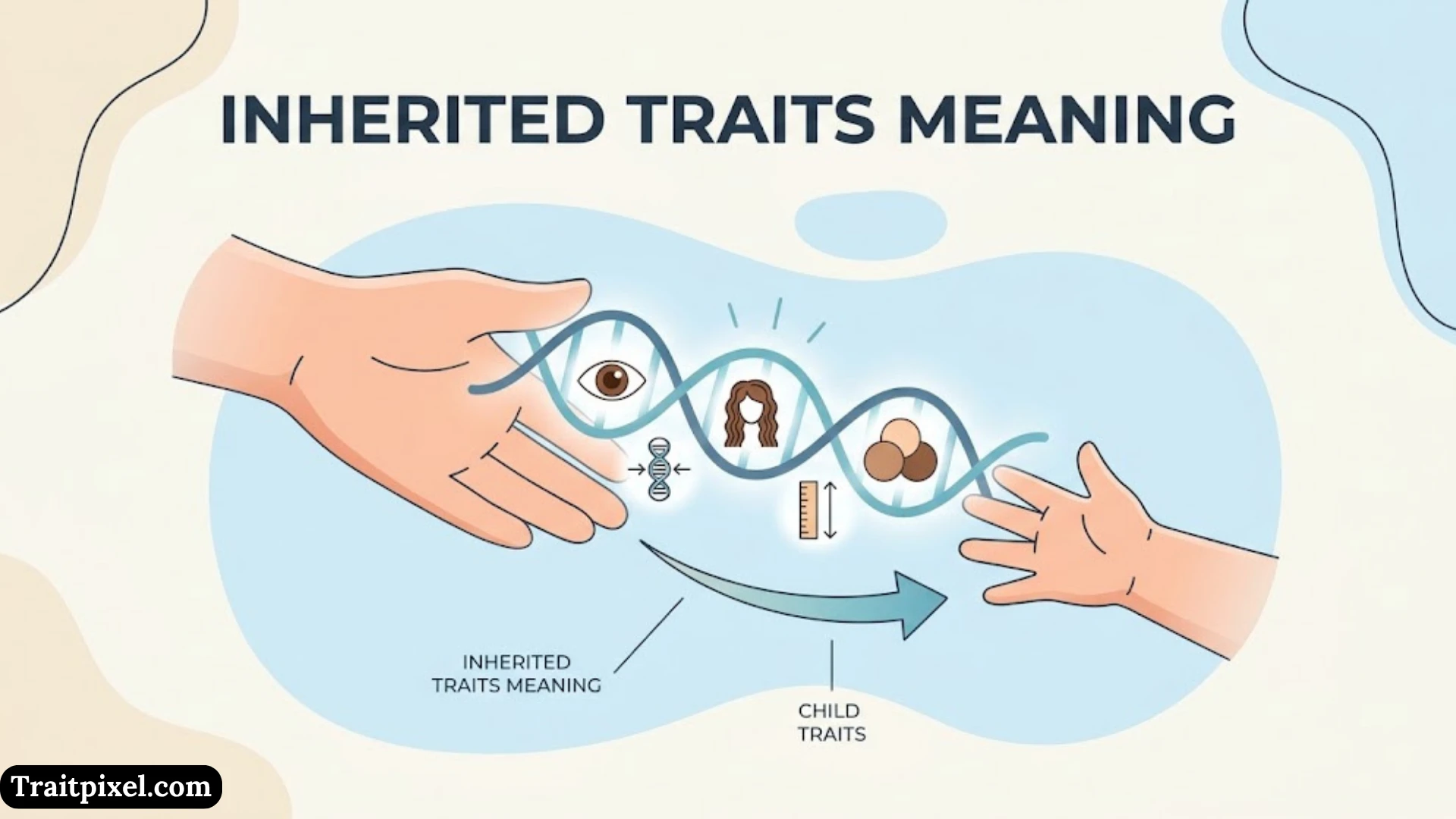
Inherited traits are characteristics passed from biological parents to their children through genes. They can affect physical features, such as eye color, hair texture, and blood type, as well as certain biological tendencies and inherited conditions. Understanding the meaning of inherited traits helps explain why family members often share similarities while still looking and behaving differently.
Some traits follow simple patterns of inheritance, while others depend on many genes and environmental factors. Learning how inheritance works can help you understand family resemblances, genetic variation, and the difference between characteristics you inherit and those you develop during your lifetime.
Inherited Traits Meaning: (Quick Answer)
Inherited traits are characteristics that an organism receives from its biological parents through genetic information, usually carried in DNA. These characteristics may influence appearance, biological functions, and the likelihood of developing certain conditions.
For example, a child may inherit a blood type, a natural tendency toward curly hair, or a genetic variant associated with a particular condition. However, not every feature or behavior shared by family members is directly inherited. Diet, upbringing, experiences, and other environmental factors also shape how people develop.
Inherited Traits: Overview
| Term | Meaning | Example |
| Inherited traits | Characteristics passed through genetic information | Blood type |
| Genes | DNA sequences that help determine biological characteristics | A gene involved in pigment production |
| DNA | Molecule that carries genetic instructions | DNA inherited from both biological parents |
| Genetic variation | Differences in DNA among individuals | Variants that contribute to differences in hair texture |
| Heredity | The passing of genetic information between generations | A genetic characteristic appearing in a family |
| Acquired traits | Characteristics developed through experience or environmental influence rather than directly inherited | A scar from an injury |
| Genetic condition | A condition caused or influenced by changes in genetic material | Sickle cell disease |
These terms are related, but they aren’t interchangeable. A gene contributes to a biological process, while an inherited trait is a characteristic that results partly or entirely from genetic information.
What Does Inherited Traits Mean in Biology?

In biology, inherited traits are characteristics influenced by genetic information transmitted from parents to offspring. This process is called heredity. It allows genetic information to continue across generations while also creating variation among individuals.
Most human cells contain 23 pairs of chromosomes. One chromosome in each pair usually comes from the egg, and the other comes from the sperm. These chromosomes contain DNA, including thousands of genes that help guide growth, development, and normal body functions.
When a child inherits genetic material from both biological parents, the resulting combination is generally unique, except in special circumstances such as identical twins.
How Genes Influence Inherited Characteristics
Genes contain instructions for making functional products, including proteins and certain RNA molecules. These products help cells function and contribute to physical and biological characteristics.
Consider pigmentation, which influences the color of your eyes, hair, and skin. Several genes help regulate pigment production and distribution. Different versions of these genes, called alleles, can contribute to differences in pigmentation.
A trait doesn’t always come from one gene acting alone. Many characteristics result from interactions among multiple genes, and some also depend strongly on environmental conditions.
For instance, a person’s adult height reflects genetic influences alongside factors such as nutrition, health, and childhood development.
Why Children Resemble Their Parents but Aren’t Identical
Children receive genetic information from both biological parents, but they don’t receive an exact copy of either parent’s complete genetic combination.
During the formation of eggs and sperm, chromosomes are distributed and recombined. This process creates different combinations of genetic variants. As a result, siblings can inherit different versions of genes even though they share the same parents.
This explains why one sibling might have tightly curled hair while another has looser curls, or why siblings can differ in height, facial features, and other characteristics.
Inherited traits create family resemblance, but genetic variation helps make each person distinct.
Types of Inherited Traits
Inherited characteristics can be grouped by how genes influence them and how genetic information passes from one generation to the next. Some traits involve a single gene, while others depend on many genes or interactions between genes and the environment.
1. Physical Traits
Physical traits are visible or measurable characteristics influenced by genetic information. They are among the easiest inherited characteristics to recognize within families.
Examples include:
- Natural hair texture
- Eye color
- Skin pigmentation
- Certain facial features
- Natural hairline patterns
- Blood type, which is inherited but not visible
- Some aspects of body build
Important distinction: Not every physical feature is determined by genes alone. Height, for example, depends on many genetic factors and environmental influences, including nutrition and health.
2. Genetic and Biological Traits
Some inherited traits affect how the body functions rather than how it looks.
Examples include:
- Blood group, such as A, B, AB, or O
- Certain inherited enzyme deficiencies
- Genetic variants affecting how the body processes particular substances
- Lactose intolerance associated with genetic variants affecting lactase production
- Some forms of inherited color vision deficiency
- Genetic variants that affect the way certain medicines are processed
These characteristics can influence health, digestion, or other biological processes. Their inheritance patterns vary, so family resemblance alone doesn’t establish whether someone carries a particular genetic variant.
3. Single-Gene Traits
Single-gene traits are primarily influenced by variants in one gene. Some follow recognizable inheritance patterns, making them useful examples in biology classes.
For example, certain inherited conditions result from changes in a single gene. However, many visible characteristics once described as simple dominant or recessive traits are more complicated than introductory textbooks suggest.
Single-gene inheritance is easiest to understand when a specific gene and its known inheritance pattern are identified.
4. Polygenic Traits

Polygenic traits are influenced by multiple genes. Their effects may combine in complex ways, often producing a wide range of outcomes.
Examples include:
- Height
- Skin pigmentation
- Many aspects of eye color
- Hair characteristics
- Certain aspects of body composition
Because multiple genes contribute to these characteristics, they don’t always follow simple dominant and recessive patterns. Environmental influences can also affect how a polygenic trait develops.
5. Inherited Genetic Conditions
Some inherited traits are associated with medical conditions. These may be harmless variations, risk factors, or genetic changes that cause disease.
Examples include:
- Sickle cell disease
- Cystic fibrosis
- Huntington’s disease
- Some forms of inherited hearing loss
- Certain inherited forms of color vision deficiency
The inheritance pattern depends on the condition. Some genetic conditions require variants in both copies of a gene, while others can result from a variant in just one copy. Some also arise from new genetic changes rather than being passed down from an affected parent.
A genetic condition isn’t a personality trait or a personal failing. It is a biological characteristic that may require medical evaluation, support, or treatment.
15 Examples of Inherited Traits in Humans
The following examples show how inherited characteristics appear in everyday life. The exact inheritance pattern differs from trait to trait.
| No. | Inherited trait or characteristic | How genetics contributes |
| 1 | Blood type | Inherited versions of genes help determine the ABO blood group. |
| 2 | Natural hair texture | Multiple genetic factors influence the shape and structure of hair. |
| 3 | Eye color | Genetic variants affect pigment production and distribution in the iris. |
| 4 | Skin pigmentation | Multiple genes influence melanin production and distribution. |
| 5 | Adult height potential | Many genes contribute, alongside nutrition, health, and development. |
| 6 | Natural hair color | Genes influence the types and amounts of pigment in hair. |
| 7 | Freckling tendency | Genetic factors influence susceptibility, while sun exposure affects freckle development. |
| 8 | Earlobe shape | Genetic and developmental factors contribute; it isn’t a reliable simple dominant-recessive example. |
| 9 | Certain dimples | Genetic influences may contribute, but the inheritance pattern is not always straightforward. |
| 10 | Color vision deficiency | Some forms are associated with inherited variants affecting color perception. |
| 11 | Lactase persistence | Genetic variants influence whether lactase production typically continues into adulthood. |
| 12 | Sickle cell disease | Specific variants in the HBB gene cause the condition when inherited in the relevant combination. |
| 13 | Cystic fibrosis | Disease-causing variants in both copies of the CFTR gene generally cause the condition. |
| 14 | Huntington’s disease | A disease-causing change in one copy of the HTT gene can cause the condition. |
| 15 | Certain inherited hearing differences | Some forms result from genetic variants affecting hearing-related structures or processes. |
These examples illustrate an important point: a trait can have a genetic basis without being controlled by one gene or appearing identically in every family member.
For example, a child may inherit genetic variants associated with taller stature but still have a different adult height from either parent. Nutrition, childhood illness, hormones, and other factors also influence growth.
How Are Inherited Traits Passed From Parents to Children?

Inherited traits pass through reproductive cells that carry genetic information from biological parents to their offspring. The combination of genetic variants a child receives influences which characteristics may develop.
The process can be understood in four steps.
- Parents carry genetic information. Their DNA contains different versions of genes, including variants inherited from earlier generations.
- Eggs and sperm receive genetic material. These reproductive cells carry one set of chromosomes rather than the usual two sets found in most human cells.
- Fertilization combines genetic information. The egg and sperm contribute genetic material to the developing embryo.
- Genes influence development. The inherited combination, along with environmental influences, helps shape the child’s characteristics.
This process explains why a child can resemble a grandparent even when the same feature isn’t obvious in either parent. A genetic variant may be present in a parent without producing an easily noticeable characteristic, or its effects may depend on other inherited variants.
What Are Dominant and Recessive Traits?
Dominant and recessive describe how certain versions of a gene relate to an observable characteristic or condition. They don’t mean that one trait is stronger, better, or more common than another.
- Dominant inheritance: In a typical autosomal dominant condition, one disease-causing variant in the relevant gene can be enough to cause the condition.
- Recessive inheritance: In a typical autosomal recessive condition, a person generally needs disease-causing variants in both copies of the gene to develop the condition.
A person with one disease-causing variant for a recessive condition is often called a carrier. Carriers usually don’t have the condition, although the details vary by gene and disorder.
| Feature | Dominant inheritance | Recessive inheritance |
| Typical genetic requirement | One relevant variant may be sufficient | Usually requires relevant variants in both gene copies |
| Can an unaffected parent pass on a variant? | Yes, in some circumstances, including new or incompletely expressed variants | Yes; unaffected carriers can pass on a variant |
| Does it always appear in every generation? | No | No |
| Example of a genetic condition | Huntington’s disease | Cystic fibrosis |
These patterns describe particular genetic conditions and shouldn’t be used to label every physical characteristic as dominant or recessive. Many everyday traits involve multiple genes.
Can a Trait Skip a Generation?
Yes. A genetic characteristic or condition can appear to skip a generation, depending on the inheritance pattern and how the genes are expressed.
For example, a child may inherit a recessive disease-causing variant from each parent. If neither parent has the condition because each carries only one relevant variant, the child can still develop the condition after inheriting both variants.
Other traits may be present genetically but not easily noticed. Family records can also be incomplete, making an inherited characteristic seem to have appeared unexpectedly.
Inherited Traits vs. Acquired Traits
Inherited traits and acquired traits differ mainly in how they develop. Inherited traits involve genetic information passed from biological parents, while acquired traits develop through life experiences, environmental exposure, learning, or changes to the body.
| Basis of comparison | Inherited traits | Acquired traits |
| Main source | Genetic information inherited from biological parents | Experiences, environment, learning, injury, or other life events |
| Present from birth? | The genetic variants are inherited at conception, but their effects may appear later | May develop at any age |
| Examples | Blood type and genetic variants affecting natural hair texture | A scar from an injury or a language learned through practice |
| Can the environment influence the outcome? | Yes, for many traits | Yes, often directly |
| Usually passed to children through ordinary inheritance? | Genetic variants can be passed on | The acquired characteristic itself usually isn’t passed on through DNA |
A useful example is muscle development. A person’s genes influence muscle-related characteristics, but muscles that grow through strength training are an acquired physical change. The training itself doesn’t rewrite the person’s inherited DNA in a way that passes those larger muscles directly to their children.
The distinction isn’t always absolute. Some characteristics reflect both inherited predispositions and acquired influences. Body weight, for example, can be affected by genes, diet, activity, sleep, health, and medication.
Inherited Traits vs. Learned Behaviors
Not every similarity between parents and children is genetic. Children also learn from family members by observing how they communicate, solve problems, manage emotions, and respond to everyday situations.
| Example | Possible genetic influence | Possible environmental influence |
| Height | Many genetic variants influence growth potential | Nutrition and health affect development |
| Athletic performance | Genetic differences can influence aspects of strength, endurance, and body structure | Training, coaching, sleep, and practice matter |
| Musical ability | Some inherited differences may influence relevant abilities | Lessons, practice, and exposure help develop skills |
| Shyness | Temperamental differences may have genetic influences | Social experiences and family environment also matter |
| Language | Genetic factors influence the development of the brain and speech-related abilities | The language a person speaks is learned from their environment |
| Anger management | Biological differences may affect emotional responses | Modeling, coping skills, and experience shape behavior |
Key takeaway: A family resemblance in behavior doesn’t prove that the behavior was inherited directly through genes. Genetics and environment often interact, and it can be difficult to separate their individual contributions.
How Do Inherited Traits Affect Personality and Behavior?
Inherited genetic differences can influence aspects of temperament, but they don’t determine a person’s entire personality. Characteristics such as sociability, emotional reactivity, activity level, and persistence may reflect a combination of genetic influences and life experiences.
For example, one child may naturally approach new situations with excitement, while another may take more time to feel comfortable. These differences can emerge early in life, but family environment, relationships, learning, and experience continue to shape how children respond to the world.
It’s useful to distinguish three related concepts:
- Temperament: Early-appearing tendencies in emotional reactions, activity, and attention.
- Personality: Broader patterns of thinking, feeling, and behaving that develop over time.
- Learned behavior: Actions and responses acquired through observation, practice, instruction, and experience.
A person may inherit a tendency toward cautiousness, for example, but learn to become more confident through supportive relationships and repeated experience.
Genetic influence doesn’t mean that a characteristic is fixed or unavoidable. Nor does a family resemblance prove that a particular behavior comes from a specific gene.
Inherited Traits in Animals and Plants
Inherited traits occur throughout the living world. Animals inherit characteristics that influence their appearance, body functions, and other biological features. Plants inherit characteristics that affect growth, reproduction, and survival.
Inherited Traits in Animals
Examples include:
- A dog’s coat color and certain coat patterns
- A cat’s fur length
- A bird’s feather coloration
- Certain inherited coat characteristics in horses
- Genetic variants associated with particular inherited diseases in animals
Selective breeding can increase the frequency of desired inherited characteristics within a population. However, breeding decisions can also increase the risk of inherited health problems when particular disease-causing variants become more common.
Inherited Traits in Plants
Plants inherit genetic information from their parent plants. This information influences characteristics such as flower color, seed shape, plant height, and fruit characteristics.
For example, pea plants can inherit different flower colors or seed characteristics. These variations helped Gregor Mendel investigate patterns of inheritance in the 19th century.
Plant breeders use knowledge of inheritance to develop crops with useful characteristics, such as disease resistance, improved quality, or greater tolerance to particular growing conditions.
Environmental factors still matter. A plant may inherit the potential to grow tall but remain small if it receives insufficient water, sunlight, or nutrients.
How Scientists Study Inherited Traits

Scientists study inherited characteristics by examining genes, comparing individuals, observing families, and investigating how biological and environmental factors interact.
Several methods help researchers understand heredity.
Genetic testing: Laboratory tests can identify specific genetic variants associated with certain traits or conditions. A test’s usefulness depends on the question being asked and the accuracy of the available test.
Family history: Researchers and healthcare professionals examine patterns across generations to identify characteristics or conditions that may have a genetic basis.
Twin studies: Comparing identical and fraternal twins can help researchers estimate the contributions of genetic and environmental differences to variation within a population.
Animal and plant breeding studies: Researchers observe how characteristics appear in successive generations under known breeding conditions.
Genome-wide association studies: These studies examine genetic variants across large groups of people to identify associations with particular characteristics or health outcomes.
What Does Heritability Mean?
Heritability describes how much of the observed variation in a particular trait within a specific population and environment is associated with genetic differences.
It does not tell you what percentage of an individual person’s trait comes from genes.
For example, a highly heritable characteristic can still be affected by environmental conditions. Heritability estimates may also differ between populations and environments.
This distinction matters because genetic influence, personal potential, and individual outcomes aren’t the same thing.
Common Misconceptions About Inherited Traits
Some common beliefs about heredity oversimplify how genes work. Understanding these distinctions helps prevent confusion.
| Misconception | What science tells us |
| Every trait comes from one gene. | Many traits depend on multiple genes and environmental influences. |
| Dominant traits are always more common. | Dominance describes a genetic relationship, not how common a trait is. |
| Children inherit all their visible features from one parent. | Children inherit genetic material from both biological parents. |
| Every child looks like their parents. | Genetic variation means siblings and parents can look quite different. |
| Acquired skills are automatically inherited. | Skills such as reading, swimming, and speaking a particular language are learned. |
| A genetic predisposition guarantees disease. | Some genetic variants increase risk without making a condition inevitable. |
| A condition must appear in every generation to be inherited. | Recessive inheritance and other genetic mechanisms can make a condition appear to skip generations. |
| Genes completely control personality. | Temperament and personality reflect genetic influences alongside development and experience. |
| All genetic changes are harmful. | Many genetic variants have no harmful effect, and some can be beneficial in particular environments. |
| An inherited trait can never be influenced by the environment. | Many genetically influenced characteristics change depending on environmental conditions. |
The most important lesson is that heredity provides biological influences, not a complete script for an individual’s life.
How to Identify Whether a Trait Is Inherited
If you want to understand whether a characteristic is inherited, use this simple guide.
A quick decision guide
1. Is there a known genetic explanation for the trait?
If yes, genetic inheritance may contribute. If the answer is unknown, family resemblance alone isn’t enough to establish inheritance.
2. Does the characteristic appear in biological relatives?
If yes, this may provide a clue, especially when a known inheritance pattern fits. However, shared environments can also explain family similarities.
3. Could learning or the environment explain it?
If the characteristic involves a learned skill, habit, or experience, environmental influences may be important. Genetic and environmental factors can also work together.
4. Does the question involve a medical condition?
Don’t rely on appearance or family resemblance alone. A healthcare professional or genetic counselor can help assess family history and determine whether testing is appropriate.
This guide helps organize your thinking, but it can’t establish a person’s genetic status or diagnose an inherited condition.
Related Traits and Genetics Terms
Understanding a few related concepts makes the meaning of inherited traits easier to remember.
- Heredity: The passing of genetic information from parents to offspring.
- Genetics: The scientific study of genes, heredity, and genetic variation.
- Gene: A DNA sequence that contributes to a functional biological product.
- DNA: The molecule that carries hereditary information.
- Chromosome: A structure made of DNA and associated proteins that carries genetic information.
- Allele: A version of a particular DNA sequence or gene.
- Genotype: An individual’s genetic makeup, or the particular genetic variants being considered.
- Phenotype: An observable or measurable characteristic resulting from genetic and environmental influences.
- Genetic variation: Differences in DNA among individuals.
- Polygenic trait: A characteristic influenced by multiple genes.
- Acquired trait: A characteristic developed through life experiences or environmental influences rather than directly inherited through DNA.
- Genetic predisposition: An increased likelihood of a particular outcome because of genetic factors.
- Mutation: A change in a DNA sequence. Such changes can have harmful, beneficial, or neutral effects.
- Gene expression: The process through which information in a gene is used to produce a functional product.
- Epigenetics: The study of changes in gene activity that don’t involve changing the underlying DNA sequence.
These concepts describe different parts of the same broader picture: how genetic information contributes to the development and variation of living organisms.
Frequently Asked Questions About Inherited Traits
1. What is the simple meaning of inherited traits?
Inherited traits are characteristics passed from biological parents to offspring through genetic information. Examples include blood type, natural hair characteristics, and certain inherited genetic conditions.
2. What are five examples of inherited traits?
Five examples are blood type, natural hair texture, eye color, skin pigmentation, and genetic variants associated with certain forms of color vision deficiency. These traits differ in how many genes influence them.
3. Are inherited traits present at birth?
The genetic variants are inherited at conception, but their effects don’t always appear at birth. Some characteristics emerge during childhood, puberty, or adulthood.
4. What is the difference between inherited and acquired traits?
Inherited traits involve genetic information passed from biological parents. Acquired traits develop through experiences, learning, environmental influences, or physical changes during life. Many characteristics reflect a combination of both genetic and environmental factors.
5. Can a child inherit traits from grandparents?
Yes. A child can inherit genetic variants that originated with a grandparent through either biological parent. This can explain why a characteristic resembles a grandparent even when it isn’t obvious in the child’s parents.
6. Do children inherit more traits from their mother or father?
For most nuclear DNA, children inherit roughly half from each biological parent. Particular inheritance patterns can differ, especially for genes on sex chromosomes and mitochondrial DNA. This doesn’t mean a child will display an equal number of visible characteristics from each parent.
7. Can inherited traits skip a generation?
Yes. A recessive genetic condition, for example, may appear in a child whose parents are unaffected carriers. Other genetic factors can also make characteristics difficult to observe in one generation but more apparent in another.
8. Are personality traits inherited?
Some aspects of temperament and personality are influenced by genetics, but they aren’t determined by genes alone. Experiences, relationships, culture, development, and other environmental factors also contribute.
9. Are dominant traits more common than recessive traits?
No. Dominance and recessiveness describe how certain gene variants relate to a characteristic. A recessive variant can be common in a population, while a dominant variant can be rare.
10. Can inherited traits change over time?
The DNA sequence inherited by an individual generally remains stable in most cells, but the way characteristics appear can change with age, hormones, health, and environmental influences. Hair color can change with age, for example, even though a person’s inherited genetic information remains largely the same.
11. Are all inherited traits physical?
No. Inherited characteristics can influence biological functions, susceptibility to certain conditions, and aspects of temperament. Not all inherited influences are visible, and behavior is especially complex because learning and environment matter too.
12. Does having a family history of a disease mean I will develop it?
Not necessarily. Some inherited conditions have well-defined inheritance patterns, while many common diseases reflect a combination of genetic, lifestyle, and environmental influences. If a condition runs in your family, discuss your history with a healthcare professional to understand your individual risk.
Key Takeaways
- Inherited traits are characteristics influenced by genetic information passed from biological parents to offspring.
- Genes are made of DNA and contribute to physical features, biological functions, and other characteristics.
- Blood type, hair characteristics, and some genetic conditions are examples of inherited traits.
- Some traits involve one gene, while others depend on many genes and environmental factors.
- Dominant doesn’t mean common, and recessive doesn’t mean rare.
- Acquired traits, such as learned skills and injury-related scars, differ from characteristics inherited through DNA.
- Genetics can influence temperament and personality, but it doesn’t completely determine behavior.
- Family resemblance can provide clues about inheritance, but it doesn’t prove a particular trait or condition has a genetic cause.
- Genetic counseling may help families understand inherited conditions and make informed healthcare decisions.
Conclusion
The meaning of inherited traits is straightforward: they are characteristics influenced by genetic information passed from biological parents to their children. These traits help explain similarities in appearance, blood type, biological functions, and certain inherited conditions.
However, inherited traits don’t tell the whole story of who a person becomes. Many characteristics reflect a combination of genes, development, experiences, and environmental conditions. Understanding this relationship makes it easier to distinguish inherited characteristics from acquired ones and appreciate why every individual has a unique combination of features.
In short, inherited traits meaning refers to the characteristics passed through genes from one generation to the next, with their final expression often shaped by more than genetics alone.

I’m Elliot Kingsley, a British author interested in the subtle characteristics that influence how people think, communicate, and respond to the world. I write about personality traits, strengths, tendencies, and behavioural qualities in clear language. My goal is to encourage readers to understand individual differences and appreciate the complexity of human character.
Books:
- The Psychology of Personality Traits
- Character in Context