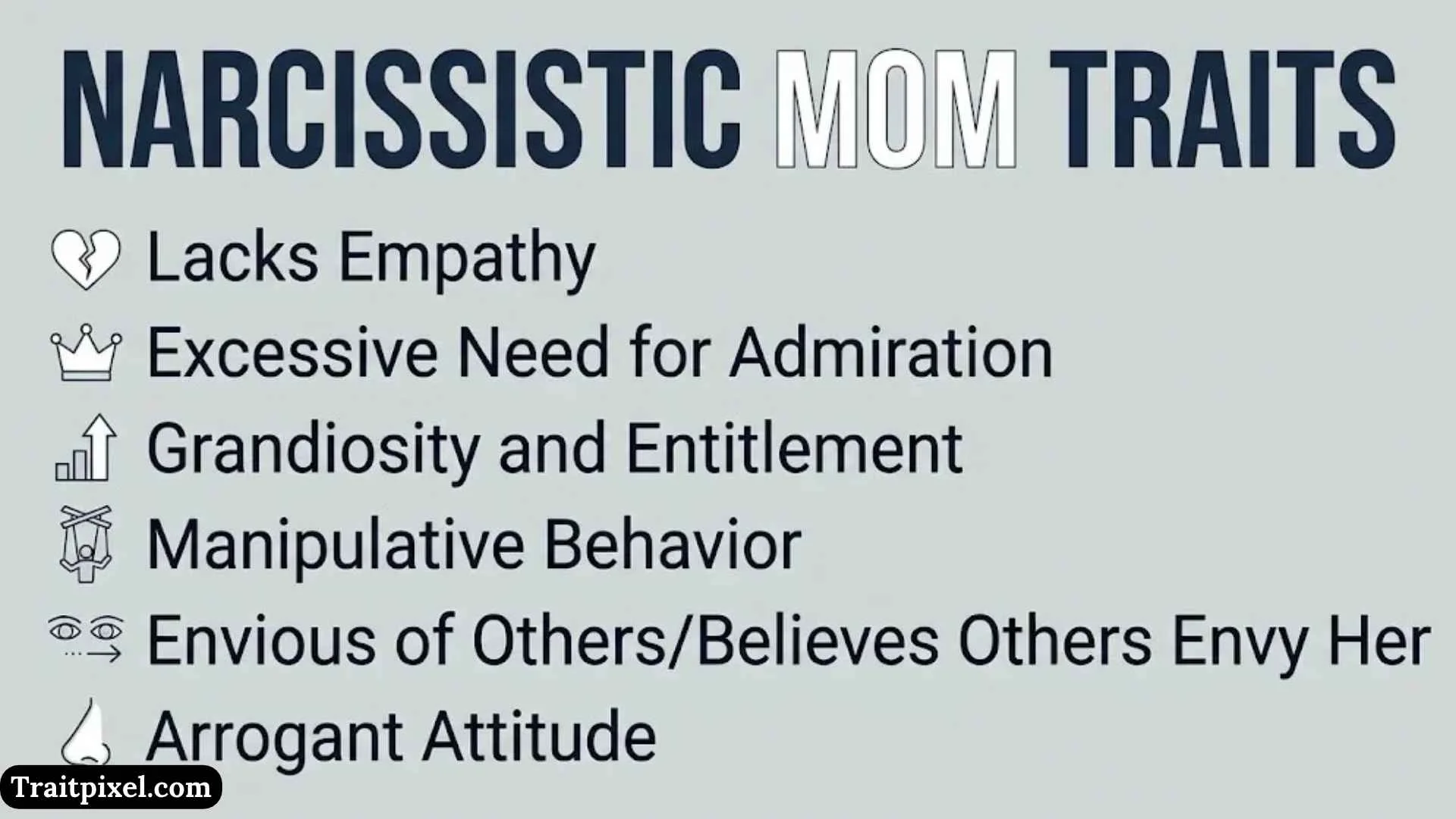
Having a difficult relationship with your mother can leave you feeling confused, guilty, or emotionally drained. If she often criticizes you, ignores your feelings, competes with you, or expects you to meet her needs first, you may wonder whether she shows narcissistic mom traits.
A mother with narcissistic traits may struggle with empathy, seek excessive admiration, demand control, or treat her children as extensions of herself. These behaviors can affect a child’s confidence, emotional health, relationships, and sense of independence. However, not every controlling or emotionally distant mother has narcissistic personality disorder (NPD).
Understanding the difference between occasional mistakes and repeated harmful patterns can help you make sense of your relationship. This guide explains common signs, realistic examples, possible effects on children, and practical ways to protect your emotional well-being.
Quick Answer
Narcissistic mom traits are recurring patterns of behavior in which a mother places excessive importance on her own needs, image, or control while struggling to respect her child’s feelings and independence. Common signs include a lack of empathy, emotional manipulation, conditional affection, excessive criticism, boundary violations, and difficulty accepting responsibility.
These traits exist on a spectrum. Only a qualified mental health professional can diagnose narcissistic personality disorder, and a difficult relationship alone does not establish that diagnosis.
Overview of Common Narcissistic Mother Traits
| Trait | How it may appear |
| Lack of empathy | Dismisses your pain or emotional needs |
| Need for admiration | Expects praise, attention, or recognition |
| Excessive control | Tries to make decisions about your life |
| Emotional manipulation | Uses guilt, shame, or emotional pressure |
| Conditional affection | Shows warmth mainly when you comply |
| Constant criticism | Focuses on your mistakes or shortcomings |
| Boundary violations | Ignores your privacy, choices, or personal limits |
| Victim mentality | Portrays herself as the injured party when challenged |
| Jealousy or competition | Treats your success as a threat |
| Entitlement | Expects special treatment or unquestioning obedience |
| Blame-shifting | Makes others responsible for her behavior |
| Public image management | Protects her reputation while dismissing private harm |
| Favoritism | Treats siblings differently to maintain influence or approval |
| Gaslighting behaviors | Repeatedly denies or distorts events in ways that undermine your confidence |
| Difficulty apologizing | Avoids genuine accountability or meaningful change |
These behaviors matter most when they form a persistent pattern, especially when they undermine your autonomy, self-worth, or emotional safety.
15 Narcissistic Mom Traits Explained in Detail
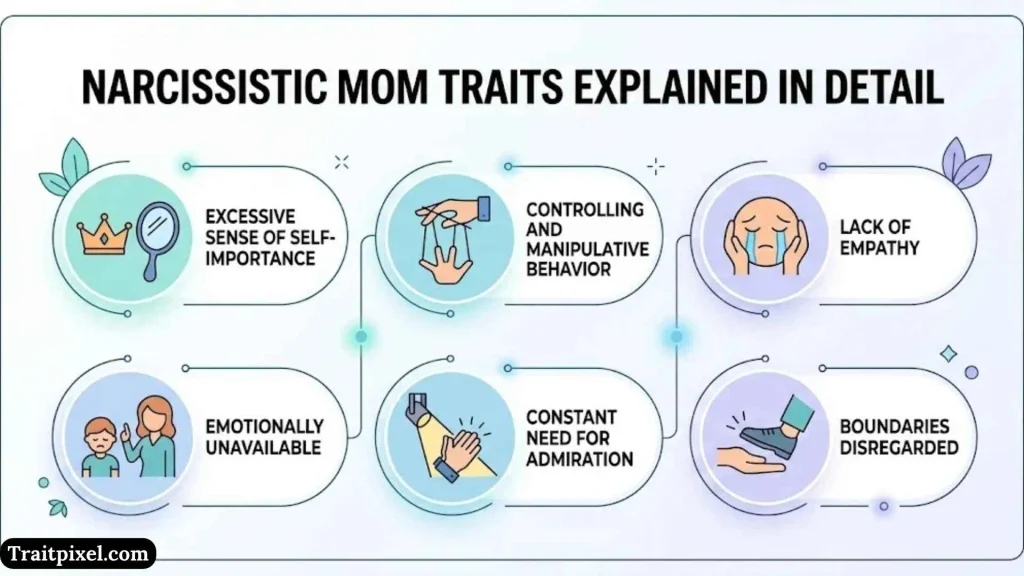
The clearest way to recognize narcissistic behavior is to look at repeated interactions, not isolated disagreements. A mother may display some of these traits without having narcissistic personality disorder, and harmful behavior can occur for many reasons.
1. She Struggles to Show Empathy
A mother with narcissistic traits may have difficulty recognizing or responding to her child’s emotional needs. She might understand that you feel hurt but show little interest in why you feel that way.
For example, you tell her that a friend betrayed your trust. Instead of listening, she interrupts to explain how her own problems are worse. She may even criticize you for being too sensitive.
Over time, you might stop sharing your feelings because you expect dismissal rather than comfort.
What to notice: Does she make room for your emotions, even when she doesn’t agree with your perspective?
2. She Needs Constant Attention or Admiration
A narcissistic mother may expect her family to praise her, recognize her sacrifices, and protect her self-image. She may become upset when attention shifts toward someone else.
For example, you receive a promotion at work, but she quickly changes the conversation to her own achievements. She might also suggest that your success reflects her parenting rather than your effort.
The issue isn’t that she enjoys recognition. Most people appreciate praise. The concern is when admiration becomes an expectation and other people’s achievements feel like competition.
3. She Tries to Control Your Decisions
Excessive control can affect your education, career, friendships, romantic relationships, appearance, and daily routines.
She might insist that you choose a particular career because it would make the family look successful. If you choose differently, she may accuse you of disrespecting her or wasting your potential.
A caring parent can offer advice and express concerns. A controlling parent may treat disagreement as disobedience, even when you’re an independent adult.
A useful distinction: Guidance respects your ability to decide. Control attempts to replace it.
4. She Uses Guilt to Influence You
Guilt can become a powerful tool when a mother expects emotional loyalty without allowing room for independence.
She might say:
- “After everything I’ve done for you, this is how you treat me?”
- “You only remember me when you need something.”
- “A good daughter or son wouldn’t make this choice.”
- “I sacrificed my whole life for you.”
These statements may make you feel responsible for her happiness, loneliness, or disappointment.
Parents can genuinely feel hurt when family relationships change. The concerning pattern appears when guilt repeatedly replaces honest discussion and pressures you to abandon reasonable needs.
5. Her Affection Depends on Your Compliance
Some mothers become warm and supportive when their children meet their expectations but turn cold when they disagree.
For example, she may speak lovingly when you follow her advice about your relationship. After you make a different choice, she ignores your calls or withdraws affection until you give in.
This can teach a child that love must be earned through obedience.
Healthy relationships allow disagreement without making affection a reward for compliance. A parent can be disappointed with a decision and still treat the child with respect.
6. She Criticizes You More Than She Encourages You
Repeated criticism can make even capable adults question their worth.
A mother with narcissistic traits may focus on your appearance, intelligence, income, parenting, relationships, or achievements. Compliments may be rare, backhanded, or followed by another criticism.
For example, you tell her that you completed a difficult course. She responds, “That’s good, but your cousin finished a better one.”
Over time, you might become a perfectionist, fear mistakes, or feel that nothing you accomplish is enough.
Constructive feedback helps you improve without attacking your identity. Constant put-downs do the opposite.
7. She Ignores Your Personal Boundaries
Boundaries establish what you consider acceptable in your relationships. They protect your privacy, time, choices, and emotional well-being.
A mother who struggles with boundaries might:
- Read your private messages without permission.
- Share personal information you asked her to keep confidential.
- Arrive at your home without checking whether it’s a good time.
- Demand immediate replies to every call or message.
- Interfere with your parenting or romantic relationship.
- Treat your need for privacy as proof that you don’t love her.
She may explain these actions as concern or parental responsibility.
However, caring about someone doesn’t automatically give you access to every part of their life. Respectful closeness leaves room for privacy and independence.
8. She Always Becomes the Victim During Conflict
When you explain that something hurt you, she may shift the conversation toward her own suffering.
For instance, you tell her that a cruel comment embarrassed you at a family gathering. Instead of discussing the comment, she says you’re ungrateful and that nobody appreciates what she does.
Now you’re defending yourself rather than addressing the original problem.
This pattern can make conflict feel impossible to resolve. Your feelings disappear from the discussion, while you become responsible for comforting her.
The important sign isn’t that she sometimes feels misunderstood. It’s that her distress repeatedly prevents her from acknowledging your concerns.
9. She Competes With You or Resents Your Success
A narcissistic mother may struggle when her child receives attention, earns independence, or achieves something she wanted for herself.
For example, she might minimize your professional success, criticize your appearance after a positive change, or make dismissive comments about your healthy relationship.
She may also compare you unfavorably with siblings or other relatives.
Not every negative reaction means jealousy. Parents can have legitimate concerns about decisions their children make. However, a persistent pattern of belittling achievements or turning milestones into competitions deserves attention.
10. She Expects Special Treatment
Entitlement involves expecting privileges, attention, or compliance beyond what a situation reasonably calls for.
A mother with this trait may expect you to cancel plans whenever she wants help. She might assume that her preferences should determine family gatherings, holidays, or major decisions.
If you cannot meet her expectations, she may react with anger or accuse you of being selfish.
Family members often make sacrifices for each other. Healthy relationships, however, allow those sacrifices to be discussed and shared rather than demanded automatically.
11. She Blames Others Instead of Taking Responsibility
A mother with strong narcissistic traits may find it difficult to acknowledge her contribution to a problem.
When you confront her about a hurtful comment, she might respond:
- “You made me say that.”
- “You’re always looking for reasons to criticize me.”
- “I wouldn’t act this way if you respected me.”
- “You’re remembering everything incorrectly.”
These responses shift responsibility away from her behavior.
A genuine apology usually acknowledges what happened, recognizes its impact, and includes an effort to do better. An apology that blames you for being hurt may leave the original issue unresolved.
12. She Protects Her Public Image at Your Expense
Some mothers behave very differently in public and in private.
Relatives, friends, or community members may see a generous, charming, devoted parent. At home, you may experience criticism, intimidation, emotional pressure, or dismissive treatment.
She may also use public praise to reinforce an image of herself as the perfect mother.
This contrast can make it harder to seek support. You might worry that other people won’t believe you because they have never seen the behavior you experience privately.
Remember that public reputation alone doesn’t establish whether someone is a caring parent. What matters is how they consistently treat the people closest to them.
13. She Plays Siblings Against Each Other
In some families, a parent repeatedly compares siblings or assigns them unequal roles.
One child may become the golden child, receiving praise and privileges. Another may become the scapegoat, blamed for family problems or criticized more harshly.
These are informal family-dynamics terms, not psychiatric diagnoses.
For example, a mother may praise one sibling for setting boundaries while accusing another of being disrespectful for doing the same thing. She might share private information about one child to gain support from another.
This pattern can damage sibling relationships and encourage competition for parental approval.
Not every difference in treatment is favoritism. Children have different needs, ages, and circumstances. The concern is persistent unfairness, manipulation, and punishment for questioning the family dynamic.
14. She Denies or Distorts Your Experiences
Repeatedly denying events, dismissing your memory, or insisting that your feelings are irrational can undermine your confidence. When such behavior is used to make you doubt your perception of reality, it may constitute gaslighting.
For example, she makes a hurtful remark and later insists that she never said it. When you explain how the comment affected you, she tells you that you invent problems.
A disagreement about memory isn’t automatically gaslighting. People can remember the same event differently.
The warning sign is a recurring pattern in which your perspective is systematically discredited, particularly when the denial helps someone avoid accountability or maintain control.
15. She Reacts Badly to Criticism or Disagreement
A mother with narcissistic traits may interpret reasonable feedback as an attack on her character.
If you tell her that a comment hurt you, she may respond with anger, contempt, prolonged silence, or accusations of betrayal. She might also bring up unrelated mistakes you’ve made to shift attention away from her actions.
Some people react strongly to criticism because of insecurity, stress, trauma, or other difficulties. This reaction alone doesn’t establish narcissism.
What matters is whether she can eventually listen, reflect, and repair the relationship—or whether every attempt to address a problem becomes another conflict.
Different Ways Narcissistic Traits Can Appear in a Mother
Narcissistic behavior doesn’t always look loud, arrogant, or openly controlling. Some patterns are obvious, while others appear through guilt, emotional withdrawal, or subtle pressure.
The terms below can help describe behavior, but they aren’t separate formal diagnoses.
Grandiose or Overt Narcissistic Traits
These traits are often more visible. A mother may emphasize her superiority, demand recognition, or expect other people to follow her preferences.
Common examples include:
- Bragging about her achievements while minimizing yours.
- Treating her opinions as more important than everyone else’s.
- Expecting special treatment from relatives.
- Responding aggressively when someone challenges her authority.
The defining pattern is an exaggerated sense of importance combined with difficulty respecting other people’s equal needs and perspectives.
Vulnerable or Covert Narcissistic Traits
Vulnerable narcissistic traits may appear through sensitivity to rejection, insecurity, resentment, or a strong need for reassurance.
A mother displaying these traits might frequently feel overlooked, interpret ordinary boundaries as rejection, or use guilt to regain attention.
For example, you tell her that you cannot visit this weekend. She responds that nobody cares about her and that she has been abandoned by her own family.
However, vulnerability, shyness, anxiety, and emotional sensitivity do not automatically indicate narcissism. The term covert narcissist is commonly used in everyday discussion, but it isn’t a separate formal diagnosis in the DSM-5-TR.
Controlling or Emotionally Manipulative Behavior
Some mothers focus less on praise and more on maintaining influence over their children.
They may discourage independence, interfere in relationships, demand loyalty, or make affection conditional on agreement.
For example, she may offer financial assistance and later use that help to dictate where you live or whom you marry.
This behavior can occur with or without narcissistic personality disorder. You can recognize its harmful effects without determining the person’s diagnosis.
Narcissistic Mother vs. Strict, Selfish, or Emotionally Immature Mother
A difficult mother isn’t necessarily a narcissistic mother. Comparing the patterns can help you avoid labeling ordinary conflict as a personality disorder.
| Behavior | Possible narcissistic pattern | Other possible explanation |
| Criticism | Repeatedly belittles you to preserve superiority or control | Gives poorly delivered feedback or has unrealistic expectations |
| Control | Treats your independence as a threat to her authority | Feels anxious about safety or struggles to adapt as you grow |
| Conflict | Shifts blame and refuses meaningful accountability | Becomes defensive but may reflect and apologize later |
| Emotional needs | Expects attention while dismissing yours | Has limited emotional skills or is under severe stress |
| Success | Minimizes your achievements or reacts competitively | Feels worried about your choices or struggles to express pride |
| Boundaries | Repeatedly ignores limits and punishes disagreement | Needs time to understand and adjust to new expectations |
| Apologies | Uses excuses or blame to avoid responsibility repeatedly | Makes mistakes but can acknowledge harm and change behavior |
The most useful distinction is the long-term pattern and its impact, not a single argument or personality label.
A mother can be strict and loving. She can also have emotional difficulties without having NPD. Equally, behavior can be harmful even when no diagnosis applies.
How Narcissistic Mother Behavior Can Affect Her Children
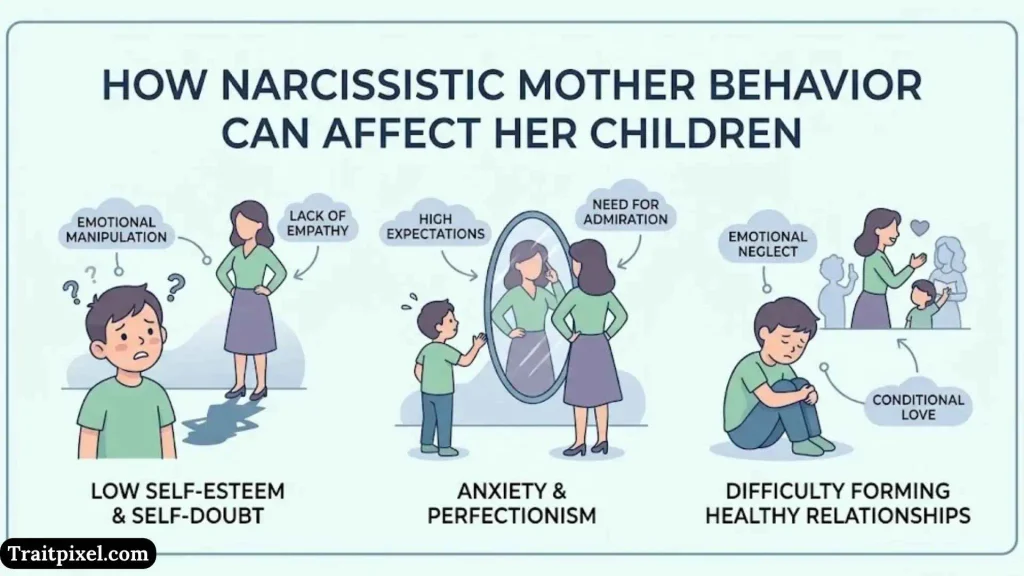
Growing up with a mother who repeatedly dismisses emotions, demands control, or makes affection conditional can influence how a child sees themselves and relates to others. The effects vary, and no single outcome is inevitable.
Some children recognize the pattern early. Others don’t understand it until adulthood, when they begin noticing similar feelings in friendships, romantic relationships, or the workplace.
1. Low Self-Esteem and Self-Doubt
Children who receive constant criticism may begin to believe they’re never good enough.
Even after becoming independent, they might seek approval before making ordinary decisions. A small mistake at work can feel like proof that they’ve failed as a person.
What can help: Practice separating your performance from your worth. Making a mistake doesn’t make you a failure, and another person’s disappointment doesn’t automatically mean you’ve done something wrong.
2. People-Pleasing and Fear of Conflict
A child who learns that disagreement leads to anger or withdrawal may become skilled at anticipating other people’s moods.
As an adult, that person might agree to unwanted favors, apologize excessively, or struggle to say no. Keeping everyone happy can feel safer than expressing personal needs.
What can help: Start with low-stakes boundaries. You might decline an invitation you genuinely don’t want to accept or ask for time before answering a request.
3. Difficulty Trusting Your Own Feelings
Repeated dismissal can lead you to question whether your emotions are reasonable.
You might think, “Maybe I’m too sensitive,” even when someone has clearly crossed a boundary. You may also feel the need to collect evidence before allowing yourself to feel hurt.
What can help: Write down what happened, how you felt, and what you needed. This can help you recognize patterns without requiring you to prove that another person intended to hurt you.
4. Anxiety and Emotional Exhaustion
Unpredictable criticism, guilt, or conflict can leave a person feeling constantly on edge.
You might rehearse conversations before calling your mother, feel anxious before family gatherings, or spend hours thinking about something she said.
These reactions don’t prove that your mother has NPD. They may indicate that the relationship is causing significant stress and deserves attention.
What can help: Notice which interactions leave you distressed. Plan recovery time after difficult conversations, and consider speaking with a qualified mental health professional if the distress affects daily life.
5. Unhealthy Relationship Patterns
Children learn about relationships partly through their experiences with caregivers.
If love repeatedly comes with criticism or control, an adult may mistake emotional intensity for closeness. They might tolerate disrespect, feel responsible for a partner’s moods, or find healthy relationships unfamiliar.
These outcomes aren’t inevitable, and a difficult childhood doesn’t determine your future.
What can help: Look for relationships where respect, accountability, and affection remain present even when people disagree.
6. Perfectionism and Fear of Failure
When approval depends on achievement, a child may learn to equate success with safety.
As an adult, they might overwork, avoid new challenges, or feel ashamed of ordinary setbacks. Completing a task may bring only temporary relief before the next demand appears.
What can help: Set goals based on your values rather than on proving your worth. Practice recognizing progress, not just finished results.
7. Guilt About Independence
An adult child may feel selfish for moving away, choosing a different career, starting a family, or limiting contact.
This guilt can be especially difficult when a mother describes independence as abandonment or betrayal.
What can help: Remind yourself that independence and love can coexist. You can care about your mother without giving her control over every important decision.
8. Confusion About Love and Responsibility
A child may grow up believing that being a good son or daughter means absorbing criticism, solving every family problem, or putting personal needs last.
This can create a lasting conflict between wanting a relationship and wanting emotional safety.
What can help: Redefine a healthy family relationship around mutual respect. Caring for a parent does not require accepting every behavior or request.
Real-Life Examples of Narcissistic Mother Traits
The following fictional scenarios illustrate how these behaviors can appear in ordinary family life. They are examples, not diagnostic tests.
| Situation | Possible narcissistic behavior | Why the pattern matters |
| Graduation | She talks about her sacrifices instead of celebrating your achievement | Your milestone becomes a story about her |
| Career choice | She threatens to withdraw support unless you choose her preferred profession | Help becomes a tool for control |
| Romantic relationship | She repeatedly insults your partner because they encourage your independence | Your relationships become a competition for influence |
| Family gathering | She humiliates you, then accuses you of being too sensitive | Your reaction replaces accountability for her comment |
| Personal privacy | She shares your private struggles with relatives despite your objections | Your boundaries and trust are disregarded |
| Financial assistance | She brings up past gifts whenever you disagree with her | Support becomes leverage |
| Sibling conflict | She praises one child while repeatedly blaming another | Favoritism creates division and insecurity |
| Holiday plans | She treats your decision to spend time elsewhere as betrayal | Your time is treated as something she controls |
| Parenting | She undermines your rules in front of your children | Your authority as a parent is challenged |
| Professional success | She minimizes your promotion and redirects attention to herself | Your achievements are treated as competition |
| Health or grief | She dismisses your distress unless it affects her directly | Your emotional needs receive little attention |
| Setting boundaries | She stops speaking to you until you give in | Withdrawal may pressure you to abandon your limits |
One incident rarely tells the whole story. Pay attention to whether the behavior repeats, whether you can discuss it safely, and whether the relationship improves after concerns are raised.
How to Deal With a Narcissistic Mother
You don’t need to prove a diagnosis before protecting your well-being. If your mother’s behavior repeatedly hurts you, you can respond to the behavior itself.
1. Set Clear, Specific Boundaries
A useful boundary explains what you will accept and what you will do if the situation continues.
Instead of saying, “You need to respect me,” try a specific statement:
- “I won’t continue a conversation while I’m being insulted.”
- “I’ll share personal news when I’m ready.”
- “Please ask before visiting.”
- “I’m making this decision myself, even though I understand you disagree.”
A boundary isn’t a demand that your mother change. It’s a limit on your own participation.
Choose consequences you can realistically follow through on. If you say you’ll end a call when insults begin, calmly end it when necessary.
2. Stop Trying to Win Every Argument
Some conversations become circular. You explain your position, she disputes your explanation, and you spend an hour defending yourself without reaching a resolution.
In these situations, more explanation may not help.
Try brief, neutral responses such as:
- “I understand that you disagree.”
- “I’ve made my decision.”
- “I’m not discussing this further.”
- “We remember that differently.”
You don’t have to persuade someone to agree before you can make a reasonable choice.
3. Share Personal Information Selectively
If private information repeatedly becomes ammunition during arguments, consider limiting what you share.
You might discuss everyday topics while keeping details about finances, relationships, work plans, or emotional struggles private.
This isn’t necessarily punishment or dishonesty. It can be a practical way to protect information that someone has not handled respectfully.
Consider what is safe and appropriate in your circumstances, especially if you depend on your mother for housing, money, or caregiving.
4. Prepare for Guilt and Pushback
A new boundary can change an established family pattern. Your mother may react with disappointment, anger, repeated calls, or accusations that you’ve become selfish.
Her reaction doesn’t automatically mean your boundary is wrong.
Before responding, ask yourself:
- Am I being unfair, or am I simply making a choice she dislikes?
- Have I communicated my limit clearly?
- Am I responsible for solving this problem, or am I being pressured to take responsibility?
- What response best protects my well-being?
You can acknowledge someone’s feelings without surrendering your decision.
5. Build a Support System Outside the Relationship
A trusted friend, supportive relative, counselor, or therapist can help you maintain perspective.
Choose people who listen without forcing you to reconcile, cut contact, or adopt a particular label. You need space to consider your own circumstances.
If you’re still living at home, look for safe ways to build independence over time. Depending on your situation, this might involve education, employment, access to important documents, savings, or support from a trusted adult.
6. Consider Low Contact or No Contact When Necessary
Not every difficult relationship requires the same response.
Low contact means reducing the frequency or depth of interactions. You might shorten calls, visit less often, or avoid topics that repeatedly lead to conflict.
No contact means ending direct communication for a period or indefinitely. Some people consider it when repeated harm continues despite attempts to establish boundaries.
Neither option is automatically right for everyone. Think about safety, finances, caregiving responsibilities, cultural expectations, family relationships, and the likely consequences of changing contact.
You can also try a temporary reduction in contact while deciding what arrangement works best.
7. Seek Therapy for Your Own Healing
A therapist can help you understand family patterns, process painful experiences, and develop practical coping skills.
Therapy may also help with anxiety, guilt, grief, low self-esteem, or difficulty setting boundaries. You don’t need your mother to attend or agree with your perspective before seeking support.
If you’re concerned that she may have NPD, remember that you cannot diagnose her from a list of traits. A professional can help you focus on what you’ve experienced and what you can change in your own life.
If you face threats, physical violence, stalking, or coercive control, prioritize safety and seek appropriate local support. You don’t have to handle an unsafe situation alone.
A Simple Decision Guide: What Should You Do Next?

Start with the problem you experience most often rather than trying to solve the entire relationship at once.
Choose your next step
If your mother criticizes or guilt-trips you
Try a short response, avoid lengthy arguments, and end conversations that become insulting.
If she ignores your privacy or boundaries
State one clear limit, explain what you’ll do if it is crossed, and follow through when safe.
If you feel anxious, guilty, or emotionally drained
Track recurring situations, seek support, and consider individual therapy.
If you depend on her financially or live with her
Plan carefully. Build practical support and independence before making changes that could threaten your stability.
If you feel unsafe or face abuse
Prioritize safety over confrontation. Reach out to a trusted person or an appropriate local support service.
The goal isn’t to find the perfect words that will finally make your mother understand. It’s to identify what you can control and choose the safest, healthiest response available to you.
Common Misconceptions About Narcissistic Mothers
Several common beliefs can make it harder to understand a complicated parent-child relationship.
Myth: Every Selfish Mother Is a Narcissist
Fact: Selfish behavior can have many causes. Narcissistic personality disorder involves a persistent pattern of traits that requires professional evaluation, not a single act of self-centeredness.
Myth: A Narcissistic Mother Is Always Cruel
Fact: A person can show warmth, generosity, humor, or genuine care in some situations while displaying harmful patterns in others. Positive moments don’t erase repeated mistreatment, but harmful moments alone don’t establish a diagnosis either.
Myth: Covert Narcissism Is a Separate Official Diagnosis
Fact: Terms such as covert narcissism and vulnerable narcissism are commonly used to describe patterns of narcissistic traits. They are not separate formal diagnoses in the DSM-5-TR.
Myth: Every Difficult Childhood Leads to Lasting Emotional Problems
Fact: People respond differently to childhood experiences. Supportive relationships, personal insight, therapy, and healthy adult connections can help people develop new ways of relating to themselves and others.
Myth: You Must Confront Your Mother to Heal
Fact: Direct confrontation isn’t necessary or safe in every situation. Some people benefit from honest conversations, while others find more value in boundaries, reduced contact, or private therapeutic work.
Myth: Setting Boundaries Means You Don’t Love Your Mother
Fact: Love and boundaries can coexist. You can care about a parent while declining conversations, requests, or behaviors that harm you.
Myth: You Must Cut Contact With a Narcissistic Parent
Fact: No-contact decisions are personal. Some people maintain relationships with limits, while others need distance for their well-being or safety. The right choice depends on the circumstances.
Frequently Asked Questions About Narcissistic Mom Traits
What are the biggest signs of a narcissistic mother?
The most common warning signs include a lack of empathy, excessive control, a need for admiration, emotional manipulation, entitlement, and difficulty accepting responsibility. She may also violate boundaries, criticize your achievements, or treat your independence as rejection. Look for persistent patterns rather than isolated incidents.
How do you know if your mom is a narcissist or just toxic?
The terms describe different things. Narcissistic personality disorder is a recognized mental health diagnosis, while toxic is an informal term for behavior that repeatedly harms a relationship. A mother can behave in emotionally harmful ways without having NPD. Only a qualified mental health professional can diagnose the disorder.
Can a narcissistic mother love her children?
A mother may feel genuine affection for her children while struggling to show empathy, respect their independence, or respond consistently to their needs. Feelings and behavior aren’t the same thing. Rather than trying to determine whether her love is genuine, consider whether the relationship provides respect, emotional safety, and room for you to grow.
What does a narcissistic mother do to her daughter?
A daughter may experience excessive criticism, pressure to meet her mother’s expectations, competition, guilt, or difficulty establishing independence. Some daughters develop people-pleasing habits or struggle with self-esteem. Others develop healthy relationships and strong boundaries. These outcomes vary, and none is inevitable.
What does a narcissistic mother do to her son?
A son may experience similar patterns, including emotional dismissal, control, guilt, or pressure to meet his mother’s needs. He may feel responsible for her happiness or struggle to balance family expectations with romantic relationships. These behaviors aren’t unique to sons, and their effects depend on the family dynamic and the individual’s circumstances.
Do narcissistic mothers get jealous of their children?
Some mothers who display narcissistic traits may react negatively to their children’s success, independence, or attention from others. They might minimize achievements or turn milestones into competitions. However, jealousy alone doesn’t establish narcissism. The broader pattern of behavior matters more than one reaction.
Why does a narcissistic mother play the victim?
Presenting herself as the injured party may help her avoid criticism, regain attention, or shift responsibility during conflict. In some cases, she may genuinely feel hurt or misunderstood. The key question is whether her distress repeatedly prevents honest discussion and accountability.
Can a narcissistic mother change?
Change is possible, but it generally requires recognizing harmful patterns, taking responsibility, and making sustained efforts to behave differently. Psychotherapy can help people with NPD work on their symptoms and relationships. Progress varies, and you cannot make another person change by explaining your pain more convincingly.
How do you set boundaries with a narcissistic mother?
Use short, specific statements that focus on your own actions. For example, say, “If the conversation becomes insulting, I’ll end the call.” Follow through calmly when it’s safe to do so. Avoid making threats you cannot maintain, and seek support if setting boundaries could put your housing, finances, or safety at risk.
Is it wrong to distance yourself from your mother?
No. Reducing contact can be a reasonable response when a relationship repeatedly harms your emotional well-being or safety. You can consider limited contact, structured visits, or no contact, depending on your circumstances. You don’t have to make that decision immediately or justify every boundary to other people.
How can I heal from growing up with a narcissistic mother?
Start by recognizing the patterns you experienced and how they affect you today. Practice self-compassion, develop supportive relationships, and learn to set boundaries without treating every disagreement as a personal failure. A qualified therapist can help you process painful experiences and build healthier relationship habits.
What is the difference between a narcissistic mother and an emotionally immature mother?
A mother with narcissistic traits may show entitlement, a strong need for admiration, limited empathy, or a persistent sense of superiority. An emotionally immature mother may struggle with emotional regulation, perspective-taking, or handling conflict. These patterns can overlap, but emotional immaturity doesn’t automatically mean narcissism or NPD.
Key Takeaways
- Narcissistic mom traits may include a lack of empathy, excessive control, entitlement, emotional manipulation, and difficulty accepting criticism.
- Repeated behavior matters more than a single argument, insensitive comment, or disagreement.
- Narcissistic traits don’t automatically mean a person has narcissistic personality disorder.
- A difficult mother-child relationship can affect self-esteem, boundaries, trust, and emotional well-being, but these effects aren’t inevitable.
- You can address harmful behavior without diagnosing your mother.
- Clear boundaries, supportive relationships, and therapy can help you protect your emotional health.
- Low contact or no contact may be appropriate in some situations, but neither is necessary for everyone.
- You are allowed to make independent decisions and prioritize your safety, even when your mother disagrees.
Conclusion
Recognizing narcissistic mom traits can help you understand a relationship that has left you feeling confused, guilty, or emotionally exhausted. Patterns such as constant criticism, conditional affection, excessive control, and a lack of empathy may explain why interactions with your mother feel so difficult.
However, you don’t need a clinical diagnosis to take your experiences seriously. Focus on what happens repeatedly, how it affects you, and whether your mother respects reasonable boundaries. These questions often provide more practical guidance than trying to determine which label fits her.
You can care about your mother while protecting your independence. You can acknowledge her struggles without taking responsibility for her behavior. And you can work toward healthier relationships without waiting for her approval.
Healing doesn’t require you to change your mother’s personality. It begins with understanding your own needs, trusting your experiences, and choosing what helps you move forward.

I’m Elliot Kingsley, a British author interested in the subtle characteristics that influence how people think, communicate, and respond to the world. I write about personality traits, strengths, tendencies, and behavioural qualities in clear language. My goal is to encourage readers to understand individual differences and appreciate the complexity of human character.
Books:
- The Psychology of Personality Traits
- Character in Context