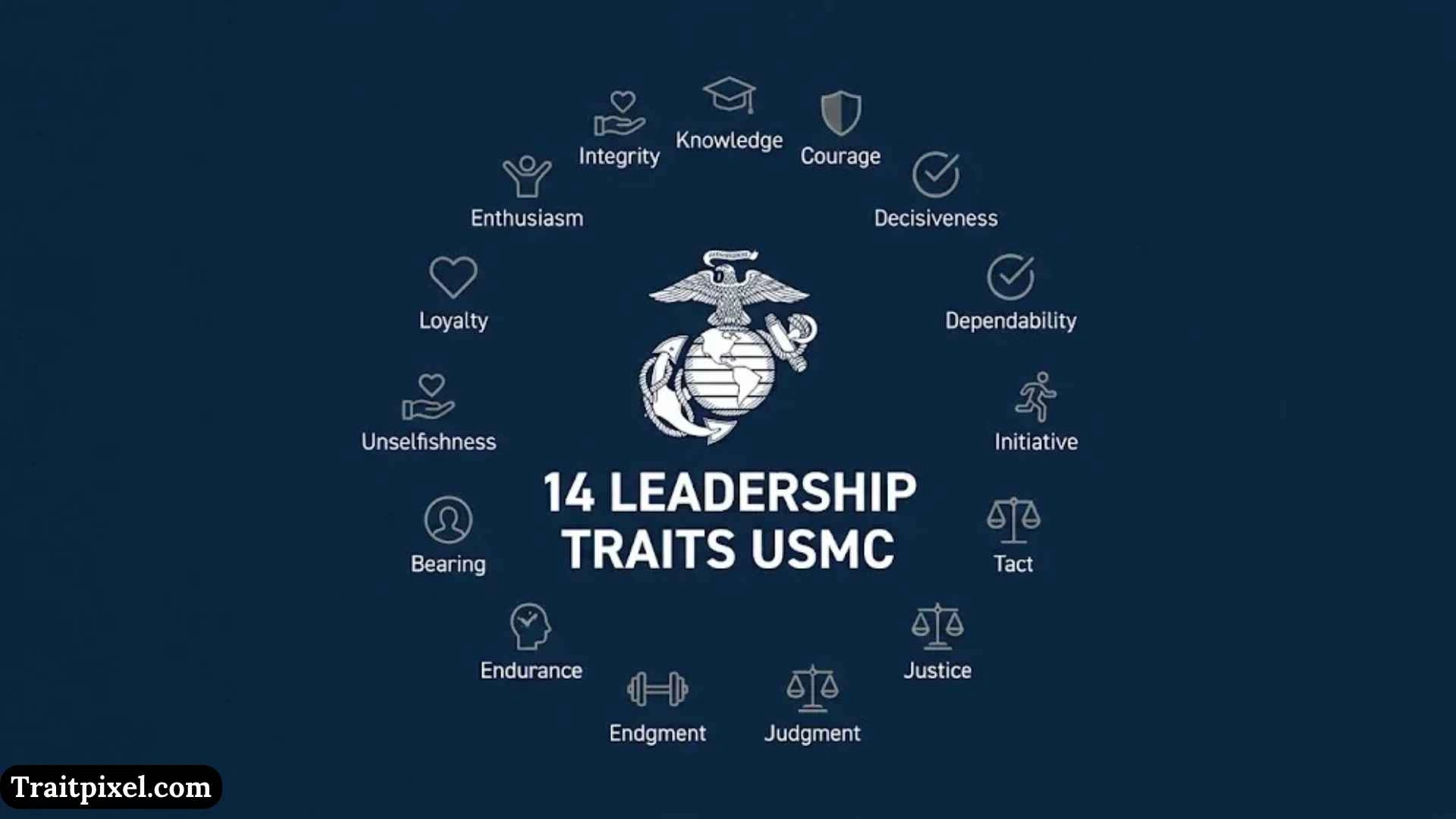
The 14 leadership traits USMC refers to the core qualities the United States Marine Corps uses to teach and evaluate effective leadership. Often remembered through the acronym JJ DID TIE BUCKLE, these traits help Marines understand how leaders should act, make decisions, earn trust, and take responsibility for their teams.
The traits are justice, judgment, dependability, initiative, decisiveness, tact, integrity, enthusiasm, bearing, unselfishness, courage, knowledge, loyalty, and endurance. Each trait serves a practical purpose, from treating people fairly to staying effective under pressure.
Although the Marine Corps developed this framework for military leadership, its lessons also apply to civilian workplaces, education, team management, and everyday life. Understanding the traits can help you become a more accountable, confident, and effective leader.
Quick Answer
The 14 USMC leadership traits are:
- Justice — Treating people fairly and impartially.
- Judgment — Making sound decisions.
- Dependability — Being reliable and fulfilling responsibilities.
- Initiative — Acting appropriately without waiting to be told.
- Decisiveness — Making timely, well-reasoned decisions.
- Tact — Communicating with consideration and respect.
- Integrity — Being honest and following strong moral principles.
- Enthusiasm — Showing genuine interest and commitment.
- Bearing — Maintaining a professional presence and composure.
- Unselfishness — Putting the team’s legitimate needs ahead of personal gain.
- Courage — Facing danger, difficulty, or moral challenges.
- Knowledge — Understanding your job, responsibilities, and people.
- Loyalty — Being faithful to legitimate commitments and responsibilities.
- Endurance — Sustaining effort through physical and mental challenges.
The mnemonic JJ DID TIE BUCKLE helps Marines remember all 14 traits in the correct order.
Overview of the 14 USMC Leadership Traits
| No. | Leadership trait | Core meaning | Practical example |
| 1 | Justice | Fairness and impartiality | Applying standards consistently |
| 2 | Judgment | Sound decision-making | Weighing risks before acting |
| 3 | Dependability | Reliability | Completing assigned tasks on time |
| 4 | Initiative | Proactive action | Addressing a problem before it grows |
| 5 | Decisiveness | Timely decisions | Choosing a workable plan under pressure |
| 6 | Tact | Thoughtful communication | Correcting a mistake respectfully |
| 7 | Integrity | Honesty and moral consistency | Admitting an error instead of hiding it |
| 8 | Enthusiasm | Genuine commitment | Motivating others through engaged effort |
| 9 | Bearing | Professional presence | Staying composed during a difficult situation |
| 10 | Unselfishness | Service before personal gain | Sharing credit with the team |
| 11 | Courage | Physical and moral bravery | Reporting unsafe conduct |
| 12 | Knowledge | Professional understanding | Learning procedures before supervising others |
| 13 | Loyalty | Faithfulness to legitimate obligations | Supporting the mission while speaking honestly |
| 14 | Endurance | Sustained effort | Continuing responsibly through prolonged challenges |
These traits work together. Courage without judgment can become recklessness, while loyalty without integrity can turn into blind obedience. Effective leadership requires balancing the traits according to the situation.
The 14 Leadership Traits USMC: Detailed Definitions and Examples
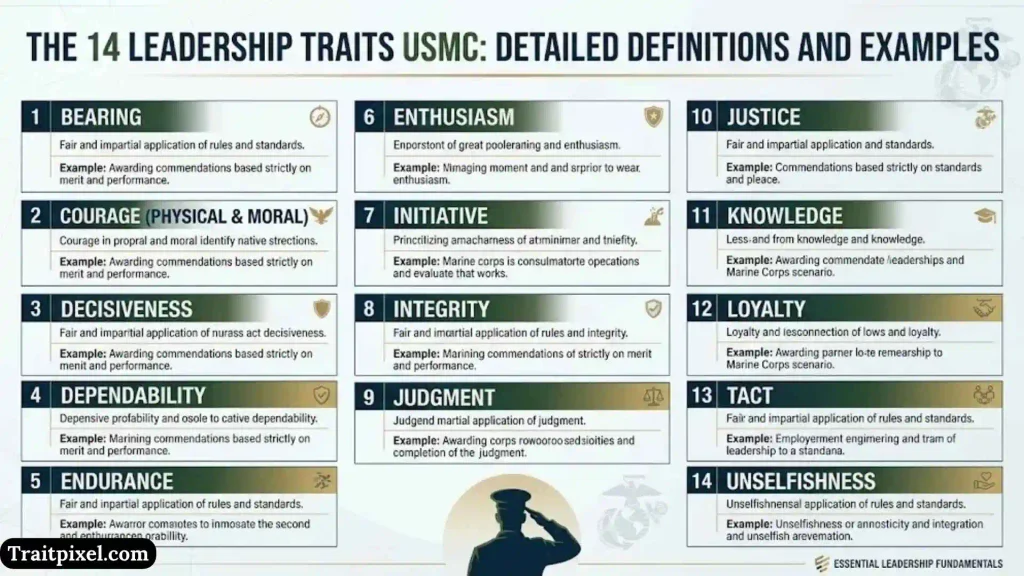
The Marine Corps teaches these traits as practical standards for character and conduct. The definitions below follow the traditional 14-trait framework used in Marine Corps leadership education.
tecom.marines.mil+2
1. Justice
Justice means treating people fairly, consistently, and impartially. A just leader bases decisions on facts, established standards, and the merits of each situation rather than favoritism or personal feelings.
In the Marine Corps, justice helps build trust, discipline, and unit cohesion. Marines need to know that leaders will apply standards fairly, even when doing so is uncomfortable.
Example: Two Marines make the same mistake under similar circumstances. A fair leader considers the facts and applies the appropriate standard consistently instead of punishing one more harshly because of a personal disagreement.
How to develop justice:
- Listen to all sides before making a decision.
- Apply standards consistently.
- Recognize good performance fairly.
- Correct misconduct without personal bias.
- Separate facts from rumors and assumptions.
Key lesson: Fairness strengthens authority because people are more likely to trust leaders who treat them impartially.
2. Judgment
Judgment is the ability to evaluate facts, consider options, and make sound decisions. Good judgment requires more than intelligence. It involves understanding the situation, weighing risks, and recognizing the likely consequences of each choice.
Marine leaders may need to make decisions with limited time or incomplete information. Sound judgment helps them distinguish urgent problems from minor distractions.
Example: During a training exercise, a team leader notices that a plan depends on equipment that isn’t working properly. Rather than continuing simply to meet the schedule, the leader evaluates the risk and chooses a safer course of action.
How to develop judgment:
- Gather the most relevant facts available.
- Consider more than one possible solution.
- Think through the likely consequences.
- Ask experienced people for advice when appropriate.
- Review past decisions to identify lessons.
Key lesson: Good judgment means making the best reasonable decision with the information available, not pretending to know everything.
3. Dependability
Dependability means that others can rely on you to fulfill your responsibilities properly. A dependable leader follows through on commitments, meets standards, and communicates when a problem threatens completion.
In military settings, reliability matters because one person’s failure can affect an entire team. The same principle applies to civilian organizations, where missed deadlines and broken commitments undermine trust.
Example: A Marine is responsible for preparing equipment before a scheduled exercise. The Marine completes the inspection, reports a defect, and follows the required process rather than assuming someone else will handle it.
How to develop dependability:
- Arrive prepared and on time.
- Complete assigned tasks to the required standard.
- Keep track of deadlines and responsibilities.
- Communicate problems early.
- Admit when you cannot meet a commitment.
Key lesson: Dependability is demonstrated through consistent action, not promises.
4. Initiative
Initiative means taking appropriate action without waiting for someone to tell you every step. It involves recognizing what needs to be done, thinking independently, and acting within your authority and the leader’s intent.
Initiative is especially important when circumstances change. A leader who waits passively for detailed instructions may lose valuable time.
Example: During preparation for an inspection, a Marine notices that a required supply is missing. The Marine informs the appropriate supervisor and takes an authorized step to resolve the problem before it delays the team.
How to develop initiative:
- Learn your responsibilities and limits.
- Anticipate common problems.
- Identify useful improvements.
- Take action when the situation allows.
- Report important changes to the chain of command.
Key lesson: Initiative means being proactive and responsible, not ignoring orders or acting outside your authority.
5. Decisiveness
Decisiveness is the ability to make timely decisions and communicate them clearly. A decisive leader doesn’t allow unnecessary hesitation to prevent action when a reasonable choice must be made.
Decisiveness differs from impulsiveness. An impulsive person acts without enough thought, while a decisive person gathers the necessary information and commits to a suitable course of action.
Example: A team has two workable plans for completing a task. After considering the deadline, available resources, and risks, the leader chooses one plan and explains the next steps clearly.
How to develop decisiveness:
- Identify the decision that needs to be made.
- Determine which facts matter most.
- Set a reasonable time limit for evaluating options.
- Choose a course of action.
- Communicate the decision and reassess if circumstances change.
Key lesson: Effective leaders balance careful thinking with the ability to act at the right time.
6. Tact
Tact means dealing with people respectfully while maintaining clear standards. A tactful leader understands how words, timing, tone, and setting can affect a conversation.
Tact doesn’t mean avoiding difficult discussions or agreeing with everyone. It means addressing problems in ways that preserve dignity and support a useful outcome.
Example: A supervisor notices that a team member repeatedly makes an error. Instead of embarrassing the person in front of coworkers, the supervisor discusses the problem privately, explains the expected standard, and offers guidance.
How to develop tact:
- Listen before responding.
- Correct mistakes without personal insults.
- Choose the right time and setting for sensitive feedback.
- Remain firm without becoming hostile.
- Adapt your communication to the situation.
Key lesson: Tact helps leaders correct problems without creating unnecessary resentment.
7. Integrity
Integrity means being honest and acting according to sound moral principles, even when doing so is difficult. It includes telling the truth, accepting responsibility, and keeping your conduct consistent with your stated values.
Integrity is central to leadership because people must be able to trust a leader’s words and decisions.
Example: A leader discovers that a report contains an error that makes the team’s performance look better than it was. The leader corrects the report and accepts responsibility rather than allowing the mistake to remain hidden.
How to develop integrity:
- Tell the truth, including when it is uncomfortable.
- Follow ethical standards when nobody is watching.
- Admit mistakes promptly.
- Keep commitments or explain why you cannot.
- Refuse to mislead others for personal advantage.
Key lesson: Integrity is the alignment between what you believe, what you say, and what you do.
8. Enthusiasm
Enthusiasm is a sincere interest in your duties and a willingness to approach work with energy and commitment. Enthusiastic leaders help create a constructive environment by showing that the mission and the team’s efforts matter.
Enthusiasm doesn’t require constant excitement or forced positivity. Leaders can acknowledge fatigue, setbacks, and frustration while remaining committed to doing the job well.
Example: A team faces a demanding training schedule. The leader stays engaged, explains the purpose of the work, recognizes progress, and encourages the team without pretending the challenge is easy.
How to develop enthusiasm:
- Understand the purpose behind your responsibilities.
- Set meaningful goals.
- Recognize team progress.
- Maintain a constructive attitude during setbacks.
- Support morale through your actions.
Key lesson: Genuine enthusiasm helps sustain motivation, especially when the work becomes difficult.
9. Bearing
Bearing means maintaining a professional presence through your appearance, conduct, communication, and composure. In the Marine Corps, bearing reflects how a Marine carries themselves and responds to demanding situations.
Bearing is not limited to physical appearance or a commanding voice. It also includes emotional control, confidence, attentiveness, and professionalism.
Example: During a tense briefing, a leader listens carefully, speaks clearly, and responds to questions without losing composure. The leader acknowledges uncertainty rather than pretending to have every answer.
How to develop bearing:
- Maintain appropriate grooming and appearance.
- Practice clear, respectful communication.
- Stay composed when challenged.
- Prepare thoroughly before important duties.
- Match your behavior to professional standards.
Key lesson: Strong bearing helps others see that you are prepared, attentive, and capable of handling responsibility.
10. Unselfishness
Unselfishness means considering the needs of others and avoiding personal comfort or advancement at their expense. In Marine Corps leadership, it reflects a commitment to the welfare and development of the people entrusted to your care.
Unselfishness doesn’t mean ignoring your own health or accepting every request. Effective leaders must remain capable of serving the team over time.
Example: A supervisor recognizes that a junior team member has done most of the work on a successful project. Rather than taking all the credit, the supervisor acknowledges the person’s contribution and makes sure it receives appropriate recognition.
How to develop unselfishness:
- Share credit fairly.
- Consider how decisions affect the team.
- Support others’ professional development.
- Listen to concerns about workload and welfare.
- Avoid using authority mainly for personal advantage.
Key lesson: Unselfish leaders put the mission and the team’s legitimate needs ahead of ego.
11. Courage
Courage is the ability to act appropriately despite fear, danger, uncertainty, or possible criticism. The Marine Corps distinguishes between physical courage and moral courage.
Physical courage involves facing physical danger. Moral courage involves standing up for what is right, admitting mistakes, and accepting responsibility when doing so may bring personal consequences.
Example: A Marine notices a serious safety concern that a senior person has overlooked. Raising the concern may be uncomfortable, but the Marine reports it through the appropriate channel.
How to develop courage:
- Prepare through training and practice.
- Learn to recognize fear without letting it control every decision.
- Speak up about serious ethical or safety concerns.
- Accept responsibility for your mistakes.
- Take calculated risks rather than unnecessary ones.
Key lesson: Courage isn’t the absence of fear. It is the willingness to do what is necessary and right despite fear.
12. Knowledge
Knowledge means understanding your profession, responsibilities, people, and the principles needed to perform your duties effectively. For Marines, this includes relevant technical and tactical knowledge as well as an understanding of the people they lead.
A leader who lacks knowledge may make poor decisions, overlook risks, or struggle to earn the team’s confidence. A strong leader also recognizes the limits of their expertise.
Example: Before supervising a technical task, a leader studies the applicable procedures, checks that the team has the required training, and seeks qualified guidance when a problem exceeds their knowledge.
How to develop knowledge:
- Study relevant manuals and procedures.
- Learn from experienced leaders.
- Ask questions when something is unclear.
- Practice essential skills regularly.
- Keep learning as responsibilities change.
Key lesson: Knowledge gives leaders the foundation to make informed decisions and guide others effectively.
13. Loyalty
Loyalty means remaining faithful to legitimate commitments and responsibilities toward your country, organization, team, leaders, and colleagues. In the Marine Corps, loyalty supports trust and unit cohesion.
Loyalty should not be confused with blind agreement. A responsible leader can support the team while raising legitimate concerns, correcting mistakes, and refusing unethical conduct.
Example: A Marine supports a teammate during a difficult assignment but also reports a serious safety violation through the proper channels. The Marine’s commitment to the team includes helping it meet its responsibilities honestly.
How to develop loyalty:
- Honor legitimate commitments.
- Support teammates without concealing misconduct.
- Communicate concerns through appropriate channels.
- Protect confidential information when required.
- Put shared responsibilities ahead of personal rivalries.
Key lesson: True loyalty strengthens a team by combining commitment with integrity.
14. Endurance
Endurance is the physical and mental stamina needed to continue performing through fatigue, stress, discomfort, and hardship. It helps leaders remain effective when tasks take longer than expected or conditions become demanding.
Endurance isn’t simply pushing through every difficulty without rest. Good leaders recognize when recovery, medical attention, or a change in plan is necessary to protect people and maintain performance.
Example: During a prolonged training exercise, a leader maintains a steady pace, monitors the team’s condition, prioritizes essential tasks, and adjusts the plan when fatigue begins to affect performance.
How to develop endurance:
- Build physical fitness progressively.
- Practice staying focused during demanding tasks.
- Develop sound routines for sleep and recovery.
- Break large challenges into manageable steps.
- Recognize when fatigue creates unacceptable risks.
Key lesson: Endurance means sustaining effective effort while using judgment to manage your limits.
How to Remember the 14 USMC Leadership Traits
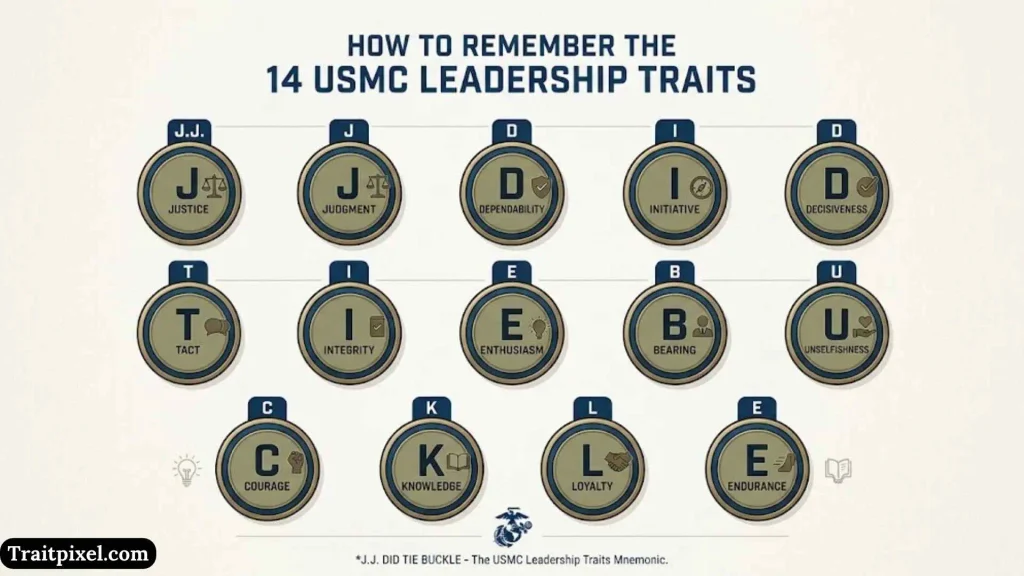
The easiest way to remember the traditional 14 traits is the mnemonic JJ DID TIE BUCKLE. Each letter represents the first letter of a trait, in order.
JJ DID TIE BUCKLE
JJ
Justice
Judgment
DID
Dependability
Initiative
Decisiveness
TIE
Tact
Integrity
Enthusiasm
BUCKLE
Bearing
Unselfishness
Courage
Knowledge
Loyalty
Endurance
Memory tip: Learn the four letter groups first, then practice naming the traits in order.
A Simple Practice Method
Use this short routine to memorize the traits for a class, leadership discussion, or examination.
- Read the mnemonic aloud three times.
- Write all 14 traits from memory.
- Explain each trait in your own words.
- Give one practical example for each trait.
- Repeat the exercise until you can recall the list without looking.
Memorization is only the first step. The deeper goal is to understand how each trait affects decisions, relationships, and performance.
The 14 Leadership Traits vs. the 11 USMC Leadership Principles
The leadership traits describe the qualities a leader should develop. Leadership principles explain how leaders should apply those qualities when working with people and accomplishing a mission.
| Leadership traits | Leadership principles |
| Focus on character and personal qualities | Focus on leadership actions and responsibilities |
| Include integrity, courage, judgment, and tact | Include setting the example, training the team, and keeping Marines informed |
| Help explain what a leader should be | Help explain how a leader should lead |
| Develop through reflection, practice, and accountability | Apply through planning, communication, supervision, and decision-making |
The traditional 11 Marine Corps leadership principles are:
- Know yourself and seek self-improvement.
- Be technically and tactically proficient.
- Know your Marines and look out for their welfare.
- Keep your Marines informed.
- Set the example.
- Ensure that each task is understood, supervised, and accomplished.
- Train your Marines as a team.
- Make sound and timely decisions.
- Develop a sense of responsibility among your subordinates.
- Employ your unit in accordance with its capabilities.
- Seek responsibility and take responsibility for your actions.
These principles complement the traits. For example, knowledge supports technical proficiency, dependability supports task completion, and integrity supports setting the example. The Marine Corps presents both frameworks in its leadership education materials.
MCJROTC+2
Are There 14 or 15 USMC Leadership Traits?
The traditional framework contains 14 traits, but current Marine Corps leadership doctrine also includes empathy as a leadership trait.
The Marine Corps publication MCWP 6-10, Leading Marines, identifies 15 traits and uses the expanded mnemonic JJ DID TIE BUCKLEE. The additional E stands for empathy. This explains why some official Marine Corps educational resources list 14 traits while newer materials list 15.
United States Marine Corps+2
What Is Empathy in Marine Corps Leadership?
Empathy means making a genuine effort to understand the experiences, challenges, and well-being of the people you lead.
An empathetic leader listens to concerns, considers individual circumstances, and recognizes how decisions affect team members. Empathy does not require lowering standards or ignoring misconduct.
Example: A team member’s performance declines after a difficult personal event. An empathetic leader speaks with the individual, assesses the situation, and considers appropriate support while maintaining necessary expectations.
Empathy complements the other traits:
- Justice: Understand individual circumstances while applying fair standards.
- Tact: Communicate in ways that respect people’s dignity.
- Unselfishness: Consider the welfare of others.
- Judgment: Use relevant information to make sound decisions.
- Loyalty: Support the team and its legitimate needs.
For readers studying a specific course, exam, or Marine Corps training document, use the version required by that program. The 14-trait framework remains widely taught, while the 15-trait framework reflects the expanded doctrine.
Real-Life Examples of the 14 Leadership Traits
The traits become easier to understand when applied to everyday decisions. These fictional examples show how they can work together.
| Scenario | Trait demonstrated | Leadership lesson |
| 1. Assigning work fairly | Justice | Distribute responsibilities using consistent standards. |
| 2. Evaluating a risky plan | Judgment | Weigh benefits, risks, and alternatives. |
| 3. Completing a difficult assignment | Dependability | Follow through on commitments. |
| 4. Fixing a preventable problem | Initiative | Act within your authority before the problem grows. |
| 5. Choosing between two plans | Decisiveness | Make a timely decision and communicate it clearly. |
| 6. Giving corrective feedback | Tact | Address the problem without humiliating the person. |
| 7. Reporting a mistake | Integrity | Tell the truth and accept responsibility. |
| 8. Encouraging a tired team | Enthusiasm | Sustain commitment without dismissing difficulties. |
| 9. Remaining calm in a briefing | Bearing | Project professionalism under pressure. |
| 10. Sharing recognition | Unselfishness | Give credit where it belongs. |
| 11. Raising an ethical concern | Courage | Do what is right despite possible criticism. |
| 12. Learning a new procedure | Knowledge | Prepare before taking responsibility. |
| 13. Supporting a teammate honestly | Loyalty | Protect the team without hiding misconduct. |
| 14. Managing a prolonged challenge | Endurance | Maintain effective effort and manage fatigue. |
What These Examples Reveal
Leadership rarely depends on one trait alone. A decision about an underperforming team member, for instance, may require judgment to assess the facts, justice to apply standards fairly, tact to communicate the problem, and courage to address it.
This is why memorizing definitions isn’t enough. The traits are most useful when leaders recognize which qualities a situation requires and balance them appropriately.
Common Misconceptions About USMC Leadership Traits
Myth: Leadership Means Giving Orders
Fact: Giving clear directions is important, but leadership also requires accountability, judgment, communication, and concern for the team. A leader who issues orders without understanding the situation may undermine the mission.
Myth: Courage Means Never Feeling Fear
Fact: Courage involves acting appropriately despite fear. Physical and moral courage both require the ability to face difficult circumstances without allowing fear to dictate every decision.
Myth: Initiative Means Acting Without Permission in Every Situation
Fact: Initiative means taking appropriate action within your authority and responsibilities. Leaders must understand their limits, follow lawful orders, and communicate important decisions when required.
Myth: Loyalty Means Always Agreeing With Your Leader
Fact: Loyalty involves commitment to legitimate responsibilities and shared values. Respectfully raising a serious concern can be more loyal than remaining silent about a harmful mistake.
Myth: Bearing Is Only About Appearance
Fact: Professional appearance matters in military settings, but bearing also includes composure, conduct, communication, and self-control.
Myth: Endurance Means Ignoring Fatigue
Fact: Endurance involves sustaining performance through hardship. Sound judgment is still necessary because exhaustion can affect safety, decision-making, and mission effectiveness.
Myth: The 14 Traits and 15 Traits Are Contradictory
Fact: Both versions appear in Marine Corps educational materials. The traditional 14-trait framework uses JJ DID TIE BUCKLE, while the expanded framework adds empathy and uses JJ DID TIE BUCKLEE.
How to Apply USMC Leadership Traits in Civilian Life
The Marine Corps leadership framework can also help teachers, managers, students, coaches, and community leaders improve their conduct.
| Civilian setting | Traits to emphasize | Practical application |
| Workplace | Integrity, dependability, judgment | Keep commitments and make evidence-based decisions. |
| Education | Initiative, knowledge, endurance | Take responsibility for learning and persist through challenges. |
| Business | Decisiveness, justice, tact | Make timely decisions, treat employees fairly, and communicate clearly. |
| Sports | Enthusiasm, courage, unselfishness | Encourage teammates, face setbacks, and share credit. |
| Family life | Tact, loyalty, judgment | Communicate respectfully and honor reasonable commitments. |
| Community service | Justice, integrity, empathy | Consider different perspectives and serve people responsibly. |
The military setting has unique responsibilities, but the underlying lessons about trust, fairness, preparation, and accountability apply broadly.
How to Develop the Leadership Traits Step by Step
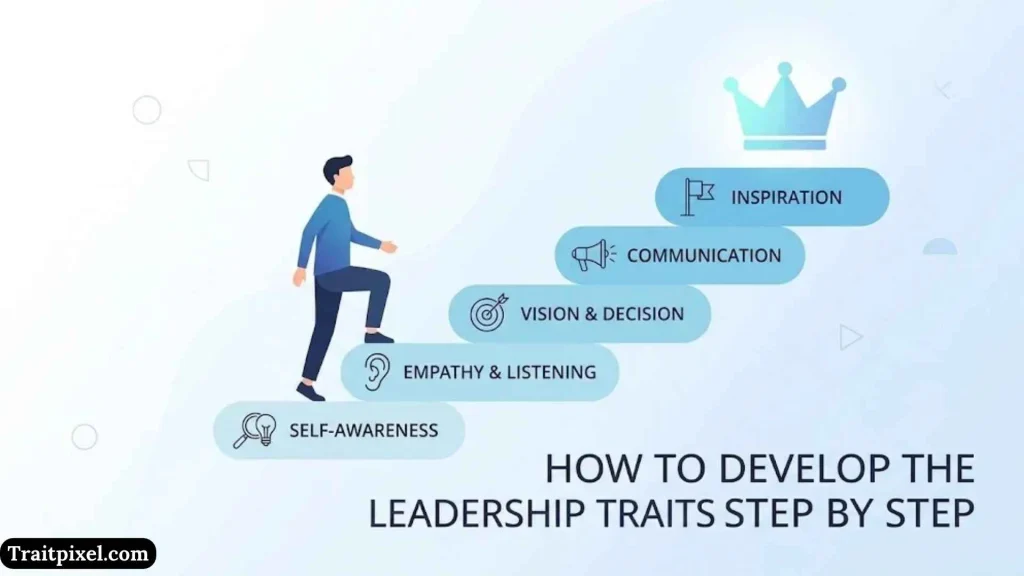
You can strengthen these qualities through deliberate practice rather than relying on personality alone.
Step 1: Assess Your Current Strengths
Review each trait and identify where you perform well. Then consider situations in which you struggle.
For example, you might be dependable with deadlines but hesitate to make decisions when information is incomplete. This gives you a clear area to work on.
Step 2: Choose One Trait to Improve
Focus on a specific behavior instead of setting a vague goal such as “become a better leader.”
If you want to improve tact, practice giving feedback privately and respectfully. If you want to improve initiative, identify one recurring problem you can address within your authority.
Step 3: Set a Measurable Practice Goal
Create a simple goal that you can observe.
Examples include:
- Complete every assigned task by the agreed deadline.
- Ask for relevant facts before making a difficult decision.
- Give each team member a chance to explain their perspective.
- Admit and correct mistakes as soon as you identify them.
- Recognize a colleague’s contribution during a team review.
These actions make abstract qualities easier to develop and evaluate.
Step 4: Request Honest Feedback
Ask a trusted supervisor, instructor, or teammate which leadership behaviors you demonstrate consistently and which need improvement.
Specific questions produce better feedback than asking whether you’re a good leader. For example, ask whether you communicate decisions clearly or apply standards consistently.
Step 5: Review Your Decisions
After a difficult task, consider what went well, what could have been better, and which traits influenced the outcome.
A short review helps turn experience into learning. Repeat the process regularly and adjust your goals as your responsibilities grow.
Frequently Asked Questions
What does JJ DID TIE BUCKLE stand for?
JJ DID TIE BUCKLE stands for Justice, Judgment, Dependability, Initiative, Decisiveness, Tact, Integrity, Enthusiasm, Bearing, Unselfishness, Courage, Knowledge, Loyalty, and Endurance. It is the traditional mnemonic used to memorize the 14 USMC leadership traits.
What are the 14 leadership traits of the Marine Corps?
The 14 traditional traits are justice, judgment, dependability, initiative, decisiveness, tact, integrity, enthusiasm, bearing, unselfishness, courage, knowledge, loyalty, and endurance. They describe qualities that support effective military leadership and professional conduct.
What is the most important USMC leadership trait?
No single trait replaces the others. Integrity is foundational because trust depends on honesty and moral consistency, but effective leadership also requires judgment, courage, justice, and the ability to fulfill responsibilities.
What is the difference between USMC leadership traits and core values?
Leadership traits describe qualities that leaders should develop and demonstrate. The Marine Corps’ three core values are Honor, Courage, and Commitment. The frameworks are related, but they serve different purposes. Courage appears in both because it is both a core value and a leadership trait.
Why are the Marine Corps leadership traits important?
The traits give Marines a shared framework for developing character, evaluating conduct, and building trust. They also help leaders identify strengths and weaknesses in their own behavior and in the way they lead others.
Are the USMC leadership traits used outside the military?
Yes. The traits can help civilian managers, teachers, students, coaches, and community leaders develop fairness, reliability, sound judgment, and accountability. Their application should reflect the responsibilities and needs of each setting.
What are the 11 Marine Corps leadership principles?
The 11 principles include knowing yourself and seeking improvement, being technically and tactically proficient, looking after your Marines, keeping them informed, setting the example, supervising tasks, training as a team, making sound decisions, developing responsibility, employing a unit according to its capabilities, and accepting responsibility.
Is empathy one of the 14 USMC leadership traits?
Empathy is included in the expanded 15-trait framework in MCWP 6-10, Leading Marines. Traditional educational materials often teach the original 14 traits. The appropriate list depends on the publication or course being used.
How can I memorize the 14 leadership traits for an exam?
Learn the mnemonic in four groups: JJ, DID, TIE, and BUCKLE. Write the full list from memory, check your answers, and repeat the exercise. Practice explaining each trait with a short example to improve recall and understanding.
Can leadership traits be learned?
Yes. Although people may naturally find certain behaviors easier than others, leadership qualities can be strengthened through education, practice, feedback, and reflection. Consistent behavior is a better measure of progress than memorizing definitions alone.
Key Takeaways
- The traditional USMC leadership framework contains 14 traits summarized by JJ DID TIE BUCKLE.
- Each trait describes a quality that supports effective leadership, responsible decisions, and trust.
- Justice, judgment, dependability, and integrity help leaders act fairly and responsibly.
- Initiative, decisiveness, and courage help leaders respond to challenges appropriately.
- Tact, enthusiasm, bearing, unselfishness, knowledge, loyalty, and endurance support effective teamwork and professional conduct.
- Current Marine Corps doctrine also includes empathy, creating an expanded list of 15 traits.
- The 11 leadership principles explain how leaders put their qualities into practice.
- Regular self-assessment, deliberate practice, and honest feedback can help anyone strengthen leadership skills.
Conclusion
The 14 leadership traits USMC framework provides a practical foundation for understanding what effective leadership looks like. Its emphasis on justice, judgment, dependability, initiative, decisiveness, tact, integrity, enthusiasm, bearing, unselfishness, courage, knowledge, loyalty, and endurance connects personal character with everyday leadership decisions.
The mnemonic JJ DID TIE BUCKLE makes the traditional list easy to remember, but applying the traits is what gives them value. Leaders demonstrate these qualities through fair decisions, honest communication, responsible action, and consistent care for the people they lead.
For anyone studying Marine Corps leadership, the best approach is to learn the definitions, understand the examples, and practice the behaviors. Strong leadership is not built from a single trait. It develops when these qualities work together in service of the mission, the team, and the responsibilities of leadership.

I’m Elliot Kingsley, a British author interested in the subtle characteristics that influence how people think, communicate, and respond to the world. I write about personality traits, strengths, tendencies, and behavioural qualities in clear language. My goal is to encourage readers to understand individual differences and appreciate the complexity of human character.
Books:
- The Psychology of Personality Traits
- Character in Context