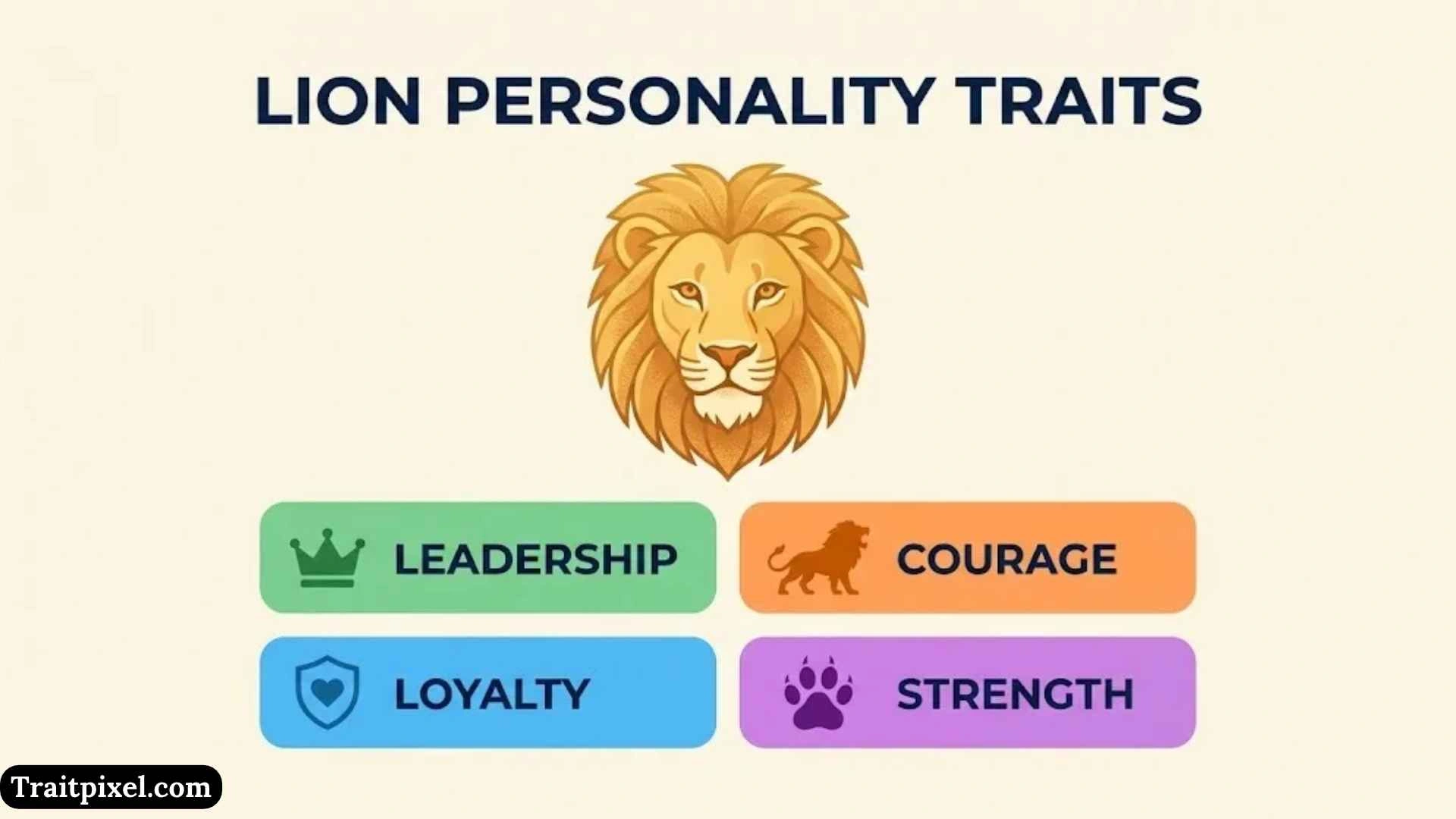
Lions are powerful social predators known for their strength, confidence, courage, and complex relationships. When people describe lion personality traits, they usually mean qualities such as bravery, leadership, protectiveness, patience, and dominance. These traits help explain how lions hunt, defend territory, raise cubs, and live in prides.
However, a lion’s behavior isn’t simply about being fierce or fearless. Lions are social animals that rest for long periods, cooperate during hunts, care for their young, and respond to changing threats. Understanding their behavior means looking at both their physical abilities and their social lives.
Quick Answer: What Are the Main Lion Personality Traits?
The main lion personality traits include:
- Courage: Lions may confront threats to protect themselves, their cubs, or their territory.
- Confidence: Their size, strength, and behavior can help them compete with rivals.
- Social bonding: Pride members form relationships and may cooperate in hunting and cub care.
- Protectiveness: Lions can defend cubs, mates, and territory against perceived threats.
- Patience: They often rest for long periods and may wait for a suitable hunting opportunity.
- Dominance: Some lions establish social status through competition and displays of strength.
- Cooperation: Lions sometimes work together to hunt, defend territory, and raise young.
- Adaptability: They adjust their behavior to prey availability, habitat, and social conditions.
- Territoriality: Lions use scent marking, vocalizations, and other behaviors to signal their presence.
- Independence: Individual lions can make decisions and act alone, even within a social pride.
These are useful descriptions of lion behavior, not fixed human-style personality labels. Individual lions differ, and their actions depend on age, sex, experience, health, environment, and social position.
Lion Personality Traits at a Glance
| Trait | How it appears in lions | Why it matters |
| Courage | Facing rivals or potential threats | Can help with defense and competition |
| Strength | Powerful muscles and forceful movements | Supports hunting and fighting |
| Social bonding | Grooming, resting together, and maintaining relationships | Helps preserve pride relationships |
| Protectiveness | Defending cubs or responding to danger | Can improve offspring survival |
| Patience | Waiting, stalking, and resting | Helps conserve energy |
| Dominance | Competing for access to mates or social position | Influences reproductive opportunities |
| Cooperation | Coordinated hunting or group defense | Can improve success in certain situations |
| Territoriality | Roaring, scent marking, and patrolling | Helps communicate occupancy and deter rivals |
| Adaptability | Changing activity or hunting behavior | Supports survival under different conditions |
| Independence | Exploring, hunting, or responding without group assistance | Helps individuals manage immediate needs |
These traits describe common behavioral patterns rather than guarantees about every lion.
What Does Lion Personality Mean?
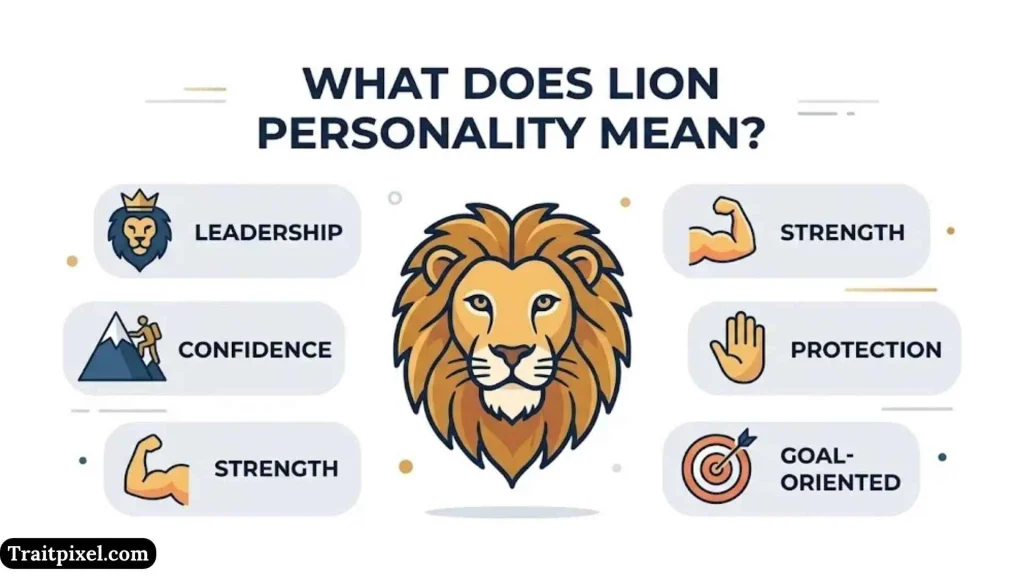
A lion’s personality refers to its individual patterns of behavior, reactions, and interactions. Scientists may study animal personality by examining whether an individual shows relatively consistent differences in behavior across situations, such as boldness, aggression, sociability, or activity.
In everyday language, people often call lions brave, proud, protective, or commanding. These words can make their behavior easier to understand, but they also reflect human interpretations.
For example, a lion that approaches an unfamiliar object might appear curious or bold. A lion that avoids it might be cautious. Neither response automatically makes one lion better than the other. Caution can reduce risk, while boldness can help an animal explore opportunities.
The key distinction: A lion’s behavior is shaped by both individual differences and immediate circumstances. A hungry lion, a lion defending cubs, and a lion resting after a meal may act very differently.
Positive Lion Personality Traits
Lions display several behaviors that people often associate with positive qualities, including cooperation, persistence, social bonding, and protectiveness. These traits can help them survive in environments where food, territory, and reproduction create constant challenges.
Courage
Courage is one of the most recognizable qualities associated with lions. They may confront rivals, defend their territory, or respond aggressively when they perceive a threat.
However, courage doesn’t mean lions never retreat. Avoiding a dangerous confrontation can conserve energy and prevent serious injuries.
Example: A resident male may challenge an unfamiliar male approaching his pride, but he may withdraw if the opponent has a clear advantage.
Leadership
Lions don’t lead through human-style planning or formal authority. Instead, their social structure develops through relationships, competition, experience, and reproductive roles.
Adult males may help defend a pride’s territory, while lionesses often coordinate hunting and contribute to cub care. These different roles show why lion behavior cannot be reduced to a single leader controlling every activity.
Example: During a hunt, several lionesses may approach prey from different directions. Their actions can look like teamwork, although the group doesn’t necessarily follow one fixed leader.
Loyalty and Social Bonding
Lions form social relationships with other members of their pride. Related females may remain together for much of their lives, while male coalitions can consist of brothers or other relatives.
Grooming, resting close together, and friendly physical contact help maintain social bonds. These relationships can matter during hunting, territorial defense, and the raising of young.
Example: Two male lions that grew up together may remain partners after leaving their birth pride, giving each other support while competing for access to territory.
Protectiveness
Protective behavior is especially noticeable when lions respond to threats near their cubs or territory. Adult lions may confront intruders or position themselves between a perceived danger and vulnerable pride members.
Protection isn’t always successful, and lions don’t behave protectively toward every individual. Their responses depend on social relationships and circumstances.
Example: A lioness may become highly alert when an unfamiliar animal approaches her cubs, even if she was resting calmly moments earlier.
Patience
Lions often rest for extended periods and save their energy for activities such as hunting, feeding, and territorial defense. During a hunt, they may remain still while approaching prey or wait for a suitable opportunity to attack.
This behavior is better understood as energy management than as a deliberate human-like lesson in patience.
Example: A lion may remain hidden in tall grass until a herd moves within striking distance rather than chase prey across an open plain.
Cooperation
Cooperation is one of the most important features of lion social behavior. Pride members may work together to hunt large prey, defend territory, or care for cubs.
Group hunting doesn’t guarantee success. The outcome depends on prey species, terrain, wind, the positions of individual lions, and the condition of the animals involved.
Example: Several lionesses may spread out around a herd, increasing the chance that one can approach a vulnerable animal.
Confidence and Boldness
Lions can appear confident when they approach unfamiliar surroundings, confront rivals, or investigate potential food sources. However, confidence is a human interpretation of behavior. Researchers would need to observe consistent individual patterns before describing a lion as unusually bold.
Example: One lion may investigate a new object quickly, while another approaches slowly or keeps its distance.
Both responses may be reasonable in an unfamiliar situation.
Negative Lion Personality Traits
Some lion behaviors may look negative from a human perspective. In nature, however, aggression, competition, and territorial defense can serve survival or reproductive functions.
Aggression
Lions can behave aggressively during fights over territory, mating opportunities, food, or social access. Such encounters can lead to serious injuries.
Aggression is not constant. Lions also spend substantial time resting, grooming, playing, and interacting peacefully with familiar group members.
Example: Two rival males may fight when one attempts to replace the other as a pride’s resident male.
Dominance
Dominance describes the outcome of repeated social interactions in which one animal consistently gains priority over another in particular contexts. It doesn’t mean that one lion controls every decision or always wins every confrontation.
Male lions may compete intensely for access to prides and breeding opportunities. Within a pride, relationships can be more complex than a simple ranking system.
Example: A resident male may challenge another male near the pride’s boundary but avoid an unnecessary confrontation when the rival retreats.
Territorial Behavior
Lions defend areas that provide access to prey, water, shelter, and opportunities to reproduce. They communicate their presence through roaring, scent marking, and other behaviors.
Territoriality can reduce encounters with competitors, but it also creates conflict when neighboring groups or incoming males challenge existing residents.
Example: A lion may roar repeatedly at night, signaling its presence to nearby lions and potentially discouraging rivals from approaching.
Impulsiveness or Reactivity
A lion may respond quickly to a sudden sound, movement, or close approach. Yet calling this impulsiveness can be misleading because the response may be a useful reaction to danger.
Scientists distinguish between an immediate response to a threat and a stable tendency to act without caution. The latter requires more careful observation.
Example: A lion resting near a water source may suddenly stand and move away when a large herd approaches.
Competition
Competition affects access to food, territory, mates, and other resources. Lions may compete directly or use displays and vocalizations to discourage rivals.
Competition can help determine which animals reproduce, but it can also increase stress and injury risk.
Example: Several lions may compete for access to a carcass, especially when food is limited or the group is large.
Physical Traits vs. Behavioral Traits in Lions
Physical traits describe a lion’s body and appearance. Behavioral traits describe how it acts and responds to its environment.
| Physical trait | Behavioral trait | How they relate |
| Powerful forelimbs | Grappling with prey or rivals | Strength supports physical confrontation |
| Sharp claws | Gripping and restraining prey | Claws help with hunting and defense |
| Large canine teeth | Biting prey | Teeth are adapted to a carnivorous diet |
| Adult male mane | Competitive display and some neck protection | Mane appearance can influence interactions |
| Keen senses | Detecting movement and sounds | Sensory information supports hunting and threat detection |
| Muscular body | Short bursts of speed and force | Body structure supports ambush hunting |
| Strong vocal apparatus | Roaring and other vocalizations | Sounds communicate presence and social information |
Physical traits can influence behavior, but they don’t determine every action. A large, powerful lion may avoid a fight, while a smaller lion may defend itself when escape isn’t possible.
Male Lion Traits vs. Female Lion Traits
Male and female lions share many behavioral characteristics, but they often play different roles in wild populations. These differences aren’t absolute, and individuals may behave differently depending on their age, social position, and circumstances.
| Feature | Male lions | Female lions |
| Common social role | Resident males may help defend the pride’s territory | Lionesses often maintain the core social group |
| Hunting | Hunt alone when nomadic and may join group hunts | Often perform much of the pride’s hunting |
| Territorial behavior | Roar, scent-mark, patrol, and confront rivals | Also roar, scent-mark, and defend their territory |
| Social relationships | May form coalitions, often with relatives | Related females often maintain long-term bonds |
| Reproduction | Compete for access to prides and mating opportunities | Give birth and provide much of the care for cubs |
| Appearance | Usually develop a mane, though its size and color vary | Usually lack a prominent mane |
| Independence | Young males often leave their birth pride | Females often remain in their birth pride |
These are broad patterns, not rigid rules. Male lions sometimes hunt alongside females, and lionesses also participate in defense.
How a Lion’s Personality Changes With Age
Lion behavior changes as an individual grows, gains experience, and moves through different social stages. A cub’s playfulness, an adolescent’s exploration, and an adult’s territorial behavior serve different purposes.
Lion Cubs: Playful and Curious
Lion cubs use play to develop coordination, strength, and social skills. They may chase one another, wrestle, stalk moving objects, and explore their surroundings.
Play can help them practice movements that later become useful during hunting or social encounters. Cubs still depend heavily on adults for protection and food.
Adolescent Lions: Exploratory and Competitive
As lions mature, they begin developing the physical and social skills needed for adulthood. Young males eventually leave their birth pride and may form coalitions with other males.
Young females often remain with their maternal pride. Their experiences depend on the group’s stability, food availability, and the risks in their environment.
Adult Lions: More Established Behavior
Adult lions generally have greater physical strength and more experience than younger animals. Their behavior may reflect established relationships, reproductive opportunities, and familiarity with their surroundings.
An adult lion isn’t necessarily more aggressive or confident than a younger one. Age alone cannot explain an individual’s behavior.
Older Lions: Energy and Health Matter More
Older lions may experience changes in strength, mobility, and hunting ability. Their behavior can shift as their physical condition changes.
An older lion might avoid a costly fight or spend more time resting. Such behavior may reflect practical limits rather than a change in its underlying personality.
What Influences a Lion’s Personality and Behavior?
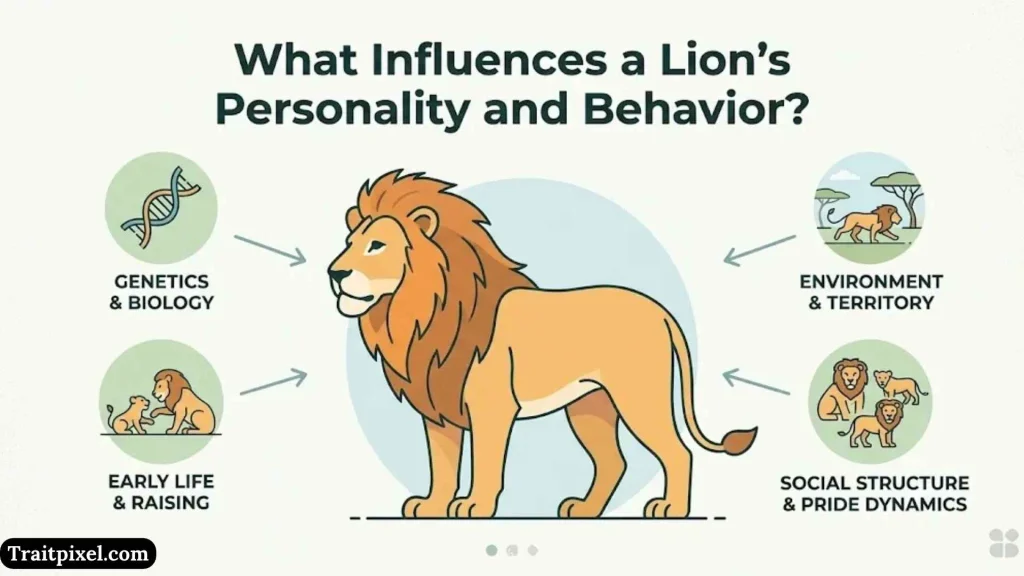
A lion’s behavior develops through the interaction of several factors. No single trait explains how every lion responds to a particular situation.
- Genetics: Inherited characteristics can contribute to physical development and may influence behavioral tendencies.
- Early experience: Experiences during cubhood can affect how an individual responds to its surroundings.
- Age: Young lions, mature adults, and older animals face different challenges.
- Sex and reproductive status: These can influence competition, territorial behavior, and social roles.
- Social relationships: Familiar pride members and unfamiliar lions may receive very different responses.
- Food availability: Scarcity can intensify competition and alter movement or hunting behavior.
- Habitat: Vegetation, terrain, water access, and prey distribution affect how lions hunt and travel.
- Health and injury: Pain, illness, or reduced mobility can change an animal’s activity and reactions.
- Immediate threats: A lion protecting cubs may respond differently from one resting in a secure location.
The practical lesson is simple: observe the situation before assigning a personality label. A lion that retreats from danger isn’t necessarily timid, and one that attacks isn’t automatically courageous. Context matters.
How Lions Communicate Their Traits Through Behavior
Lions communicate through sounds, body posture, facial expressions, scent marking, and physical contact. These signals help them maintain relationships, warn rivals, and respond to possible threats.
Roaring
A roar can communicate a lion’s presence over a wide area. Lions use roaring in territorial and social contexts, although the meaning depends on the situation.
A roar isn’t simply a sign of anger. It can function as a long-distance signal to other lions.
Body Language
A lion’s posture can provide clues about its immediate state. A tense body, direct approach, growling, or repeated attempts to close distance may signal a potential threat. Relaxed posture and grooming can occur during peaceful social interactions.
No single gesture should be interpreted in isolation. Observers should consider the lion’s surroundings, other animals, and changes in behavior.
Scent Marking
Lions use scent to communicate information about their presence and territory. They may spray urine, rub against vegetation, or scratch the ground.
These behaviors provide information to other lions even when the animals aren’t physically together.
Grooming and Physical Contact
Pride members may rub against each other, groom one another, or rest close together. These interactions can reinforce familiarity and social bonds.
Such behavior shows that lion life involves more than hunting and fighting. Social contact is an important part of their daily routine.
14 Real-Life Examples of Lion Personality Traits
The following scenarios illustrate how commonly described traits appear in lion behavior. They are examples based on known behavioral patterns, not claims about specific named lions.
| Situation | Trait illustrated | What the behavior shows |
| A lion confronts a rival near its territory | Courage | It responds to a potential challenge |
| A lioness waits in cover before attacking | Patience | It conserves energy and waits for a better opportunity |
| Several lionesses approach prey from different directions | Cooperation | Group members may contribute to a hunt |
| Two related males remain together after leaving their birth pride | Social bonding | Relationships can support coalition formation |
| A lioness responds to a threat near her cubs | Protectiveness | Her behavior reflects the risk to her offspring |
| A lion roars near a territorial boundary | Territoriality | It signals its presence to other lions |
| A young cub chases its sibling | Playfulness | Play helps develop coordination and social skills |
| A lion investigates an unfamiliar scent | Curiosity | It gathers information about its surroundings |
| A lion withdraws from a stronger rival | Risk avoidance | Retreat may prevent a costly injury |
| A nomadic male hunts without pride members | Independence | It must obtain food without group assistance |
| A lion approaches a carcass while competitors are nearby | Competition | Food access may involve risk and confrontation |
| A lion rests in shade during hot weather | Energy conservation | Activity changes with environmental conditions |
| A lioness changes her approach when prey turns toward her | Adaptability | Hunting behavior responds to changing circumstances |
| A lion pauses when it hears an unfamiliar sound | Alertness | It assesses a possible threat before acting |
| A lion grooms a familiar pride member | Social bonding | Physical contact helps maintain relationships |
| A lion moves away from a crowded water source | Conflict avoidance | It may reduce the chance of a confrontation |
These examples also show why lion behavior is flexible. The same individual can appear bold in one setting and cautious in another.
Common Misconceptions About Lion Personality Traits
Popular stories often portray lions as fearless rulers who always dominate their surroundings. Real lion behavior is more complicated.
Myth: Lions Are Always Fearless
Fact: Lions can retreat, avoid rivals, and respond cautiously to unfamiliar situations. Avoiding danger can be an effective survival strategy.
Myth: Every Male Lion Is the Leader of Its Pride
Fact: Lions don’t follow a single, universal leadership system. Pride relationships vary, and lionesses play central roles in hunting, social cohesion, and raising cubs.
Myth: Lions Are Always Aggressive
Fact: Lions can fight fiercely, but they also spend considerable time resting and engaging in peaceful social behavior. Aggression often depends on context.
Myth: Lions Are Loyal to Every Member of Their Group
Fact: Lions form social bonds, especially with familiar pride members and coalition partners. However, social relationships don’t guarantee universal cooperation or protection.
Myth: Lions Hunt Alone Because They Are Independent
Fact: Lions can hunt alone, particularly when nomadic, but they also cooperate in group hunts. Their approach depends on the prey, habitat, and availability of other lions.
Myth: A Lion’s Mane Proves Its Personality
Fact: Mane size and color vary with factors such as age, genetics, and hormones. Appearance alone doesn’t establish whether a lion is brave, aggressive, or dominant.
Myth: The “King of the Jungle” Title Describes Lion Behavior
Fact: Lions are commonly associated with kingship in human culture, but they don’t rule every habitat or control all other animals. Their success depends on ecological conditions, prey, competitors, and social relationships.
Lion Personality Traits in Human Symbolism
Lions have long served as symbols of courage, strength, leadership, authority, and pride. These associations appear in literature, folklore, national emblems, and popular culture.
However, symbolic meanings aren’t scientific descriptions of lion psychology. Human societies often use a lion’s appearance and behavior as metaphors for qualities they admire or fear.
| Lion-associated quality | Common symbolic meaning | Important distinction |
| Courage | Facing fear or hardship | Real lions also avoid unnecessary risks |
| Strength | Physical power and resilience | Strength doesn’t guarantee success |
| Leadership | Authority and responsibility | Lion social behavior doesn’t mirror human leadership exactly |
| Protection | Defending family or community | Lion defense is shaped by survival and reproduction |
| Pride | Dignity, confidence, or self-respect | A lion’s pride is its social group, not human vanity |
| Independence | Self-reliance | Lions are social animals, although some live or hunt alone |
| Determination | Persistence toward a goal | Animal behavior isn’t necessarily driven by human-like goals |
When people say someone has a “lion personality,” they usually mean that person appears bold, confident, protective, or assertive. That’s a metaphor rather than a formal psychological category.
Lion Personality vs. Tiger Personality
Lions and tigers share many physical and behavioral features because both are large cats. One major difference is their typical social organization.
| Feature | Lion | Tiger |
| Social structure | Usually social, living in prides or male coalitions | Generally solitary outside mating and mother-cub relationships |
| Hunting | Can hunt alone or cooperate | Usually hunts alone |
| Territorial behavior | Uses roaring and scent marking; pride territory may be defended by resident males and females | Uses scent marking, vocalizations, and other signals to maintain individual territories |
| Social bonding | Strong relationships may develop among pride members | Adults generally spend less time in long-term social groups |
| Common symbolic meaning | Courage, leadership, unity | Strength, stealth, independence |
| Behavioral flexibility | Adjusts between group and individual activity | Relies heavily on individual hunting and territorial behavior |
Neither species has a universally superior personality. Their behavior reflects different ecological and social strategies.
How to Describe a Lion’s Personality Accurately
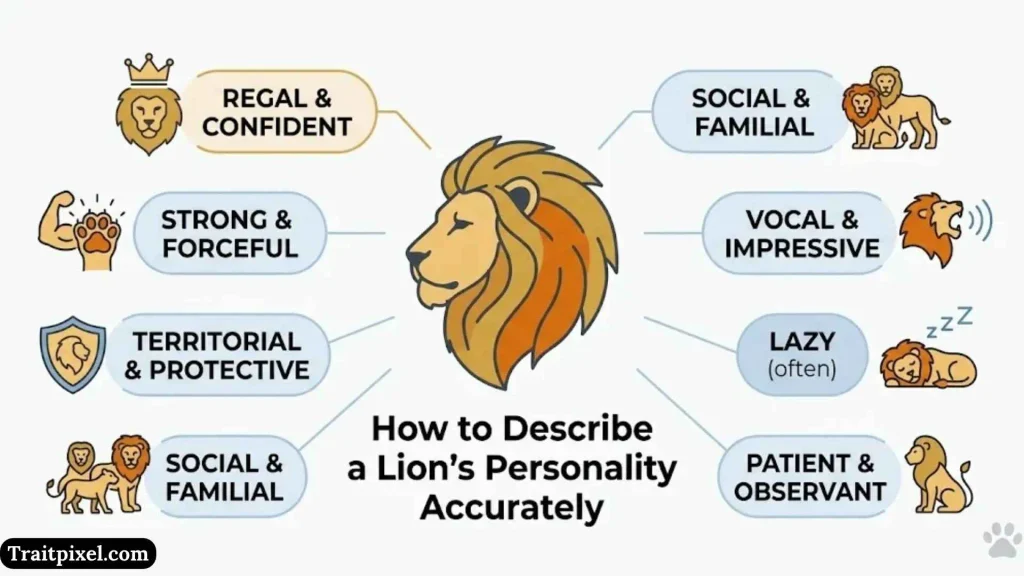
If you’re writing a school report, wildlife description, or character profile, choose words that match observable behavior rather than relying only on popular stereotypes.
Use this simple decision guide:
- Did the lion repeatedly approach unfamiliar objects or situations? Consider bold or exploratory, while noting the context.
- Did it maintain close relationships with familiar lions? Consider social or strongly bonded.
- Did it defend territory or respond to rivals? Consider territorial or competitive.
- Did it wait quietly before approaching prey? Consider patient as an everyday description of its hunting behavior.
- Did it respond quickly to a possible threat? Consider alert or reactive rather than automatically calling it aggressive.
- Did you observe only one event? Describe the behavior directly instead of treating it as a permanent personality trait.
Repeated observations across different situations provide a stronger basis for describing an individual animal than a single dramatic encounter.
Related Animal Traits Worth Understanding
Lion behavior becomes easier to understand when compared with broader concepts in animal behavior.
- Animal temperament: Relatively consistent ways an animal tends to react, such as boldness or caution.
- Social behavior: How animals interact, cooperate, compete, and maintain relationships.
- Territoriality: Behaviors used to establish or defend access to an area.
- Dominance: Patterns of social interaction that influence priority or access in particular contexts.
- Cooperative hunting: Hunting behavior in which multiple animals contribute to an attempt to capture prey.
- Parental care: Behaviors that help offspring survive, including protection and feeding.
- Adaptation: An inherited feature that helps an organism survive or reproduce in a particular environment.
- Animal communication: The use of sounds, scents, movements, and physical contact to convey information.
These terms describe different aspects of behavior. For example, dominance concerns social interactions, while territoriality concerns the use and defense of space. A lion may display both, but they aren’t the same trait.
Frequently Asked Questions About Lion Personality Traits
What are the five main personality traits of a lion?
Five commonly described traits are courage, strength, protectiveness, cooperation, and territoriality. These terms summarize recognizable behavior, but they aren’t a standardized scientific personality test for lions.
Are lions brave or fearful?
Lions can behave boldly when facing threats or pursuing prey, but they also avoid danger. Their responses depend on experience, health, social circumstances, and the level of risk.
Are lions naturally aggressive?
Lions can be aggressive, especially during competition over territory, mates, food, or social position. They also engage in peaceful social interactions and spend long periods resting. Aggression is a behavior, not a constant personality state.
Are lions loyal to their families?
Lions can form strong social bonds. Related females often remain together, and male coalitions may include close relatives. However, social bonds don’t mean lions always cooperate or protect every member in every situation.
Are lionesses more cooperative than male lions?
Lionesses often cooperate in hunting and cub care, while resident males may contribute to territorial defense. Male lions also form coalitions and can cooperate closely. Their behavior reflects different social roles rather than a simple difference in personality.
What makes a lion a good hunter?
Lions combine strength, stealth, sharp senses, and flexible hunting strategies. Cooperation can improve hunting opportunities in some circumstances, especially when pursuing large prey. Success still depends on the environment and the type of prey.
Do lions have individual personalities?
Individual lions can differ in behavior, and researchers study consistent behavioral differences in many animal species. However, a single observation isn’t enough to establish a stable personality trait. Repeated observations provide stronger evidence.
What does a lion symbolize in personality descriptions?
A lion commonly symbolizes courage, confidence, strength, leadership, and protectiveness. These meanings come from human culture and symbolism rather than a scientific classification of lion personality.
Are lions more independent or social?
Lions are among the most social wild cats. They often live in prides, but individual lions may also hunt alone, travel independently, or live outside a pride for a period. Both social cooperation and individual action are part of their behavior.
Can a lion be described as calm?
Yes, if its observable behavior is relaxed in a particular situation. However, calm behavior at one moment doesn’t prove that the lion is always calm. A lion’s response may change when food, rivals, cubs, or other threats enter the picture.
Key Takeaways
- Lions are social predators whose behavior includes cooperation, competition, territorial defense, and strong social relationships.
- Commonly described lion personality traits include courage, strength, patience, protectiveness, boldness, and adaptability.
- Aggression and dominance are context-dependent behaviors, not constant characteristics of every lion.
- Male and female lions often perform different roles, but both can hunt, communicate, and defend territory.
- Age, health, genetics, experience, social relationships, and environmental conditions all influence behavior.
- Human descriptions such as “king,” “fearless,” and “loyal” can be useful metaphors, but they don’t fully explain lion behavior.
- Repeated observations offer a more reliable basis for describing an individual lion than one isolated action.
Conclusion
Lion personality traits include a range of behaviors associated with courage, strength, cooperation, protectiveness, patience, and territoriality. Lions can be bold in one situation and cautious in another, depending on the risks and opportunities around them.
Their social lives reveal more than the familiar image of a fierce predator. Lions build relationships, cooperate during hunts, care for cubs, compete with rivals, and adjust their behavior to changing conditions.
Understanding these patterns gives you a more accurate picture of the lion. Rather than assuming every lion is fearless or dominant, look at how the animal behaves, what its circumstances demand, and whether the behavior appears consistently over time.

I’m Nathaniel Brooks, a British writer fascinated by the qualities that shape personality, character, and behaviour. I explore human traits through practical explanations and thoughtful observations, helping readers understand what different characteristics can reveal. My aim is to make personality concepts accessible, engaging, and useful for anyone curious about human nature.
Books:
- The Atlas of Human Traits
- Understanding Personality and Character