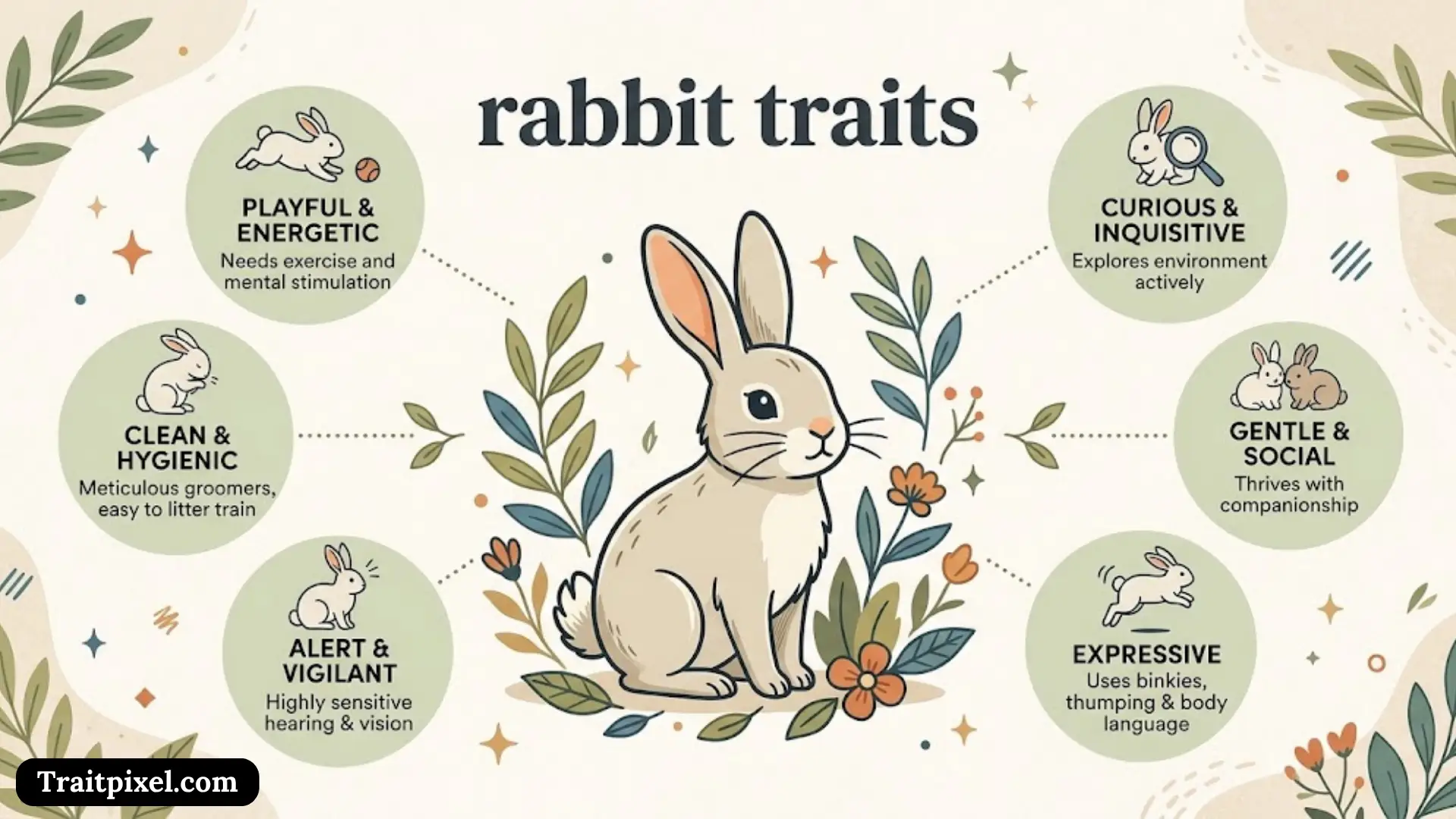
Rabbit traits include the physical features, natural behaviors, sensory abilities, social habits, and personality characteristics that make rabbits unique. Rabbits are small mammals known for their long ears, powerful hind legs, soft fur, constantly growing teeth, and strong instincts for survival. They are also intelligent, social animals that can form bonds with people and other rabbits.
Understanding rabbit characteristics helps pet owners provide better care, recognize signs of stress, and build trust with their animals. It also explains how wild rabbits survive, communicate, find food, and protect themselves from predators.
Whether you are learning about rabbits for school, considering a pet rabbit, or simply curious about animal behavior, this guide covers their physical traits, temperament, diet, communication, genetics, survival instincts, and common misconceptions.
Quick Answer
What are the main traits of a rabbit?
The main rabbit traits include long ears, strong hind legs, continuously growing teeth, a compact body, sensitive hearing, a wide field of vision, herbivorous eating habits, and powerful instincts to hide from predators. Rabbits are generally alert, gentle, cautious, and social, although their personalities vary by individual. They communicate through body posture, scent marking, ear movements, foot thumping, and other behaviors. Domestic rabbits can become affectionate companions when they feel safe and receive proper care.
Rabbit Trait Overview Table
| Trait category | Main characteristics | Why it matters |
| Physical appearance | Long ears, fur, compact body, strong hind legs | Supports movement, protection, and temperature regulation |
| Teeth | Continuously growing incisors and cheek teeth | Requires a suitable diet rich in fiber |
| Vision | Wide field of view | Helps detect approaching predators |
| Hearing | Mobile ears and sensitive hearing | Helps locate sounds and potential danger |
| Diet | Herbivorous | Requires appropriate plant-based foods |
| Behavior | Digging, chewing, hiding, exploring | Reflects natural instincts |
| Social nature | Bonding, grooming, social interaction | Influences companionship and housing |
| Temperament | Cautious, curious, playful, or affectionate | Varies with genetics, experience, and environment |
| Communication | Body language, scent, sounds, and foot thumping | Helps identify comfort, fear, and distress |
| Reproduction | Rapid breeding under suitable conditions | Makes responsible population management important |
| Grooming | Frequent self-cleaning | Helps maintain the coat |
| Lifespan | Often around 8–12 years for well-cared-for domestic rabbits, with variation | Helps owners plan for long-term care |
What Are the Main Characteristics of Rabbits?
Rabbits have a combination of physical, behavioral, and biological traits that help them survive in the wild and adapt to domestic life. Their bodies are designed for rapid movement, their senses help them detect danger, and their behaviors reflect a natural need for safety, food, and social contact.
1. Physical Traits of Rabbits
The physical traits of rabbits vary by breed, age, and genetics, but several features are common to most rabbits.
- Long ears: Help detect sounds and, in many breeds, release body heat.
- Powerful hind legs: Support fast running, jumping, and sudden changes in direction.
- Soft fur: Provides insulation and protection from environmental conditions.
- Large eyes: Positioned on the sides of the head to provide a broad field of vision.
- Short tail: Usually small and fluffy, with a lighter underside in many wild rabbits.
- Strong claws: Help with digging, gripping surfaces, and moving through loose soil.
- Compact body: Supports quick movement and access to sheltered spaces.
- Sensitive whiskers: Help detect nearby objects and navigate close surroundings.
Rabbit size and appearance depend heavily on breed. A Netherland Dwarf is much smaller than a Flemish Giant, while Rex rabbits are known for their distinctive plush coats. Lop-eared rabbits have drooping ears, unlike breeds with upright ears.
These differences are physical traits, not reliable indicators of intelligence, friendliness, or overall temperament.
2. Behavioral Traits of Rabbits
Rabbit behavior is shaped by survival instincts, social needs, previous experiences, and the environment.
Common behavioral traits include:
- Alertness: Rabbits frequently pause to listen and observe their surroundings.
- Caution: They may retreat when unfamiliar people or objects approach.
- Curiosity: They investigate new smells, toys, food, and safe spaces.
- Digging: They dig to create shelter or express a natural instinct.
- Chewing: They chew plants, hay, and suitable objects as part of normal feeding and exploratory behavior.
- Grooming: They clean themselves and may groom bonded companions.
- Hiding: They seek sheltered spaces when frightened, tired, or uncomfortable.
- Foraging: They search for food and explore different feeding areas.
- Playfulness: Comfortable rabbits may run, jump, toss toys, and perform energetic leaps.
These behaviors should be interpreted in context. A rabbit hiding in a quiet shelter may simply be resting, while a rabbit that suddenly hides and stops eating may be unwell. Changes from an animal’s usual behavior deserve attention.
3. Personality Traits of Rabbits
Rabbits have individual personalities. Some are confident and outgoing, while others are shy, independent, or slow to trust.
| Personality trait | How it may appear |
| Curious | Investigates new objects or rooms |
| Affectionate | Seeks contact or grooms a trusted companion |
| Independent | Prefers exploring or resting alone at certain times |
| Playful | Runs, jumps, and interacts with toys |
| Cautious | Watches unfamiliar people before approaching |
| Social | Enjoys the company of a compatible rabbit |
| Territorial | Protects a preferred resting or feeding area |
| Stubborn-looking | Refuses to move, cooperate, or accept something it dislikes |
| Gentle | Interacts calmly when it feels safe |
| Confident | Explores familiar surroundings without frequent retreat |
A rabbit that avoids being picked up is not necessarily unfriendly. Many rabbits feel vulnerable when lifted because their natural response to danger is to escape or hide.
Practical insight: Build trust by sitting on the floor, offering appropriate food, moving slowly, and allowing the rabbit to approach voluntarily. This gives the animal more control over the interaction and helps you understand its natural temperament.
4. Sensory Traits: Hearing, Vision, Smell, and Touch
Rabbits rely on several senses to understand their environment and detect possible threats.
Hearing: Their ears help them detect sounds from different directions. Sudden noises can cause a rabbit to freeze, hide, or run away.
Vision: Their side-facing eyes provide a wide field of view, helping them detect movement around them. However, their vision is not equally sharp in every direction, and they have blind spots close to the front of their face.
Smell: Rabbits use scent to investigate food, recognize familiar animals, and communicate through scent marking.
Touch: Their whiskers and sensitive skin help them assess nearby objects and physical contact.
Taste: Rabbits distinguish between different foods and often show preferences for particular leaves, herbs, and vegetables.
These sensory traits explain why a rabbit may become frightened when approached suddenly from behind or directly in front of its nose. Approaching calmly from a visible direction is usually less startling.
Why Do Rabbits Have These Traits?
Rabbit traits developed through evolution and are closely connected to survival. Wild rabbits face predators, changing weather, competition for food, and the need to reproduce successfully.
Their long ears help them detect sounds and may assist with temperature regulation. Strong hind legs support rapid escape. Their broad field of vision helps them notice movement, while their tendency to hide reduces exposure to danger.
Other traits support feeding and digestion. Rabbits are herbivores with specialized digestive systems that extract nutrients from fibrous plant material. Their teeth continue growing throughout life, so regular chewing on suitable food is essential.
Domestic rabbits retain many of these inherited characteristics even when they live in a home. A pet rabbit may never encounter a wild predator, but it can still react strongly to sudden movement, loud sounds, unfamiliar animals, or being lifted off the ground.
This is why suitable rabbit care must accommodate natural behavior rather than expecting rabbits to behave like dogs or cats.
Positive, Negative, and Neutral Rabbit Traits
Rabbit characteristics can be described as positive, negative, or neutral from a human perspective. However, these labels do not always reflect what a behavior means to the rabbit.
| Category | Examples | What the trait may indicate |
| Positive | Curiosity, playfulness, gentle interaction | Comfort, exploration, or positive engagement |
| Negative-seeming | Hiding, biting, scratching, territorial behavior | Fear, discomfort, frustration, or a need for space |
| Neutral | Sleeping frequently, resting alone, grooming | Normal daily activity |
| Protective | Freezing, fleeing, thumping | Response to a possible threat |
| Social | Grooming, resting beside a companion | Bonding and social interaction |
| Exploratory | Sniffing, digging, chewing safe objects | Investigation and natural instincts |
A behavior that appears difficult to manage may have a practical explanation. For example, a rabbit that bites when someone reaches into its enclosure may be protecting its space or reacting to fear. A rabbit that chews furniture may need more appropriate chewing materials and environmental enrichment.
Instead of labeling the animal as bad, identify the trigger, assess its needs, and make the environment safer.
How Rabbit Traits Affect Daily Life
Understanding rabbit characteristics makes it easier to provide suitable housing, feeding, exercise, and social interaction.
Diet and Digestive Health
Rabbits need a high-fiber diet that supports healthy digestion and normal tooth wear. Good-quality grass hay should generally be available at all times for healthy adult pet rabbits, alongside fresh water, appropriate leafy greens, and a suitable amount of rabbit pellets.
Sudden dietary changes can upset digestion. Sugary treats and excessive amounts of high-calorie food can also contribute to weight problems.
Rabbits produce two types of droppings: ordinary dry fecal pellets and softer nutrient-rich droppings called cecotropes. They normally eat cecotropes directly to absorb nutrients that their digestive system has not fully extracted during the first passage through the gut.
This behavior is a normal part of rabbit digestion, not a sign of poor hygiene.
Exercise and Enrichment
Rabbits need enough room to run, stretch, jump, explore, and rest comfortably. A small enclosure without regular access to a larger exercise area cannot meet all their behavioral needs.
Useful enrichment includes:
- Tunnels and covered hiding places.
- Untreated, rabbit-safe materials for chewing.
- Digging boxes filled with safe material.
- Food puzzles and simple foraging activities.
- Safe toys that can be pushed or tossed.
- Opportunities to explore a rabbit-proofed space.
Rotate toys and rearrange some enrichment items periodically to encourage exploration without constantly disrupting familiar resting areas.
Social Interaction
Rabbits are social animals, and many benefit from living with a compatible rabbit companion. However, rabbits may also show territorial behavior, particularly when unfamiliar animals are introduced.
Successful bonding requires careful introductions, adequate space, and supervision. Spaying or neutering, when recommended by a rabbit-experienced veterinarian, can help manage reproduction and certain hormone-related behaviors.
Human companionship is valuable too, but it does not always replace the social interaction provided by another compatible rabbit.
Sleep and Activity Patterns
Rabbits are generally crepuscular, meaning they are often most active around dawn and dusk. They may also be active at other times, depending on their environment and individual routine.
A rabbit that rests during the middle of the day may be following a normal activity pattern. However, unusual lethargy, reduced appetite, or a sudden loss of interest in its surroundings should not be dismissed as ordinary sleepiness.
Rabbit Body Language: What Common Behaviors Mean
Rabbit body language provides clues about comfort, fear, excitement, and possible illness. The most reliable interpretation considers the whole body, the setting, and the rabbit’s normal behavior rather than relying on one movement alone.
| Behavior | Possible meaning | What to do |
| Binky (a joyful leap and twist) | Happiness or excitement | Provide safe space for exercise |
| Relaxed, stretched-out posture | Comfort and security | Let the rabbit rest undisturbed |
| Gentle tooth chattering while relaxed | Contentment | Continue calm interaction |
| Loud tooth grinding | Possible pain or distress | Contact a rabbit-experienced veterinarian |
| Hind-leg thumping | Alarm, fear, or frustration | Check for threats and reduce stress |
| Hiding | Feeling unsafe, resting, or illness | Assess the context and monitor for changes |
| Nose twitching | Normal sniffing and exploration | Observe the surroundings |
| Ears held flat | May indicate fear, discomfort, or another state | Consider posture and other signals |
| Lunging or boxing | Feeling threatened or territorial | Give space and identify the trigger |
| Grooming another rabbit | Social bonding | Observe whether both animals appear comfortable |
| Sudden refusal to eat | Possible illness or digestive emergency | Seek urgent veterinary advice |
No single sign provides a complete diagnosis. For example, flattened ears can have different meanings depending on the rabbit’s posture and circumstances. Sudden changes in appetite or droppings are especially important because rabbits can become seriously ill without showing dramatic signs.
15 Real-Life Examples of Rabbit Traits
The following examples show how rabbit characteristics appear in everyday situations and how people can respond appropriately.
1. The curious explorer: A rabbit enters a new room and sniffs the furniture before moving farther. This demonstrates curiosity and cautious exploration.
2. The shy companion: A rabbit hides when visitors arrive but comes out after the room becomes quiet. This behavior may reflect caution rather than a lack of affection.
3. The playful jumper: A rabbit suddenly leaps into the air and twists its body. This movement, called a binky, is commonly associated with excitement or happiness.
4. The territorial feeder: A rabbit lunges when someone reaches toward its food bowl. It may be guarding a resource or feeling threatened. A calmer feeding routine can help.
5. The affectionate groomer: A rabbit gently licks a bonded companion. This is a form of social grooming that can strengthen their relationship.
6. The persistent digger: A rabbit repeatedly scratches the floor near a doorway. Digging is a natural behavior, so providing a suitable digging box may help meet this need.
7. The furniture chewer: A pet rabbit chews a table leg. This does not necessarily indicate bad behavior; it may reflect normal chewing instincts, boredom, or access to unsuitable materials. Protect the furniture and provide safe alternatives.
8. The cautious learner: A rabbit initially avoids a new toy but gradually investigates it. This illustrates how familiarization can build confidence.
9. The alert listener: A rabbit suddenly raises its head after hearing a door close. Its hearing and alertness help it assess possible danger.
10. The independent napper: A rabbit rests alone in a sheltered corner while its companion explores. This can be normal if both rabbits otherwise interact comfortably.
11. The food-motivated student: A rabbit learns to enter a carrier when rewarded with a suitable treat. This demonstrates learning through positive reinforcement.
12. The warning thumper: A rabbit stamps its hind feet after noticing an unfamiliar sound. It may be communicating alarm or frustration.
13. The relaxed companion: A rabbit lies stretched out beside a trusted person who is sitting quietly on the floor. This may indicate that the rabbit feels secure in that person’s presence.
14. The seasonal shedder: A rabbit loses more loose fur during a coat change. Regular observation and suitable grooming help owners distinguish ordinary shedding from excessive hair loss or skin problems.
15. The suddenly withdrawn rabbit: A normally active rabbit stops eating, hides, and produces fewer droppings. These changes may signal a serious health problem and require urgent veterinary assessment rather than behavioral training.
These examples demonstrate an important principle: a rabbit’s actions become easier to understand when you consider its natural instincts, surroundings, health, and previous experiences together.
Common Misconceptions About Rabbit Traits
Several popular beliefs about rabbits overlook their real biological and behavioral needs.
Myth 1: Rabbits Are Easy, Low-Maintenance Pets
Fact: Rabbits need daily care, a suitable high-fiber diet, exercise, enrichment, social interaction, and veterinary attention. Their long-term needs require planning.
Myth 2: All Rabbits Are Naturally Cuddly
Fact: Some rabbits enjoy petting, while others prefer sitting nearby or interacting on their own terms. Trust and personality influence how much contact an individual rabbit accepts.
Myth 3: Rabbits Are Rodents
Fact: Rabbits belong to the order Lagomorpha, not Rodentia. Both groups have continuously growing incisors, but lagomorphs have a second small pair of upper incisors behind their main upper front teeth.
Myth 4: Rabbits Eat Only Carrots
Fact: Carrots can be offered in small quantities, but they should not form the main part of a pet rabbit’s diet. Grass hay is a central dietary requirement for healthy adult rabbits.
Myth 5: A Rabbit That Stays Still Is Always Relaxed
Fact: A rabbit may freeze when frightened. Remaining motionless, especially when held on its back, does not necessarily indicate comfort.
Myth 6: Rabbits Are Silent Animals
Fact: Rabbits communicate through body language, scent, foot thumping, and vocalizations. Some make soft grunting, squeaking, or growling sounds.
Myth 7: Aggressive Behavior Means a Rabbit Has a Bad Personality
Fact: Lunging, biting, or scratching may arise from fear, pain, territorial behavior, or unwanted handling. Health problems should be considered before assuming the behavior is simply a personality issue.
Myth 8: All Rabbits Look and Behave the Same
Fact: Breed, genetics, age, health, socialization, and individual experience all influence a rabbit’s appearance and behavior.
Myth 9: Rabbits Can Live Comfortably in a Small Cage Alone
Fact: Rabbits need adequate room to move and exercise, suitable hiding places, and opportunities to express natural behaviors. Many also benefit from a compatible rabbit companion.
Myth 10: Rabbits Do Not Need Veterinary Care
Fact: Rabbits require appropriate preventive care and prompt assessment of illness. Because they may hide signs of pain, subtle changes can be important warning signals.
How to Recognize a Healthy, Comfortable Rabbit

A rabbit’s normal physical condition and daily routine provide useful clues about its well-being. No single feature guarantees good health, but several signs can help owners recognize when things appear normal.
A generally healthy rabbit typically has:
- Clear eyes without unusual discharge.
- Clean ears without obvious sores or heavy crusting.
- A clean coat and skin without unexplained bald patches.
- A healthy appetite and regular drinking habits.
- Normal movement and the ability to hop comfortably.
- Regular, firm, dry fecal pellets.
- A clean rear end without persistent wetness or soiling.
- Interest in its surroundings and familiar activities.
Warning Signs That Need Attention
Contact a rabbit-experienced veterinarian promptly if you notice:
- Reduced appetite or refusal to eat.
- Fewer droppings or a sudden change in their appearance.
- Unusual lethargy or withdrawal.
- Difficulty breathing.
- Persistent tooth grinding, a hunched posture, or signs of pain.
- Head tilt, loss of balance, or difficulty moving.
- Diarrhea or significant discharge.
A rabbit that stops eating or produces substantially fewer droppings needs urgent veterinary assessment. Do not wait for the animal to appear visibly ill. Rabbits can deteriorate quickly when digestive problems develop.
How to Choose the Right Rabbit for Your Home
Choosing a rabbit should involve more than selecting a breed or coat color. A good match depends on the animal’s needs, your living environment, and the time and resources you can provide.
Use this simple decision guide.
Step 1: Consider your available space.
- If you can provide a spacious, secure exercise area, explore suitable housing arrangements.
- If you can provide only a small cage, reconsider whether you can currently meet a rabbit’s needs.
Step 2: Consider your daily schedule.
- If you can provide daily feeding, cleaning, enrichment, and observation, rabbit ownership may be suitable.
- If you travel frequently without reliable care arrangements, plan for dependable help before adopting.
Step 3: Consider the temperament you prefer.
- If you want an outgoing rabbit, ask a reputable rescue or experienced caregiver about individuals that readily explore and interact.
- If you prefer a quieter companion, look for a rabbit whose observed behavior suits your household.
- If you want a pet that enjoys being carried frequently, understand that many rabbits dislike being picked up.
Step 4: Consider companionship.
- If you can care for two rabbits, ask a rabbit-experienced rescue about an already bonded pair or safe bonding arrangements.
- If you already have a rabbit, seek advice before introducing another animal.
Step 5: Plan for health care.
Make sure you can afford suitable food, housing, routine veterinary care, emergency treatment, and appropriate preventive care.
The best choice is an individual rabbit whose needs match the care you can reliably provide. Breed descriptions can offer clues about physical characteristics, but they cannot guarantee a particular personality.
Related Traits and Concepts
Rabbit traits connect to several broader concepts in animal biology, behavior, and care.
Rabbit Traits vs. Rabbit Breed Characteristics
| Rabbit traits | Rabbit breed characteristics |
| Include physical features and behavior | Describe features associated with a particular breed |
| May vary between individual rabbits | Tend to follow established breed patterns |
| Include curiosity, chewing, and social behavior | Include typical size, coat type, and ear shape |
| Are influenced by genetics and experience | Are influenced substantially by selective breeding |
A breed may have recognizable physical features, but individual temperament still varies.
Rabbit Traits vs. Hare Traits
Rabbits and hares are related lagomorphs, but they have important differences.
| Feature | Rabbits | Hares |
| Typical body build | Often compact | Often larger and longer-legged |
| Ears | Vary by species and breed | Often long, with dark tips in some species |
| Young | Generally born helpless, with closed eyes and little or no fur | Generally born well developed, with fur and open eyes |
| Shelter | Many species use burrows or sheltered nests | Many species rest in shallow ground depressions |
| Escape strategy | Hiding and using shelter are important for many species | Speed and open-ground escape are especially important |
These are general patterns, not absolute rules for every species. Rabbits and hares both rely on adaptations that help them avoid predators.
Rabbit Traits vs. Guinea Pig Traits
Rabbits and guinea pigs are sometimes grouped together as small pets, but they have distinct biological needs.
| Feature | Rabbits | Guinea pigs |
| Animal group | Lagomorphs | Rodents |
| Front teeth | Two pairs of upper incisors, including a small pair behind the main incisors | One pair of upper incisors |
| Social needs | Often benefit from compatible rabbit companionship | Usually benefit from compatible guinea pig companionship |
| Diet | High in fiber; grass hay is central for healthy adults | High in fiber; grass hay is central |
| Vitamin C | Can generally obtain adequate vitamin C through appropriate diets without the same essential dietary dependence as guinea pigs | Require dietary vitamin C |
| Handling | Many dislike being lifted | Many also need gentle handling and secure support |
Neither species should be treated as interchangeable with the other. Their nutritional and social needs differ.
Related Animal Characteristics
Readers interested in rabbit behavior may also find these concepts useful:
- Prey animal instincts: Explain hiding, freezing, vigilance, and rapid escape responses.
- Herbivorous digestion: Explains the importance of fiber and specialized digestive processes.
- Social grooming: Helps explain bonding and relationships between compatible rabbits.
- Selective breeding: Explains differences in size, coat, and ear shape among domestic breeds.
- Animal body language: Helps people interpret posture, movement, and behavioral signals.
- Environmental enrichment: Explains how suitable activities support natural behavior and welfare.
These concepts provide a broader understanding of why rabbits behave as they do and how people can support their well-being.
Frequently Asked Questions About Rabbit Traits
1. What are the five main traits of a rabbit?
Five major rabbit traits are strong hind legs, long ears, continuously growing teeth, a wide field of vision, and cautious behavior. These characteristics help rabbits move quickly, detect potential threats, process fibrous foods, and survive in their environments.
2. What are the personality traits of a rabbit?
Rabbits may be curious, playful, cautious, affectionate, independent, social, or territorial. Each rabbit has an individual temperament shaped by genetics, early experiences, health, and its living environment.
3. Are rabbits intelligent animals?
Yes. Rabbits can learn routines, recognize familiar people, explore puzzles, respond to cues, and learn behaviors through positive reinforcement. Their intelligence is often demonstrated through exploration, problem-solving, and adapting to familiar environments.
4. Are rabbits friendly to humans?
Many rabbits can develop trusting relationships with humans. Their friendliness depends on temperament, experience, and how people interact with them. Sitting quietly at ground level and allowing a rabbit to approach voluntarily often works better than trying to pick it up.
5. What are the unique physical traits of rabbits?
Distinctive rabbit features include two pairs of upper incisors, continuously growing teeth, powerful hind legs, mobile ears, side-facing eyes, sensitive whiskers, and a specialized digestive system. Coat color, body size, and ear shape vary among breeds.
6. Why do rabbits thump their hind legs?
Rabbits may thump to signal alarm, respond to a perceived threat, or express frustration. The meaning depends on the situation and other body language. Checking for unfamiliar sounds, animals, or environmental changes can help identify the cause.
7. Why do rabbits chew so much?
Chewing is a normal part of rabbit feeding and exploration. Their teeth continue growing throughout life, and fibrous foods such as grass hay support appropriate tooth wear. Providing safe chewing materials also helps protect household objects.
8. Are rabbits social animals?
Yes. Many rabbits benefit from the company of a compatible rabbit, and social grooming and resting together can strengthen their bond. However, compatibility matters, and introductions should be managed carefully to prevent fighting and stress.
9. What are the negative traits of rabbits?
Behaviors that owners may find challenging include chewing furniture, digging, territorial aggression, hiding, and resisting handling. These actions often reflect natural instincts or unmet needs rather than deliberate misbehavior. Sudden changes may also indicate illness or pain.
10. Are rabbit traits inherited or learned?
Both genetics and experience influence rabbit characteristics. Physical traits such as coat type and ear shape are strongly affected by inherited factors. Behavior is more complex and may reflect inherited tendencies, early socialization, health, training, and the environment.
11. How can you tell if a rabbit is happy?
A comfortable rabbit may stretch out while resting, explore its surroundings, groom a trusted companion, or perform joyful leaps called binkies. Relaxed posture and normal eating habits can also be reassuring. No single behavior proves happiness, so consider the animal’s overall condition.
12. Do all rabbit breeds have the same traits?
No. Breeds differ in size, body shape, fur, and ear type. Individual personalities also vary, even within the same breed. Breed characteristics can suggest physical tendencies but cannot reliably predict every aspect of temperament.
13. What makes rabbits different from other small pets?
Rabbits belong to the order Lagomorpha, have specialized digestive systems, and possess distinctive dental anatomy. Their strong prey instincts, need for suitable space, social requirements, and sensitivity to handling also shape their care needs.
14. How long do domestic rabbits live?
Many domestic rabbits live approximately 8–12 years, although lifespan varies with genetics, breed, diet, veterinary care, and living conditions. Prospective owners should plan for a long-term commitment rather than assuming rabbits are short-lived starter pets.
15. Can rabbit behavior change over time?
Yes. A rabbit may become more confident as it learns to trust its surroundings and caregivers. Age, hormonal changes, social experiences, and environmental changes can also influence behavior. Sudden changes in appetite, movement, or activity should prompt veterinary assessment.
Key Takeaways About Rabbit Traits
- Rabbits have distinctive physical characteristics, including strong hind legs, long ears, continuously growing teeth, and a wide field of vision.
- Common behavioral traits include hiding, digging, chewing, grooming, exploring, and foraging.
- Rabbit personalities vary; some are outgoing and playful, while others are cautious or independent.
- Rabbits use body language, scent marking, foot thumping, and vocalizations to communicate.
- Their specialized digestive systems make a high-fiber diet essential.
- Many rabbits benefit from a compatible rabbit companion, sufficient exercise, and environmental enrichment.
- Behaviors that seem negative often reflect fear, discomfort, territorial instincts, or unmet needs.
- Breed influences physical appearance, but it does not guarantee a particular personality.
- Changes in appetite, droppings, or normal behavior can indicate illness and should not be ignored.
- Understanding a rabbit’s natural instincts helps people provide safer, more suitable care.
Conclusion
Rabbit traits combine distinctive physical features, specialized biology, natural survival instincts, and individual personality. Their long ears, powerful hind legs, sensitive senses, and continuously growing teeth help them survive, while their social behaviors and curiosity influence how they interact with their surroundings.
Understanding these characteristics is valuable for pet owners, students, animal enthusiasts, and anyone interested in wildlife. It helps explain why rabbits dig, chew, hide, thump, groom one another, and sometimes resist being handled.
The most important lesson is that rabbit behavior makes more sense when viewed from the rabbit’s perspective. Patience, suitable housing, proper nutrition, social opportunities, and careful observation help rabbits feel secure and maintain good health.

I’m Nathaniel Brooks, a British writer fascinated by the qualities that shape personality, character, and behaviour. I explore human traits through practical explanations and thoughtful observations, helping readers understand what different characteristics can reveal. My aim is to make personality concepts accessible, engaging, and useful for anyone curious about human nature.
Books:
- The Atlas of Human Traits
- Understanding Personality and Character