
ENTJ traits describe the common personality patterns associated with the ENTJ type in the Myers-Briggs Type Indicator (MBTI). Often called the Commander, an ENTJ typically values leadership, strategic thinking, efficiency, direct communication, and long-term planning. People with this personality preference often enjoy solving complex problems, organizing people around a shared goal, and turning ambitious ideas into practical results.
However, ENTJ traits are not limited to confidence and leadership. An ENTJ may also struggle with impatience, perfectionism, emotional expression, or a tendency to control situations. Understanding both sides helps you recognize how this personality type behaves at work, in friendships, in romantic relationships, and under pressure.
This guide explains the defining ENTJ personality traits, their strengths and weaknesses, how they influence everyday decisions, and how ENTJs can develop healthier relationships without losing their ambition.
ENTJ Traits: Quick Answer
ENTJs are commonly described as decisive, ambitious, logical, organized, assertive, independent, and goal-oriented. They tend to focus on the big picture, evaluate problems rationally, and take an active role in planning and leadership. Their potential challenges include impatience, blunt communication, overconfidence, difficulty accepting inefficiency, and overlooking emotional needs.
ENTJ stands for Extraversion, Intuition, Thinking, and Judging. These four preferences come from the Myers-Briggs personality framework. They describe broad tendencies rather than fixed abilities, guaranteed behaviors, or a person’s entire character.
ENTJ Personality Traits at a Glance
| Category | Common ENTJ tendency |
| Personality type | Extraverted, intuitive, thinking, judging |
| Common nickname | The Commander |
| Communication style | Direct, confident, and solution-focused |
| Decision-making | Logical, strategic, and results-oriented |
| Leadership approach | Organizes people, resources, and plans |
| Main motivation | Progress, achievement, and meaningful challenges |
| Social behavior | Engages actively with people and ideas |
| Emotional tendency | May prioritize solutions over emotional processing |
| Biggest strengths | Strategic planning, decisiveness, and organization |
| Common weaknesses | Impatience, bluntness, and excessive control |
| Relationship needs | Respect, honesty, intellectual connection, and trust |
| Preferred work environment | Challenging, structured, and goal-oriented |
| Growth opportunity | Balancing efficiency with empathy and flexibility |
These descriptions reflect common interpretations of the MBTI framework. Not every ENTJ will display all these characteristics, and people with other personality types can share many of them.
What Does ENTJ Mean?
ENTJ is one of the 16 personality types in the Myers-Briggs Type Indicator, a framework developed from ideas associated with psychologist Carl Jung and later expanded by Isabel Briggs Myers and Katharine Cook Briggs.
The four letters represent four personality preferences.
| Letter | Meaning | How it may appear in daily life |
| E | Extraversion | Engages with people, activities, and the outside world |
| N | Intuition | Looks for patterns, possibilities, and future outcomes |
| T | Thinking | Emphasizes logic and consistent criteria when deciding |
| J | Judging | Prefers structure, planning, and clear decisions |
Extraversion: Energy Through Engagement
ENTJs often enjoy discussing ideas, leading group projects, debating solutions, and working toward shared goals. They may think aloud and prefer active engagement over spending long periods working in isolation.
Extraversion does not mean being loud, constantly social, or unable to enjoy solitude. An ENTJ can value private time while still preferring an active, outward-facing approach to many tasks.
Intuition: Focus on Patterns and Possibilities
The intuitive preference often leads ENTJs to consider what could happen next rather than focusing exclusively on immediate details. They may spot connections between ideas, recognize opportunities, and create long-term strategies.
For example, instead of asking only how a business can fix this month’s sales problem, an ENTJ might investigate why the problem exists and how the company can improve its entire sales process.
The downside is that a strong focus on the future can make routine details or present-day concerns seem less interesting than they deserve.
Thinking: Logic-Based Decisions
ENTJs are often described as prioritizing logic, consistency, and measurable outcomes when making decisions. They may challenge an idea if the evidence does not support it, even when the idea comes from someone they respect.
This preference does not mean ENTJs lack feelings. It means their preferred decision-making approach tends to emphasize objective reasoning. Their emotions, values, and relationships can still play an important role in their choices.
Judging: Structure and Closure
The judging preference describes a tendency to prefer plans, organization, and clear decisions. ENTJs may feel more comfortable when responsibilities are defined, deadlines are visible, and progress can be measured.
They often enjoy creating schedules, setting milestones, and deciding what should happen next.
However, too much structure can become a problem when circumstances change. A useful plan should provide direction without preventing necessary adjustments.
Core ENTJ Personality Traits
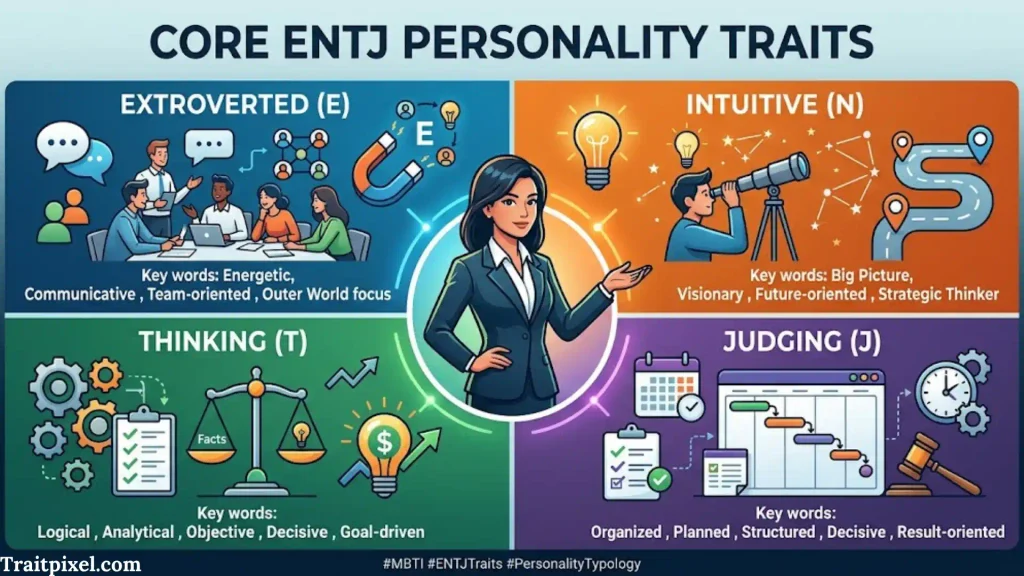
The most recognizable ENTJ traits often involve taking initiative, thinking strategically, setting ambitious goals, and seeking practical solutions. These tendencies can help ENTJs manage complex projects and make decisions, but their impact depends on how they use them.
Positive ENTJ Traits
Ambitious
ENTJs often set challenging goals and look for ways to make steady progress. They may pursue leadership roles, build businesses, master demanding skills, or seek greater responsibility.
Strategic
They tend to connect current decisions with future outcomes. Rather than fixing one problem at a time without considering the larger picture, they often look for a plan that addresses the underlying issue.
Natural organizers
ENTJs may enjoy assigning responsibilities, coordinating resources, and establishing clear expectations. They often bring order to situations in which people lack direction.
Analytical
They often examine evidence, compare options, and question assumptions before choosing a course of action. They may be especially comfortable with complex decisions that require structured reasoning.
Assertive communicators
ENTJs often state their opinions clearly and prefer discussions that lead somewhere. They may be comfortable presenting ideas, negotiating responsibilities, or challenging an inefficient process.
Improvement-oriented
They may continually look for better methods, clearer systems, and more effective ways to use time and resources. Repeated inefficiency can frustrate them when they believe a practical solution exists.
Other potential strengths include independence, persistence, curiosity, confidence, resourcefulness, and a willingness to make difficult decisions.
The key distinction is that a personality preference creates neither a guaranteed strength nor an automatic skill. An ENTJ still needs knowledge, experience, emotional awareness, and practice to turn these tendencies into effective behavior.
Negative ENTJ Traits and Weaknesses
The less helpful side of ENTJ traits often appears when efficiency, achievement, or control becomes more important than people, flexibility, or personal well-being.
| Potential weakness | How it may appear | A healthier alternative |
| Impatience | Interrupting people or rushing decisions | Allow enough time to understand the problem |
| Bluntness | Giving feedback that feels harsh | Be direct without attacking the person |
| Controlling behavior | Taking over tasks others can handle | Agree on outcomes and let people choose their methods |
| Perfectionism | Repeatedly correcting minor details | Define what good enough looks like |
| Overconfidence | Dismissing objections too quickly | Test assumptions and invite disagreement |
| Emotional avoidance | Offering solutions before acknowledging feelings | Listen first and ask what support is needed |
| Workaholism | Treating rest as wasted time | Schedule recovery as part of sustainable performance |
| Difficulty delegating | Rechecking every task | Set clear standards and trust capable teammates |
| Competitive behavior | Turning cooperation into a contest | Measure success against shared goals |
| Rigidity | Resisting a change to an established plan | Review new evidence and adjust when needed |
These weaknesses aren’t inevitable features of every ENTJ. They’re potential habits that can develop when a strength becomes excessive.
For example, decisiveness is useful when a team needs direction. However, making a decision before hearing important concerns can create avoidable mistakes. Confidence helps an ENTJ take responsibility, but overconfidence can make valuable feedback seem like an obstacle.
The goal isn’t to become less ambitious or less decisive. It’s to learn when to apply those strengths and when to balance them with another approach.
ENTJ Cognitive Functions: How This Type Processes Information
In the traditional MBTI cognitive-function model, ENTJs are associated with four functions: extraverted thinking, introverted intuition, extraverted sensing, and introverted feeling. This is a theoretical interpretation of personality preferences, not a direct measurement of brain activity.
Understanding this model can help explain why ENTJs are often described as practical strategists who prefer clear outcomes.
| Cognitive function | Traditional role | Possible everyday expression |
| Dominant: Extraverted Thinking (Te) | Organizes the external world around logic and results | Creates plans, assigns roles, and tracks performance |
| Auxiliary: Introverted Intuition (Ni) | Looks for patterns and likely future developments | Builds long-term strategies and anticipates consequences |
| Tertiary: Extraverted Sensing (Se) | Responds to immediate information and experiences | Acts quickly when circumstances require a practical response |
| Inferior: Introverted Feeling (Fi) | Relates to personal values and internal emotional judgments | May need deliberate reflection to clarify personal feelings and values |
Extraverted Thinking: The Drive to Make Things Work
ENTJs are traditionally associated with extraverted thinking as their leading cognitive function. This helps explain their reputation for organizing systems, evaluating results, and making decisions.
Imagine a project team that keeps missing deadlines. An ENTJ might examine the workflow, identify unclear responsibilities, and introduce milestones. The focus is on changing the system rather than repeatedly discussing the same problem.
The risk arises when measurable results become the only standard of success. A system can look efficient on paper while leaving people exhausted or discouraged.
Introverted Intuition: Connecting Present Choices to Future Outcomes
Introverted intuition is associated with recognizing patterns and forming an internal picture of what may happen next.
An ENTJ might notice that customer complaints, delayed deliveries, and staff turnover all point to a deeper operational problem. Instead of treating them as separate issues, the person may search for one underlying cause.
This future-focused approach can support planning, but predictions still need evidence. A convincing strategy is not necessarily a correct one.
Extraverted Sensing: Acting on What Is Happening Now
In this model, extraverted sensing helps a person engage with immediate conditions and concrete information.
An ENTJ might adjust a presentation after noticing that the audience is confused, respond quickly to a change in a project, or make a practical decision when a plan breaks down.
The useful balance is between long-term strategy and present reality. A plan needs to respond to what is actually happening rather than what someone expected to happen.
Introverted Feeling: Understanding Personal Values
Introverted feeling is traditionally described as a focus on internal values and personal convictions.
ENTJs may be portrayed as less comfortable expressing vulnerable emotions, but this doesn’t mean they lack empathy or deeply held values. Some may simply prefer to process their feelings privately or express care through practical support.
For example, an ENTJ might help a friend prepare for a difficult job interview rather than immediately discussing the friend’s anxiety. The help can be meaningful, but asking whether the friend wants advice or simply wants to be heard can make that support more effective.
Cognitive functions offer one way to interpret ENTJ behavior. They shouldn’t be treated as proven explanations for every person’s thoughts or actions.
ENTJ Leadership Traits
ENTJs are commonly associated with leadership because the type combines preferences for outward engagement, long-range possibilities, logical decision-making, and organization. These preferences may support leadership, but effective leadership also depends on skills, experience, ethics, and the situation.
What Makes an ENTJ Leader Effective?
ENTJ-style leadership can be especially useful when a group needs direction, a difficult decision, or a plan for reaching a demanding goal.
Common leadership tendencies include:
- Setting direction: Defining a goal and explaining why it matters.
- Making decisions: Comparing options and choosing a practical course of action.
- Creating structure: Establishing deadlines, responsibilities, and standards.
- Challenging inefficiency: Questioning outdated processes and unnecessary steps.
- Holding people accountable: Following up on commitments and addressing problems.
- Thinking ahead: Preparing for risks, opportunities, and future demands.
Consider a team preparing to launch a new product. An ENTJ-style manager might divide the project into phases, assign owners, establish deadlines, and identify the decisions that could delay the launch. This can reduce confusion and help everyone understand their responsibilities.
However, a clear plan alone doesn’t guarantee success. The manager must also understand the team’s workload, listen to technical experts, and adjust when new information appears.
When ENTJ Leadership Becomes Too Controlling
A strong focus on results can become counterproductive when a leader assumes that their preferred method is the only reasonable one.
Warning signs include:
- Rejecting suggestions before considering them.
- Treating questions as challenges to authority.
- Expecting everyone to work at the same pace.
- Prioritizing deadlines over safety or well-being.
- Taking over instead of coaching others.
- Measuring performance without considering circumstances.
An effective ENTJ leader can remain decisive while inviting disagreement. In fact, encouraging people to challenge a plan before implementation can reveal risks that the leader might otherwise miss.
How ENTJs Can Become Better Leaders
- Explain the reasoning behind decisions. People are more likely to support a plan when they understand the goal and the trade-offs.
- Ask for opposing views early. Invite the team to identify what could go wrong before committing resources.
- Delegate outcomes rather than every step. Define the required result, then give capable people room to work.
- Recognize contributions publicly. Acknowledge the effort and judgment behind success, not just the final numbers.
- Adjust communication to the audience. Some people want a short decision summary; others need background, reassurance, or time to consider alternatives.
- Review the human impact. Ask whether a plan is sustainable and fair, not only whether it is efficient.
The most effective version of ENTJ leadership combines clarity with trust. People need to know where the team is going, but they also need room to contribute.
ENTJ Traits in the Workplace and Career
ENTJs may prefer work that involves complex decisions, clear objectives, responsibility, and opportunities to improve systems. They can find repetitive work frustrating when it offers little autonomy or room to solve problems.
However, personality type cannot reliably determine which career someone will excel in. Skills, interests, qualifications, values, working conditions, and personal circumstances matter more than a four-letter label.
Careers That May Appeal to ENTJs
| Career area | Why it may appeal | Skills still required |
| Business management | Coordinates people and resources toward shared goals | Communication, budgeting, and people management |
| Entrepreneurship | Offers autonomy and complex problem-solving | Financial planning, customer research, and resilience |
| Project management | Combines deadlines, planning, and accountability | Risk management, negotiation, and coordination |
| Management consulting | Involves analyzing organizational problems | Research, analytical rigor, and client communication |
| Law | Can involve structured arguments and strategic reasoning | Legal education, careful research, and ethical judgment |
| Engineering management | Combines technical systems with team leadership | Technical knowledge, safety awareness, and collaboration |
| Operations management | Focuses on workflows and performance | Process knowledge, data analysis, and practical judgment |
| Strategy and planning | Requires long-term thinking and evaluation of options | Research, uncertainty management, and sound execution |
| Sales leadership | May involve negotiation, targets, and team development | Listening, relationship building, and market knowledge |
| Public administration | Can involve policy, coordination, and complex decisions | Public accountability, stakeholder engagement, and subject expertise |
These are possibilities rather than prescriptions. An ENTJ who loves research may prefer a specialist role, while another may find creative work more rewarding than managing a team.
What ENTJs Often Want From a Job
An ENTJ may find a role more satisfying when it provides:
- Clear objectives and meaningful challenges.
- Opportunities to learn and develop expertise.
- Some independence in making decisions.
- A chance to solve complex problems.
- Fair recognition for good work.
- Colleagues who communicate openly.
- A reasonable path for advancement.
Not every ENTJ needs a management position. Leadership can mean guiding a technical decision, improving a process, mentoring a colleague, or taking responsibility for a project without having formal authority.
ENTJ Strengths at Work
In a suitable environment, an ENTJ’s strategic thinking and decisiveness may help a team move from discussion to action. They may be good at identifying bottlenecks, prioritizing competing goals, and creating a structure for complex projects.
For example, if a company has several competing priorities, an ENTJ-style employee might compare their expected value, cost, and urgency before recommending which project to tackle first.
The quality of that recommendation still depends on the evidence used. A confident presentation cannot compensate for weak assumptions or incomplete data.
ENTJ Weaknesses at Work
Workplace difficulties may arise when an ENTJ:
- Expects colleagues to share the same pace and priorities.
- Gives criticism without enough context or respect.
- Focuses on short-term output at the expense of learning.
- Takes over tasks instead of developing teammates.
- Underestimates the value of routine work.
- Treats disagreement as resistance rather than useful information.
A practical improvement is to distinguish between a performance problem, a communication problem, and a difference in working style. Each calls for a different response.
How ENTJs Can Handle Workplace Conflict
A useful approach is to separate the issue from the person.
Instead of saying, “You never organize anything properly,” an ENTJ could say, “The last two reports arrived after the deadline. What is causing the delay, and what change would help us finish on time?”
The second statement identifies a specific problem, invites information, and creates room for a solution without turning the discussion into a personal attack.
This approach is not less direct. It is more precise.
ENTJ Traits in Love and Romantic Relationships

ENTJs may approach romantic relationships with commitment, direct communication, and a desire to build a shared future. They often appreciate partners who communicate honestly, respect their independence, and take their own goals seriously.
However, no personality type guarantees romantic compatibility. Two ENTJs can have very different relationship habits, and people with contrasting preferences can build strong relationships through mutual respect and communication.
How ENTJs Show Love
An ENTJ may express affection through practical support, thoughtful planning, loyalty, and a willingness to solve problems.
For example, an ENTJ partner might help organize a move, create a budget for a shared goal, or develop a plan to support the other person’s career. These actions may reflect genuine care, even if the person doesn’t always express affection in traditionally romantic ways.
Common ways an ENTJ may show love include:
- Making time for a partner despite a demanding schedule.
- Helping solve problems that affect the relationship.
- Encouraging a partner’s ambitions and personal growth.
- Speaking openly about future plans.
- Taking responsibility when something goes wrong.
- Showing commitment through consistent actions.
These behaviors vary from person to person. Practical support is valuable, but it shouldn’t replace affection, listening, or emotional connection.
What ENTJs Need in a Relationship
Many ENTJs may appreciate a relationship that includes:
Honesty: They often prefer clear conversations over hints, games, or unresolved tension.
Mutual respect: They want their ideas and ambitions taken seriously and should offer the same respect to their partner.
Intellectual connection: Discussing ideas, solving problems, and learning together may help keep the relationship engaging.
Independence: Both partners should have room for friendships, personal interests, and individual goals.
Reliability: Keeping promises and addressing problems directly can build trust.
Emotional openness: Even someone who prefers logic benefits from learning about their partner’s feelings and sharing their own.
ENTJ Weaknesses in Romantic Relationships
ENTJs may unintentionally create tension when they treat relationship problems like business problems.
| Relationship challenge | What might happen | Better response |
| Offering solutions too quickly | The partner feels unheard | Ask whether they want advice or emotional support |
| Being overly critical | The partner feels judged | Focus on the issue and communicate appreciation |
| Prioritizing work | The relationship receives too little attention | Schedule meaningful time together |
| Trying to control decisions | The partner feels restricted | Discuss decisions as equals |
| Avoiding vulnerability | Emotional distance develops | Share feelings before they become overwhelming |
| Expecting immediate answers | The partner feels pressured | Allow time to process difficult topics |
One particularly useful lesson for ENTJs is that emotional conversations don’t always require an immediate solution.
If a partner says, “I’m worried that we’re growing apart,” a response such as “Let’s spend more time together” may help, but it can miss the emotional meaning of the concern.
A stronger first response might be, “I didn’t realize you were feeling that way. Can you tell me what’s been making you feel distant from me?”
The solution can come after both people understand the problem.
Are ENTJs Romantic?
Yes, an ENTJ can be deeply romantic. The stereotype that ENTJs are purely logical overlooks the complexity of human emotions.
Some ENTJs enjoy grand gestures, ambitious shared plans, and thoughtful surprises. Others express romance through everyday reliability, affectionate conversations, or making time for someone they love.
The important question isn’t whether an ENTJ matches a particular romantic stereotype. It’s whether both partners feel valued, understood, and respected.
ENTJ Traits in Friendships and Family Life
ENTJs may bring energy, loyalty, directness, and practical problem-solving to friendships and family relationships. They may enjoy helping loved ones make plans, overcome challenges, and work toward personal goals.
Their directness can also create misunderstandings when other people want empathy rather than advice.
ENTJs as Friends
An ENTJ friend may encourage you to take a chance, prepare for a difficult conversation, or stop postponing a goal that matters to you. They may enjoy friendships built around shared interests, meaningful discussions, and mutual encouragement.
Potential challenges include:
- Giving unsolicited advice.
- Becoming impatient when a friend repeats a mistake.
- Treating disagreements as debates to win.
- Neglecting friendships during demanding work periods.
- Assuming practical help communicates affection clearly enough.
A simple habit can make a big difference: ask, “Do you want my honest opinion, or would you rather I just listen?” This gives a friend a chance to explain what they need.
ENTJs in Family Relationships
Within a family, ENTJs may take responsibility for planning, organizing events, managing practical issues, or helping family members make decisions.
These contributions can be useful, especially during stressful periods. However, family members don’t always need someone to direct the situation.
For example, an ENTJ parent may want a teenager to choose a college major based on job opportunities. The teenager may care more about creative interests, personal meaning, or exploring different options.
A productive conversation considers both sets of concerns. It explores financial realities without dismissing personal interests and encourages independence without abandoning guidance.
How ENTJs Can Strengthen Family Bonds
- Listen without immediately correcting someone’s interpretation.
- Ask family members what kind of help they want.
- Accept that different people have different priorities.
- Make room for unstructured time together.
- Apologize when direct communication becomes hurtful.
- Celebrate progress even when the outcome isn’t perfect.
Family relationships thrive when support doesn’t turn into control.
ENTJ Compatibility With Other Personality Types
ENTJ compatibility depends on much more than MBTI letters. Shared values, emotional maturity, trust, communication habits, and the ability to resolve conflict usually matter more than a type pairing.
Still, personality frameworks can offer useful questions to explore when two people have different preferences.
| Personality type | Potential connection with an ENTJ | Possible challenge |
| INTJ | Shared interest in strategy, independence, and long-term goals | Both may become overly focused on analysis or control |
| INTP | Intellectual curiosity and complementary problem-solving | Differences in structure and decision-making speed |
| ENTP | Energy, debate, creativity, and new possibilities | Competing ideas may delay follow-through |
| ENFJ | Shared interest in leadership and helping people grow | Differences in how decisions balance logic and personal impact |
| INFJ | Potential for thoughtful discussion and long-term planning | Direct communication may feel too forceful |
| ESTJ | Shared preference for organization and clear expectations | Disagreements over methods or authority |
| ISTJ | Complementary planning and attention to responsibilities | Different approaches to innovation and established procedures |
| INFP | Potential balance between strategy and personal values | Conflict over priorities or the tone of feedback |
| ISFP | Opportunities to balance action with present-moment awareness | Different preferences for planning and resolving disagreements |
| ENFP | Shared enthusiasm for possibilities and personal growth | The ENTJ may prefer more structure than the ENFP does |
| Other types | Potential for meaningful connection through shared values and effort | Differences vary by individual rather than following a fixed formula |
This table is a conversation starter, not a ranking of suitable partners. A relationship between two similar types can still struggle, while a relationship between very different types can work well.
How to Decide Whether a Relationship Is a Good Fit
Rather than asking only which personality type matches yours, consider these questions:
- Can you disagree without insulting or belittling each other?
- Do you both feel safe expressing emotions and concerns?
- Can you negotiate decisions instead of allowing one person to dominate?
- Do your long-term values and expectations fit together?
- Can you adapt when your partner needs something different from what you would prefer?
If the answers are generally positive, the relationship has useful foundations regardless of the four-letter types involved.
ENTJ Traits Under Stress
ENTJ traits may become more pronounced or less balanced when a person feels pressured, overwhelmed, or unable to control an important outcome.
Someone who is normally decisive may become domineering. A naturally analytical person may become excessively critical. Someone who values efficiency may become frustrated with any delay, even when patience is necessary.
Common Stress Responses
| Stress trigger | Possible ENTJ reaction | Helpful adjustment |
| Repeated delays | Pushes others harder | Identify the actual bottleneck before escalating |
| Unclear expectations | Tries to control every detail | Clarify responsibilities and decision rights |
| Public failure | Becomes defensive or overly self-critical | Review what can be learned without attacking yourself |
| Emotional conflict | Focuses on fixing the issue | Pause and acknowledge the emotional impact |
| Loss of autonomy | Challenges authority aggressively | Identify which decisions can still be influenced |
| Too many commitments | Works longer and sacrifices rest | Reassess priorities and remove low-value tasks |
Stress doesn’t affect every ENTJ in the same way. Sleep, health, workload, life experience, relationships, and individual coping habits all influence behavior.
The ENTJ Stress Cycle
A common pattern worth watching for is:
1. A goal becomes threatened
A deadline slips or a plan stops working.
2. Control increases
The person takes over, pushes harder, or becomes more critical.
3. Other people withdraw
Team members may hesitate to share concerns or admit mistakes.
4. Problems become harder to see
Less feedback creates more uncertainty and more pressure to control.
This is an illustrative pattern, not a clinical model or an inevitable ENTJ response.
The way out is to interrupt the cycle early. Clarify the problem, ask for honest feedback, separate urgent decisions from less important details, and identify which parts of the situation are actually within your control.
If stress becomes persistent or starts affecting daily functioning, seeking appropriate professional support may be more helpful than relying on a personality framework alone.
How ENTJs Can Develop Better Emotional Intelligence
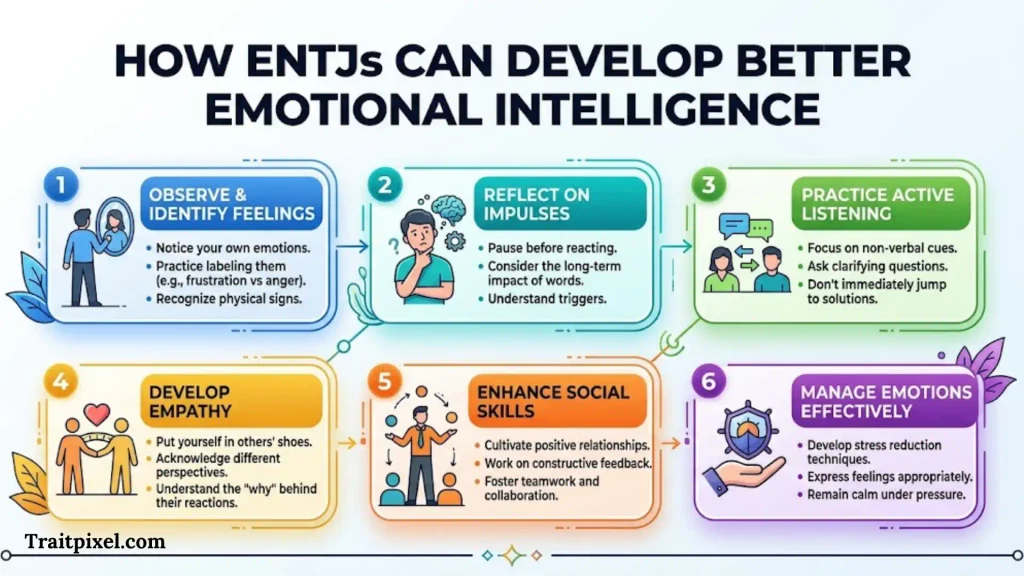
Emotional intelligence involves recognizing emotions, understanding how they affect behavior, and responding to other people with appropriate awareness. It isn’t the opposite of logic. It can make reasoning and leadership more effective.
For ENTJs, emotional development often means learning to combine directness and decisiveness with curiosity, patience, and empathy.
Listen Before Solving
When someone shares a problem, resist the urge to immediately identify a solution.
Try this sequence:
- Listen without interrupting.
- Summarize what you heard.
- Ask a clarifying question.
- Acknowledge the person’s feelings when appropriate.
- Offer advice after checking whether it’s wanted.
For example, if a coworker says they’re overwhelmed, avoid immediately telling them to reorganize their schedule. First find out whether the workload is unrealistic, expectations are unclear, or they need help prioritizing.
Make Feedback Specific and Respectful
Direct feedback can be useful, but broad judgments rarely help someone improve.
Instead of saying, “You’re disorganized,” identify the behavior: “The last two updates were missing the budget figures. Let’s agree on a checklist so the next report includes everything.”
Specific feedback gives the other person something they can change. It also reduces unnecessary defensiveness.
Learn to Recognize Emotional Signals
People don’t always express their needs directly. A short answer, a sudden change in tone, or repeated withdrawal may indicate that a conversation needs more attention.
Don’t assume you know what the signal means. Ask respectfully.
For example: “You seem quieter than usual. Is something bothering you, or would you rather talk later?”
This approach combines observation with humility rather than treating an interpretation as a fact.
Accept That Not Every Problem Has an Immediate Solution
Some problems require time, grief, reflection, or acceptance rather than action.
A friend dealing with disappointment may need company before advice. A partner facing uncertainty may want reassurance rather than a detailed plan. A team member may need time to process feedback before agreeing on next steps.
Learning when not to optimize a situation is a valuable skill for any highly goal-oriented person.
How ENTJs Can Improve Their Weaknesses
Personal development works best when it turns broad goals into observable behaviors. Telling yourself to become more patient is less useful than deciding what patience will look like in a specific situation.
The following practices can help ENTJs balance ambition with flexibility.
Pause before responding
When you feel irritated by a slow decision or an objection, take a moment to identify the reason for your reaction. Is the delay genuinely costly, or does uncertainty simply make you uncomfortable?
Practice: Ask one clarifying question before offering a correction.
Listen to understand, not to win
Treat disagreement as a chance to test your reasoning. Another person’s perspective may reveal missing information, even if you ultimately choose a different approach.
Practice: Summarize the other person’s argument in a way they agree is fair.
Delegate without micromanaging
Decide which outcomes matter, communicate the standards, and agree on check-in points. Let people choose their own methods when the methods are safe and effective.
Practice: Agree on the result and deadline before discussing every step.
Show appreciation as well as criticism
If you naturally notice problems, deliberately recognize what works. People need to understand which behaviors they should continue, not just what they should change.
Practice: Give one specific acknowledgment whenever you give important corrective feedback.
Protect time for rest
Ambition can make downtime feel unproductive. Yet sustainable effort requires recovery, and working longer doesn’t always produce better decisions.
Practice: Set a stopping time and review whether extra work is improving the outcome.
A Simple Decision Guide for ENTJs
When you’re unsure how to respond to a situation, use this quick guide.
Is the problem urgent and potentially harmful?
Yes
Act promptly, communicate clearly, and review the consequences afterward.
No
Continue to the next question.
Does the problem mainly involve another person’s feelings or concerns?
Yes
Listen, clarify, and acknowledge the concern before suggesting a fix.
No
Gather facts, compare options, and choose a reasonable next step.
Does someone else have the ability to handle it?
Yes
Delegate with clear expectations and appropriate support.
No
Take ownership and identify the resources you need.
This decision guide helps balance action with judgment. It isn’t a rigid rulebook; context, safety, and the people involved still matter.
ENTJ Traits in Everyday Life: 12 Practical Examples
ENTJ traits become easier to understand when you look at ordinary decisions rather than personality labels. The following examples show how the same tendency can help in one situation and create problems in another.
| Situation | Possible ENTJ behavior | Potential benefit | Potential downside |
| 1. School project | Divides the project into tasks and sets deadlines | Keeps the group organized | May dominate group decisions |
| 2. Workplace meeting | Summarizes the problem and proposes a decision | Saves time and creates direction | May cut off useful discussion |
| 3. Business challenge | Examines the process instead of treating symptoms | Can reveal underlying problems | May overlook human factors |
| 4. Family vacation | Creates an itinerary and books important arrangements | Reduces uncertainty | Leaves little room for spontaneity |
| 5. Friendship conflict | Suggests concrete ways to resolve the issue | Offers practical support | May overlook the need for empathy |
| 6. Romantic disagreement | Tries to identify the cause and agree on a solution | Moves toward resolution | Can make the partner feel unheard |
| 7. Career decision | Compares long-term opportunities and risks | Supports deliberate planning | May overvalue status or advancement |
| 8. Financial goal | Creates a budget and tracks progress | Makes the goal easier to monitor | Can become overly rigid |
| 9. Team leadership | Sets clear expectations and follows up | Improves accountability | Can feel like micromanagement |
| 10. Unexpected setback | Quickly develops an alternative plan | Helps the group recover | May act before understanding the full problem |
| 11. Personal learning | Chooses a challenging skill and builds a schedule | Encourages consistent practice | May become frustrated with slow progress |
| 12. Public disagreement | Challenges an argument with evidence | Encourages critical thinking | Can sound confrontational |
These examples illustrate possible behaviors, not rules for identifying an ENTJ. The same actions can arise from professional training, personal values, experience, or the demands of a particular situation.
One Trait, Two Outcomes
Consider decisiveness. An ENTJ who makes a difficult choice after gathering relevant evidence may help a team move forward. An ENTJ who decides before hearing important information may create a problem that takes longer to fix.
The personality tendency is similar, but the result differs because the person applies it differently.
This distinction matters when evaluating yourself or someone else. Ask whether a behavior is effective in context rather than deciding that it is good or bad simply because it resembles an ENTJ trait.
ENTJ vs. Other Personality Types
ENTJs are often confused with other MBTI types because several types can be ambitious, analytical, organized, or confident. The most useful way to compare them is to examine their stated preferences rather than rely on stereotypes.
ENTJ vs. INTJ
Both types share intuition, thinking, and judging preferences. The primary distinction is extraversion versus introversion.
| Feature | ENTJ | INTJ |
| General orientation | More outwardly engaged | More inwardly focused |
| Typical approach | Organizes action and people around goals | Often develops an internal strategy before acting |
| Communication | May think through ideas aloud | May prefer time to reflect before sharing |
| Leadership | May actively coordinate group decisions | May lead through expertise, analysis, or strategic direction |
| Potential challenge | Acting too quickly or dominating discussion | Becoming too detached or overanalyzing |
These are broad tendencies. An INTJ can be an effective public speaker, and an ENTJ can need plenty of quiet time.
ENTJ vs. ESTJ
ENTJs and ESTJs both have extraversion, thinking, and judging preferences. Their main difference is intuition versus sensing.
| Feature | ENTJ | ESTJ |
| Information focus | Patterns, possibilities, and future implications | Concrete information, experience, and practical details |
| Planning | Often explores new strategies and broader possibilities | Often emphasizes workable procedures and established methods |
| Problem-solving | May redesign the system | May improve execution within the system |
| Potential blind spot | Overlooking important details | Overlooking possibilities outside familiar approaches |
An ENTJ might propose a new business model, while an ESTJ might focus on implementing a proven process reliably. Either approach can be valuable, and both types can innovate or attend closely to detail.
ENTJ vs. ENTP
ENTJs and ENTPs share extraversion, intuition, and thinking. Their difference lies in judging versus perceiving.
| Feature | ENTJ | ENTP |
| General preference | Structure and closure | Flexibility and exploration |
| Approach to ideas | Often seeks a workable strategy | Often enjoys generating and testing possibilities |
| Approach to deadlines | May prefer a clear schedule | May prefer keeping options open |
| Potential challenge | Closing off alternatives too early | Generating more ideas than can be implemented |
For example, an ENTJ may want to choose a product concept and build a launch plan. An ENTP may want to keep exploring different concepts before committing. A strong team can benefit from both approaches.
ENTJ vs. ENFJ
Both types may be socially engaged and interested in leadership. Their difference is thinking versus feeling.
| Feature | ENTJ | ENFJ |
| Decision emphasis | Logic, consistency, and outcomes | Personal values and the impact on people |
| Leadership focus | Often emphasizes direction and performance | Often emphasizes people development and group relationships |
| Conflict approach | May prioritize resolving the practical issue | May prioritize understanding interpersonal concerns |
| Growth opportunity | Consider emotional consequences more deliberately | Balance relational needs with difficult practical decisions |
Neither type is automatically more rational or more compassionate. Both can use logic, empathy, and careful judgment.
Common Misconceptions About ENTJ Traits
ENTJ stereotypes can make the type seem simpler than it really is. A balanced understanding separates a personality preference from an assumption about someone’s abilities, emotions, or character.
Myth: Every ENTJ Is a Natural Leader
Fact: ENTJs are commonly associated with leadership preferences, but leadership ability develops through practice, feedback, knowledge, and experience. An ENTJ may prefer specialist work or have little interest in managing others.
Myth: ENTJs Don’t Have Feelings
Fact: Thinking preference does not mean emotional emptiness. An ENTJ can experience affection, grief, anxiety, compassion, and insecurity while preferring a logical approach to decisions.
Myth: ENTJs Are Always Confident
Fact: A person who communicates assertively can still experience self-doubt. Confidence varies by subject, experience, and circumstances.
Myth: ENTJs Are Always Extroverted in Every Situation
Fact: Extraversion describes a broad preference, not a requirement to be sociable all the time. ENTJs may enjoy solitude, need rest after demanding interactions, or feel uncomfortable in unfamiliar settings.
Myth: ENTJs Are Naturally Better at Business
Fact: The ENTJ description includes tendencies that may suit some business tasks, but success also depends on knowledge, opportunity, resources, teamwork, and execution. Personality type alone cannot establish professional competence.
Myth: ENTJs Are Inherently Rude or Dominating
Fact: Direct communication can be respectful or disrespectful. A person’s behavior, self-awareness, and willingness to listen matter more than the personality label.
Myth: ENTJs Can’t Get Along With Feeling Types
Fact: People with different preferences can build strong relationships. Differences can even create opportunities to learn, provided both people communicate respectfully.
Myth: An ENTJ Personality Type Never Changes
Fact: People can change their habits, emotional skills, priorities, and responses throughout life. MBTI results also depend on how a person interprets and answers assessment questions. The framework should not be treated as a permanent limit on behavior.
The Scientific Limitations of Personality Typing
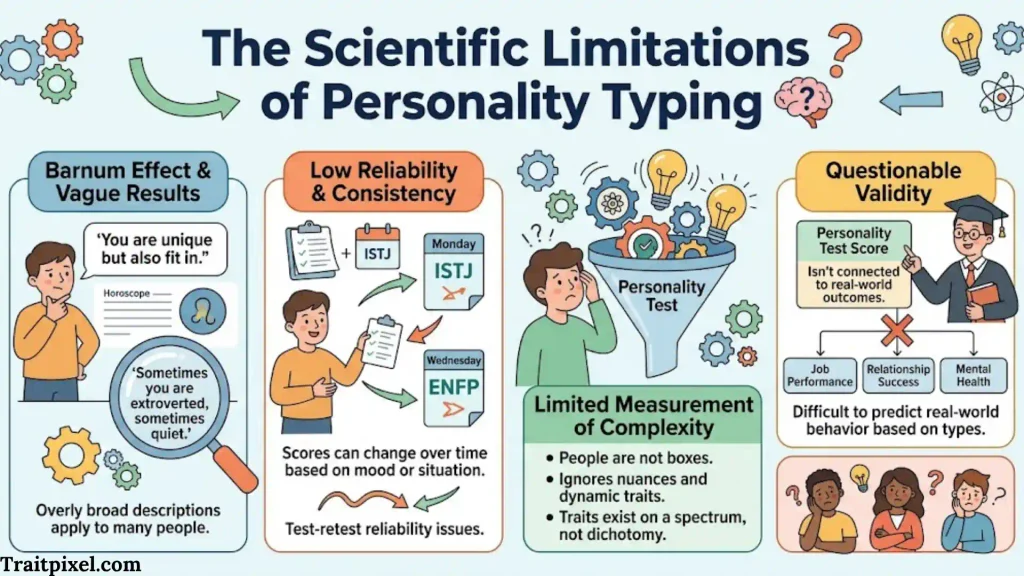
The MBTI can provide a useful vocabulary for reflecting on preferences, but it should not be treated as a complete scientific explanation of personality.
The official MBTI framework describes preferences across four pairs: extraversion–introversion, sensing–intuition, thinking–feeling, and judging–perceiving. The framework itself also emphasizes that a type does not describe every aspect of a person.
However, personality researchers have raised concerns about treating the 16 types as distinct, sharply separated categories. A 1989 study by Robert McCrae and Paul Costa found that MBTI dimensions were related to aspects of broader personality traits but did not support the idea that the assessment identified qualitatively distinct personality types. Later reviews have also raised questions about its psychometric limitations.
What does this mean for you?
- Use ENTJ traits as a reflection tool. Consider whether a description matches your experience instead of assuming it must.
- Look at behavior over time. One difficult conversation doesn’t establish a person’s entire personality.
- Consider the situation. Someone may behave differently at work, with friends, or under pressure.
- Avoid using type as a hiring filter. The Myers-Briggs Company states that MBTI assessment results aren’t intended to determine job suitability or select candidates.
- Use a broader framework when needed. The Big Five model describes personality using dimensions such as extraversion, conscientiousness, openness, agreeableness, and negative emotionality.
The practical takeaway is simple: personality frameworks can encourage self-awareness, but they cannot replace careful observation, individual assessment, or evidence about someone’s actual skills and behavior.
Related Personality Traits
Several related concepts can help you understand ENTJ characteristics more precisely.
| Related trait or concept | Connection to ENTJ descriptions |
| Assertiveness | Expressing opinions and needs clearly |
| Conscientiousness | Planning, responsibility, organization, and follow-through |
| Strategic thinking | Connecting present decisions with long-term goals |
| Emotional intelligence | Recognizing and responding to emotions effectively |
| Leadership | Influencing people and coordinating action |
| Independence | Taking initiative and accepting responsibility |
| Ambition | Working toward challenging personal or professional goals |
| Adaptability | Changing plans when circumstances or evidence change |
| Empathy | Understanding another person’s feelings and perspective |
| Resilience | Recovering from setbacks and adjusting to difficulty |
| Perfectionism | Holding very high standards, sometimes at an excessive cost |
| Communication style | Expressing ideas, listening, and resolving misunderstandings |
These concepts overlap with some ENTJ descriptions, but none is exclusive to the type. For example, conscientiousness and extraversion are dimensions of broader personality research, while ambition and leadership are influenced by many personal and environmental factors.
Understanding these distinctions prevents a common mistake: treating every desirable or undesirable characteristic associated with an ENTJ as part of one inseparable personality package.
Frequently Asked Questions About ENTJ Traits
What are the main ENTJ personality traits?
The main ENTJ traits commonly include ambition, decisiveness, strategic thinking, confidence, organization, independence, and direct communication. Potential challenges include impatience, excessive control, bluntness, and difficulty slowing down to consider emotional needs.
What are the 8 most common ENTJ strengths?
Eight commonly described strengths are:
- Strategic thinking
- Decisiveness
- Leadership
- Organization
- Confidence
- Ambition
- Problem-solving
- Long-term planning
These are tendencies associated with the type, not guaranteed abilities.
What are the biggest ENTJ weaknesses?
Commonly described weaknesses include impatience, blunt communication, perfectionism, overconfidence, workaholic tendencies, and difficulty delegating. These habits become especially problematic when an ENTJ prioritizes control or efficiency over collaboration and well-being.
Are ENTJs rare?
ENTJ is generally described as one of the less common MBTI types in some published samples. However, prevalence estimates vary by sample and assessment method. A percentage from one sample shouldn’t automatically be treated as the proportion of ENTJs in every country or population.
Are ENTJs intelligent?
ENTJ is not an intelligence category. ENTJs may enjoy analytical reasoning, strategic planning, and complex problem-solving, but MBTI results don’t establish someone’s IQ, expertise, creativity, or overall ability.
Are ENTJs good leaders?
ENTJs may enjoy organizing people, setting goals, making decisions, and improving systems. These preferences can support leadership, but successful leaders also need communication, sound judgment, adaptability, and the ability to build trust.
How do ENTJs behave when they like someone?
An ENTJ may show interest through direct communication, consistent attention, practical support, playful debate, or plans to spend time together. However, attraction cannot be reliably identified from a personality type alone. Individual behavior and communication provide better evidence.
Do ENTJs fall in love easily?
There is no reliable rule that determines how quickly ENTJs fall in love. Some may form connections quickly, while others prefer to take their time. Personal history, attachment patterns, values, and circumstances all influence romantic relationships.
Are ENTJs emotionally intelligent?
ENTJs can have high emotional intelligence, just like people of any other personality type. Although ENTJ descriptions often emphasize logic, emotional awareness and empathy are skills that people can develop through experience and deliberate practice.
What makes an ENTJ angry?
An ENTJ may become frustrated by repeated inefficiency, unclear expectations, broken commitments, or obstacles to important goals. However, anger triggers differ from person to person, and the ENTJ label cannot predict how someone will respond to conflict.
What is the difference between ENTJ-A and ENTJ-T?
ENTJ-A typically means Assertive Commander, while ENTJ-T means Turbulent Commander. These labels come from the 16Personalities framework, which uses an additional identity dimension beyond the four traditional MBTI preferences.
The assertive label is generally associated with greater self-assurance and emotional steadiness, while the turbulent label is associated with greater sensitivity to stress and self-evaluation. These are framework-specific descriptions, not official fifth and sixth MBTI letters.
Can an ENTJ be shy?
Yes. Someone who identifies as ENTJ may be shy in unfamiliar settings, uncomfortable with public attention, or hesitant in certain relationships. Extraversion describes a general preference rather than constant confidence or sociability.
Which careers are best for ENTJs?
Potentially appealing careers include management, entrepreneurship, project management, consulting, law, operations, engineering management, and strategy. The best career depends on a person’s skills, qualifications, interests, and preferred work environment rather than personality type alone.
Can ENTJs change their personality?
People can develop new habits, improve communication, manage emotions more effectively, and change their priorities. An ENTJ who learns to listen patiently or delegate effectively doesn’t lose their ambition; they expand their range of useful behaviors.
How can you tell if you have ENTJ traits?
Look for recurring patterns rather than isolated actions. Do you often enjoy organizing people, thinking about long-term possibilities, making decisions using logical criteria, and creating structure? If these tendencies fit you, the ENTJ description may be worth exploring. An online result alone cannot fully describe your personality.
Key Takeaways About ENTJ Traits
- ENTJ stands for Extraversion, Intuition, Thinking, and Judging in the Myers-Briggs framework.
- ENTJs are commonly associated with strategic thinking, ambition, assertiveness, organization, and decisive action.
- Potential weaknesses include impatience, controlling behavior, bluntness, perfectionism, and neglecting emotional needs.
- ENTJ preferences may influence leadership, career choices, friendships, and romantic relationships, but they don’t determine outcomes.
- Strong leadership requires more than confidence. Listening, adaptability, and trust matter just as much.
- Emotional intelligence can complement analytical thinking rather than compete with it.
- ENTJ compatibility depends on individual behavior, communication, shared values, and mutual respect.
- MBTI is a limited framework, not a complete description of personality or a reliable measure of intelligence and job performance.
- The most useful approach is to recognize your tendencies, develop your weaker skills, and choose behaviors that fit the situation.
Conclusion: Understanding ENTJ Traits
ENTJ traits are commonly associated with ambition, strategic thinking, decisive action, and a preference for organized progress. These tendencies can help people tackle complex challenges, coordinate teams, and pursue demanding goals.
Yet the same qualities can become obstacles when they turn into impatience, excessive control, or a habit of treating every disagreement as a problem to solve. The strongest version of an ENTJ isn’t simply the person who makes decisions fastest or sets the most ambitious goals. It’s the person who can recognize when to lead, when to listen, when to change direction, and when to make room for someone else’s perspective.
If you identify with ENTJ characteristics, use them as a starting point for self-reflection rather than a set of rules. Keep your ambition while developing empathy. Stay decisive while remaining open to new evidence. Pursue results without overlooking the people who help you achieve them.
Personality labels can help you ask better questions about yourself, but your everyday choices ultimately matter more than four letters.

I’m Elliot Kingsley, a British author interested in the subtle characteristics that influence how people think, communicate, and respond to the world. I write about personality traits, strengths, tendencies, and behavioural qualities in clear language. My goal is to encourage readers to understand individual differences and appreciate the complexity of human character.
Books:
- The Psychology of Personality Traits
- Character in Context