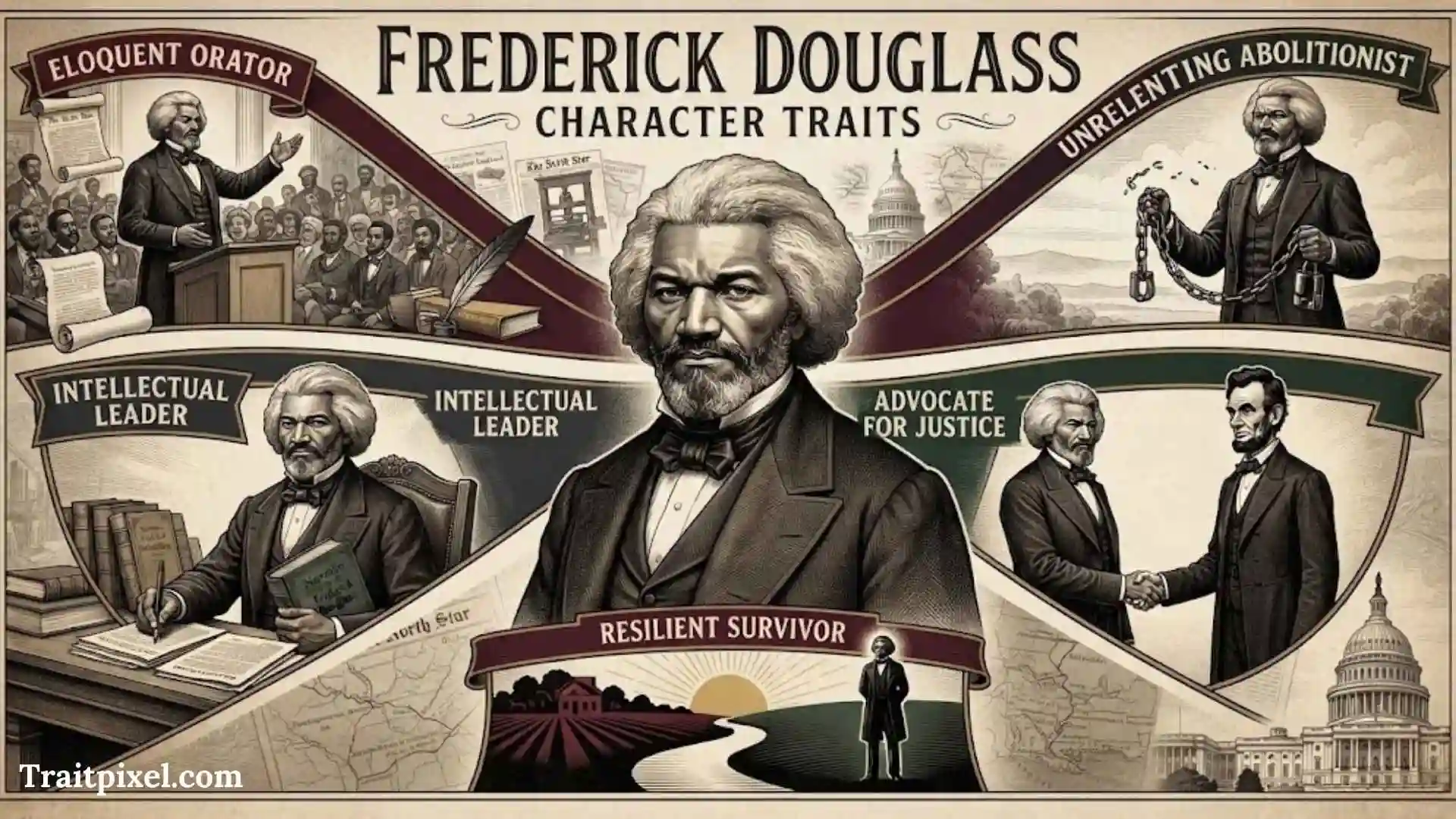
Frederick Douglass character traits are best understood through the choices he made during a life shaped by slavery, self-education, abolition, journalism, public speaking, and the struggle for equal rights. The most important traits associated with Douglass include courage, determination, intelligence, resilience, self-discipline, leadership, eloquence, independence, empathy, persistence, and a strong commitment to justice. These qualities were not simply abstract personality labels; they appeared in his actions, writing, speeches, education, and public work.
Born into slavery in Maryland around 1818, Douglass escaped slavery in 1838 and became an influential abolitionist, writer, editor, orator, and statesman. He later founded The North Star, wrote three autobiographies, advocated for African American rights and women’s suffrage, recruited Black soldiers during the Civil War, and served in several government positions.
Understanding his character traits helps readers move beyond memorizing dates. It shows how a person responded to injustice, developed knowledge, faced danger, influenced others, and continued working for social change over many decades.
Quick Answer
The major Frederick Douglass character traits are:
- Courage — He confronted slavery and racial injustice despite serious personal risks.
- Determination — He continued pursuing freedom and education despite powerful barriers.
- Intelligence — He developed his reading, writing, reasoning, and public-speaking abilities largely outside formal schooling.
- Resilience — He responded to severe hardships by continuing to learn, work, write, and organize.
- Leadership — He became a major abolitionist leader and later served in government.
- Eloquence — His speeches and writing made him a powerful public advocate.
- Self-discipline — He deliberately developed his knowledge and communication skills.
- Empathy — His writings repeatedly drew attention to the experiences and rights of people facing oppression.
- Independence — He developed his own views and eventually established his own newspaper.
- Persistence — He continued advocating for civil and political rights after slavery was abolished.
These traits are supported by the documented course of Douglass’s life, including his escape from slavery, literary work, newspaper publishing, abolitionist activism, military recruitment efforts, political involvement, and advocacy for women’s rights.
Frederick Douglass Character Traits at a Glance
| Character Trait | What It Means | Evidence From His Life |
| Courage | Willingness to face danger for a principle | Escaped slavery and publicly challenged slavery |
| Determination | Continuing toward a goal despite obstacles | Pursued literacy and freedom under severe restrictions |
| Intelligence | Ability to learn, reason, and communicate ideas | Became a skilled writer, editor, and orator |
| Resilience | Ability to continue after hardship | Built a public career after experiencing slavery |
| Leadership | Ability to influence and organize others | Became a major abolitionist leader |
| Eloquence | Skillful and persuasive communication | Became a celebrated lecturer and speaker |
| Self-discipline | Ability to control effort and pursue long-term goals | Developed his education and writing skills |
| Independence | Ability to form and express one’s own judgment | Founded and edited The North Star |
| Empathy | Attention to other people’s suffering and rights | Advocated for enslaved people, African Americans, and women |
| Persistence | Continuing a cause over time | Continued civil-rights advocacy after emancipation |
| Adaptability | Adjusting to changing circumstances | Worked as writer, publisher, activist, and government official |
| Sense of justice | Strong concern for fairness and equal rights | Opposed slavery and supported broader civil and political rights |
1. Courage
Courage is one of the clearest Frederick Douglass character traits because he repeatedly accepted personal risk when confronting slavery and injustice.
Douglass did not merely criticize slavery from a safe distance. He had experienced slavery himself and eventually escaped in 1838. After reaching freedom, he publicly described slavery and became an abolitionist speaker. The Library of Congress records that his speaking career developed after he was invited to address an anti-slavery meeting in Massachusetts in 1841.
His courage appeared in several forms:
- Physical courage in escaping slavery.
- Moral courage in condemning slavery publicly.
- Intellectual courage in challenging accepted beliefs.
- Political courage in supporting equal rights.
- Personal courage in discussing his experiences as an enslaved person.
Why courage mattered
Douglass understood that silence could allow injustice to continue. His willingness to speak publicly gave audiences a firsthand perspective that many had never encountered.
For students, his courage demonstrates that bravery does not always mean being fearless. It can mean acting despite fear because a principle matters more than personal comfort.
2. Determination
Douglass showed remarkable determination by continuing to pursue education, freedom, and social change despite restrictions designed to prevent enslaved people from gaining power through knowledge.
As a boy in Baltimore, he began learning to read and write. Formal education was unavailable to him, but he continued learning through unconventional means. The National Archives notes the importance of The Columbian Orator in Douglass’s intellectual development and describes how the book helped shape his understanding of freedom and human rights.
His determination can be seen in his willingness to:
- Learn when education was restricted.
- Practice reading and writing.
- Develop his speaking ability.
- Escape slavery.
- Build a career as a public speaker.
- Publish newspapers.
- Write autobiographies.
- Continue advocating for rights after emancipation.
What makes this trait important?
Determination connects many of Douglass’s other traits. Intelligence alone would not explain his achievements. His willingness to keep learning and working gave that intelligence practical power.
3. Intelligence and Love of Learning

Frederick Douglass was intellectually curious and used education as a tool for understanding himself, society, and freedom.
His intellectual development is particularly important because slavery attempted to deny enslaved people access to education. Douglass nevertheless pursued literacy and developed sophisticated skills in writing and rhetoric.
The National Archives describes him as largely self-taught and identifies The Columbian Orator as an important influence on his early education.
His intelligence appeared through:
- Reading widely.
- Studying rhetoric.
- Writing autobiographical works.
- Editing newspapers.
- Analyzing political questions.
- Delivering complex arguments to public audiences.
- Adapting his communication to different situations.
His life therefore illustrates an important distinction: intelligence is not limited to formal schooling.
4. Resilience
Resilience was another defining quality because Douglass continued building his life and public work despite experiences of violence, deprivation, discrimination, and social opposition.
His early life involved the harsh realities of slavery. Yet his later career expanded rather than diminished. He became a lecturer, journalist, author, publisher, political advocate, and government official.
Resilience does not mean that hardship had no emotional effect on him. His autobiographical writing shows that he reflected deeply on the psychological effects of slavery.
Instead, resilience in Douglass’s life means that hardship did not permanently prevent him from:
- Learning.
- Planning.
- Acting.
- Creating.
- Organizing.
- Speaking.
- Continuing his advocacy.
5. Leadership
Douglass demonstrated leadership by turning personal experience and intellectual ability into organized public action.
He became a major figure in the abolitionist movement and founded The North Star in 1847. He also became involved in recruiting Black soldiers for the Union Army during the Civil War. His sons Lewis and Charles Douglass served in the Union forces.
His leadership involved more than giving speeches. He:
- Organized public opinion.
- Published political arguments.
- Communicated with influential leaders.
- Encouraged African Americans to participate in national affairs.
- Supported military participation by Black Americans.
- Advocated for political rights.
- Continued public activism after the Civil War.
The National Park Service also describes Douglass as a leader who advised Abraham Lincoln and later held government positions.
Leadership lesson
Douglass shows that leadership can come from knowledge, communication, persistence, and the ability to connect personal experience with larger public issues.
6. Eloquence and Communication Skills
Douglass was exceptionally skilled at using language to explain injustice and persuade audiences.
His reputation as an orator developed after he began speaking for the Massachusetts Anti-Slavery Society. His speeches became an important part of the abolitionist movement.
His communication skills included:
- Strong storytelling.
- Clear arguments.
- Emotional appeal.
- Historical reasoning.
- Direct criticism.
- Careful word choice.
- Ability to connect personal experiences to broader principles.
His famous 1852 speech commonly known as What to the Slave Is the Fourth of July? demonstrates how he could use a familiar national idea—liberty—to expose the contradiction between American ideals and slavery. The National Archives identifies the speech as one of his influential addresses.
7. Self-Discipline
Douglass’s accomplishments suggest strong self-discipline because he consistently developed skills that required long-term effort.
Learning to read was only the beginning. He developed into a writer, editor, speaker, publisher, and political figure. Such development required sustained practice.
Self-discipline appeared in his:
- Reading habits.
- Writing.
- Public speaking.
- Newspaper editing.
- Travel and lectures.
- Political correspondence.
- Continued advocacy.
A useful lesson for students is that talent becomes more effective when combined with repeated practice.
8. Independence
Douglass valued intellectual and personal independence and increasingly established himself as an independent public voice.
One major example was his decision to establish The North Star after returning from Britain and Ireland. The newspaper became an important platform for his views.
Independence does not mean refusing all cooperation. Douglass worked with many people and organizations. Instead, his independence can be understood as his willingness to:
- Form his own judgments.
- Express disagreement.
- Build institutions.
- Publish his own arguments.
- Change strategies when circumstances changed.
This distinction is important when analyzing historical character. A strong independent thinker can still cooperate with others.
9. Empathy and Concern for Human Rights
Douglass repeatedly focused attention on the humanity and rights of people who were denied equal treatment.
His abolitionist work centered on ending slavery, while his later activism continued to address African American rights and women’s suffrage. The National Archives records his participation in the women’s rights movement and his support for women’s voting rights.
His empathy was connected to action. He did not simply describe suffering; he used his writing, speeches, journalism, and political influence to argue for change.
This makes empathy and justice closely related traits in his life.
10. Persistence
Douglass remained active across changing political periods rather than treating emancipation as the end of his work.
His activism continued after slavery ended. He worked in government and continued addressing racial equality and women’s rights.
This long-term persistence is important because his life was not one single campaign. His interests and strategies developed as American society changed.
A simplified timeline shows this progression:
Education → Escape → Abolitionist speaking → Writing and publishing → Civil War activism → Reconstruction-era public service → Continued advocacy
Each stage required him to adapt while maintaining broader commitments to freedom and equality.
11. Adaptability
Douglass was adaptable because he used different roles and communication methods as circumstances changed.
He was not only an abolitionist speaker. He became:
- An author.
- Newspaper editor.
- Publisher.
- Lecturer.
- Political commentator.
- Civil-rights advocate.
- Government official.
- Diplomatic representative.
The National Archives documents his service as Minister-Resident and Consul-General to Haiti from 1889 to 1891.
Adaptability helped him remain useful in different historical settings.
12. Strong Sense of Justice
A commitment to justice connects many of Douglass’s most important character traits.
His opposition to slavery was part of a broader argument about human rights, citizenship, freedom, and equality. His later support for women’s suffrage also shows that his public advocacy extended beyond a single issue.
His sense of justice can be understood through four connected ideas:
Freedom → people should not be enslaved.
Equality → legal and political rights should not depend on race.
Citizenship → African Americans should participate fully in American civic life.
Political rights → women and other excluded groups should not be denied rights without justification.
Positive Traits vs. Character Complexity
Historical figures should not be reduced to a simple list of positive adjectives. Douglass was a complex person who lived through changing political circumstances and sometimes disagreed with other reformers.
| Trait | Positive Meaning | Important Nuance |
| Courage | Willingness to confront injustice | Courage can involve serious personal risk |
| Independence | Thinking for oneself | Independent thinkers can disagree with former allies |
| Persistence | Staying committed to important goals | Long campaigns often require changing methods |
| Leadership | Influencing others toward action | Leadership involves persuasion as well as authority |
| Eloquence | Communicating ideas effectively | Powerful communication still needs evidence |
| Intelligence | Learning and reasoning | Intelligence develops through study and practice |
| Resilience | Continuing after hardship | Resilience does not erase the effects of trauma |
| Adaptability | Responding to changing conditions | Adaptation can change strategy without changing core principles |
This approach gives students a more historically responsible understanding of character.
Character Traits vs. Personality Traits
These terms are related but not identical.
| Character Traits | Personality Traits |
| Often describe moral qualities and patterns of conduct | Often describe characteristic ways of thinking, feeling, or behaving |
| Can be evaluated through choices and actions | Can describe temperament and behavioral tendencies |
| Examples: courage, integrity, persistence | Examples: outgoing, reserved, energetic |
| Often emphasized in literature and history assignments | Commonly used in psychology and everyday descriptions |
When a school assignment asks for Frederick Douglass character traits, it usually expects qualities demonstrated through his decisions and actions rather than a modern psychological personality profile.
12 Real-Life Examples of Frederick Douglass Character Traits
1. Learning to Read
Douglass pursued literacy even though enslaved people faced severe restrictions on education. This demonstrates determination, intelligence, and self-discipline.
2. Buying and Studying The Columbian Orator
His engagement with this book shows his curiosity and commitment to education.
3. Escaping Slavery
His 1838 escape demonstrates courage, planning, and determination.
4. Becoming an Abolitionist Speaker
After becoming involved with the anti-slavery movement, he developed into a major public speaker. This demonstrates communication skill and leadership.
5. Writing His Autobiography
His 1845 Narrative allowed readers to encounter his experience of slavery through his own words. This demonstrates literary skill, courage, and persistence.
6. Founding The North Star
Creating and editing a newspaper demonstrated independence, leadership, and organizational ability.
7. Recruiting Black Soldiers
His work encouraging African American men to join the Union Army demonstrates leadership and commitment to emancipation.
8. Supporting Women’s Suffrage
His participation in the women’s rights movement demonstrates that his advocacy extended beyond abolition.
9. Serving in Government
His later government positions demonstrate adaptability and public-service skills.
10. Serving as U.S. Minister to Haiti
His diplomatic appointment shows how his career expanded from abolitionist activism into national public service.
11. Continuing to Write
Douglass produced speeches, editorials, correspondence, and autobiographical works throughout his career. The Library of Congress and National Archives preserve extensive collections documenting this work.
12. Continuing Advocacy in Later Life
He remained involved in public issues until late in life, demonstrating long-term persistence and civic engagement.
A Simple Decision Guide for Identifying His Traits
If you are answering a school question about Douglass, use this method:
What did he do?
↓
What obstacle did he face?
↓
How did he respond?
↓
What quality does that response demonstrate?
For example:
He was denied normal educational opportunities.
↓
He continued learning to read and write.
↓
He developed his knowledge and communication skills.
↓
Traits: determination, intelligence, curiosity, and self-discipline.
Another example:
Slavery denied him freedom.
↓
He escaped and later spoke publicly against slavery.
↓
He accepted personal risk to challenge injustice.
↓
Traits: courage, persistence, and leadership.
Common Misconceptions About Frederick Douglass’s Traits
Misconception 1: He was successful simply because he was naturally talented
His abilities mattered, but his documented life also shows sustained learning, practice, writing, speaking, and organizing. His development was a process rather than an instant transformation.
Misconception 2: He only fought against slavery
Abolition was central to his career, but his interests were broader. He also advocated for African American civil and political rights, women’s suffrage, and other public causes.
Misconception 3: His main strength was public speaking alone
Douglass was an orator, but he was also an author, journalist, editor, publisher, political commentator, and government official.
Misconception 4: Resilience means slavery did not affect him
This is an important mistake. Resilience does not mean that a person experiences no pain or lasting effects from hardship. Douglass’s autobiographical writings document the serious realities of slavery.
Misconception 5: Intelligence means formal education
Douglass’s life provides a strong example of intellectual development through self-directed learning. His education was shaped by reading, observation, practice, and engagement with ideas.
Related Frederick Douglass Traits
Several traits naturally belong together rather than being treated as completely separate qualities.
Courage + Determination
Courage helped Douglass confront danger, while determination helped him continue working toward long-term goals.
Intelligence + Self-Discipline
Knowledge became more powerful because Douglass continued developing his reading, writing, and speaking abilities.
Leadership + Eloquence
His ability to communicate clearly helped him influence audiences and organize support around abolition and civil rights.
Empathy + Justice
His concern for human dignity helped shape his advocacy for people denied political and social rights.
Persistence + Adaptability
Douglass maintained long-term commitments while changing roles and strategies as circumstances changed.
Why Frederick Douglass’s Character Matters Today
Studying Douglass’s traits is useful because his life provides a concrete example of how character can appear through action.
A student might learn determination by continuing a difficult subject instead of giving up after one poor result.
A writer can learn from his discipline and communication skills by studying how carefully chosen words can explain difficult ideas.
A leader can learn from his adaptability by recognizing that effective leadership may require different methods in different situations.
A citizen can study his civic engagement by examining how he used newspapers, speeches, political relationships, and public service to participate in national debates.
The goal is not to copy a historical figure exactly. It is to understand how qualities such as courage, persistence, learning, and responsibility can appear through real decisions.
How to Write a Strong Character-Trait Answer About Frederick Douglass
If you need a short school response, avoid simply listing adjectives. Explain the evidence.
A useful structure is:
Trait → Evidence → Explanation
For example:
Frederick Douglass was determined. Despite severe restrictions on education during slavery, he worked to become literate and continued developing his knowledge. His dedication to learning later supported his career as a writer, editor, and public speaker.
For a longer response, choose three to five traits and connect each one to a documented event.
Strong trait choices for a school assignment
- Courage
- Determination
- Intelligence
- Resilience
- Leadership
- Self-discipline
- Eloquence
- Persistence
- Independence
- Sense of justice
Avoid claiming that Douglass had a specific modern psychological diagnosis or personality type. Historical evidence can support descriptions of his conduct and values, but it cannot automatically establish a modern clinical or psychological profile.
Frequently Asked Questions
What are Frederick Douglass’s main character traits?
His major character traits include courage, determination, intelligence, resilience, leadership, eloquence, self-discipline, independence, empathy, persistence, adaptability, and a strong sense of justice.
What is Frederick Douglass best known for?
Frederick Douglass is best known as an abolitionist, orator, writer, journalist, and statesman who escaped slavery and became a major leader in the movement against slavery.
What character trait did Frederick Douglass show by learning to read?
Learning to read demonstrates determination, intellectual curiosity, self-discipline, and a commitment to education. His early education played an important role in his later development as a writer and speaker.
How did Frederick Douglass show courage?
He showed courage by escaping slavery and later publicly describing slavery and advocating for its abolition. Public opposition to slavery involved significant personal and political risks.
How did Frederick Douglass demonstrate leadership?
He demonstrated leadership through abolitionist speaking, newspaper publishing, political advocacy, recruitment of Black soldiers during the Civil War, and later government service.
Was Frederick Douglass intelligent?
Historical evidence strongly supports describing Douglass as an accomplished intellectual, writer, editor, and orator. His development of literacy, rhetoric, journalism, and political analysis demonstrates substantial intellectual achievement.
What trait did Frederick Douglass show through his newspapers?
His newspaper work demonstrates independence, leadership, writing ability, organization, and persistence. He founded The North Star in 1847 and used journalism as an important platform for public advocacy.
Did Frederick Douglass support women’s rights?
Yes. Douglass advocated for women’s suffrage and attended the Seneca Falls women’s rights meeting in 1848. The National Archives also documents his public support for women’s voting rights.
What can students learn from Frederick Douglass’s character?
Students can study how determination, education, courage, communication, persistence, and civic responsibility can influence a person’s ability to respond to difficult circumstances.
What is the best way to prove a character trait?
Use a specific historical event or documented action and explain what it reveals. Instead of writing only “Douglass was brave,” connect courage to an event such as his escape from slavery or his public abolitionist work.
Key Takeaways
- Courage helped Douglass confront slavery and injustice.
- Determination drove his pursuit of education and freedom.
- Intelligence and curiosity supported his development as a writer and speaker.
- Resilience helped him continue building his public life despite severe hardship.
- Leadership allowed him to influence abolitionist and political movements.
- Eloquence made his arguments accessible and powerful to public audiences.
- Self-discipline supported his lifelong learning and writing.
- Independence can be seen in his journalism and willingness to develop his own public voice.
- Empathy and justice shaped his concern for human rights.
- Persistence kept him involved in public advocacy across changing historical periods.
- Adaptability enabled him to move between journalism, activism, politics, and government service.
- His character should be studied through documented actions and writings, not unsupported assumptions about his personality.
Conclusion
The most important Frederick Douglass character traits include courage, determination, intelligence, resilience, leadership, eloquence, self-discipline, independence, empathy, persistence, adaptability, and a strong sense of justice. His life provides evidence for these qualities through his pursuit of literacy, escape from slavery, abolitionist work, writing, newspaper publishing, Civil War activism, support for women’s suffrage, and later public service.
What makes Douglass especially important to study is the connection between his traits and his actions. His determination led him to pursue education. His education strengthened his communication skills. His communication supported his leadership. His courage allowed him to speak against injustice. His persistence kept him involved in public causes even as the political landscape changed.
For students studying Frederick Douglass character traits, the strongest approach is therefore not to memorize a list of adjectives. Instead, connect each trait to a specific event, explain the evidence, and show how the trait influenced his choices. That method creates a clearer and more historically grounded understanding of one of the major African American leaders of the nineteenth century.

I’m Nathaniel Brooks, a British writer fascinated by the qualities that shape personality, character, and behaviour. I explore human traits through practical explanations and thoughtful observations, helping readers understand what different characteristics can reveal. My aim is to make personality concepts accessible, engaging, and useful for anyone curious about human nature.
Books:
- The Atlas of Human Traits
- Understanding Personality and Character