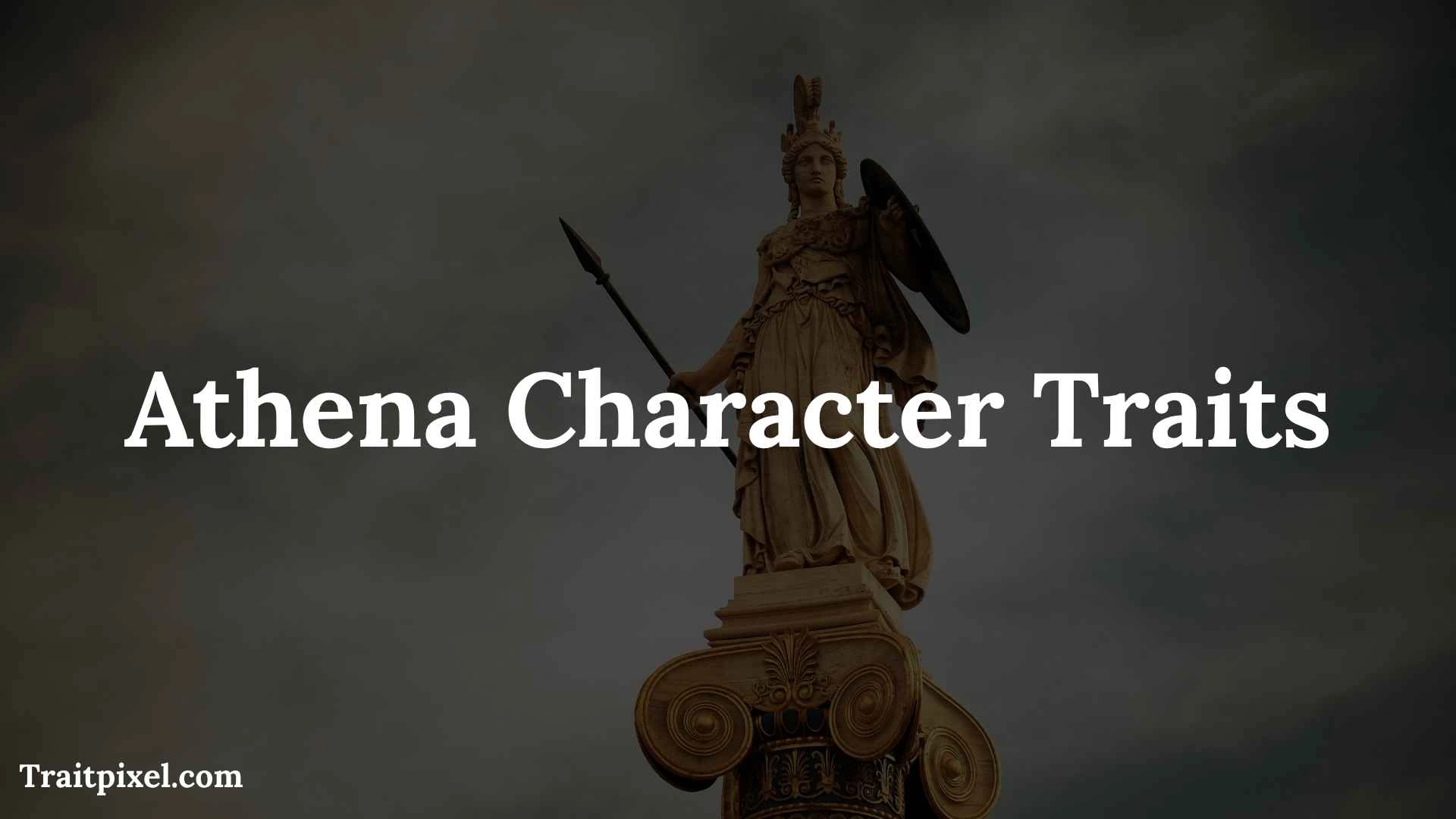
Athena character traits are best understood through the way the Greek goddess acts in mythology. Athena is commonly portrayed as wise, strategic, courageous, disciplined, resourceful, protective, skilled, and practical. She is associated with wisdom, warfare, crafts, reason, and civic life, but her character is more complex than simply being a “good goddess.” In stories such as the Iliad and Odyssey, she often solves problems through planning, guidance, disguise, intelligence, and carefully chosen action. The Metropolitan Museum of Art identifies Athena with wisdom and war, while the British Museum connects her with reason, handicraft, wisdom, and war.
This guide explains Athena’s major character traits, what they mean, how they appear in Greek mythology, her strengths and weaknesses, her relationship with heroes such as Odysseus and Perseus, and what her character represents in ancient Greek culture.
Quick Answer: What Are Athena’s Character Traits?
Athena’s most important character traits include:
- Wise — She values knowledge, judgment, and thoughtful decisions.
- Strategic — She prefers planning and intelligent tactics over uncontrolled force.
- Courageous — She faces conflict directly when action is necessary.
- Resourceful — She finds practical solutions when circumstances change.
- Disciplined — She is usually controlled rather than impulsive.
- Protective — She frequently supports cities, heroes, and people under her protection.
- Practical — Her wisdom is often applied to real problems rather than kept as abstract knowledge.
- Skilled — She is connected with crafts, weaving, technology, and useful forms of knowledge.
- Independent — Athena is portrayed as a powerful divine figure who does not depend on a romantic partner for her identity.
- Cunning — She understands disguise, persuasion, timing, and deception when those tools serve a larger strategy.
- Competitive — Several myths show her taking contests and challenges seriously.
- Proud — Her confidence can become severe when others challenge her status or skills.
The most important idea is that Athena represents intelligence put into action. Her wisdom is not passive. She uses it to plan, protect, solve problems, and influence outcomes.
Athena Character Traits at a Glance
| Trait | What It Means | How It Appears in Myth |
| Wisdom | Good judgment and knowledge | Advising heroes and making plans |
| Strategy | Thinking several steps ahead | Helping Odysseus and other heroes |
| Courage | Facing danger without surrendering | Appearing as a warrior goddess |
| Resourcefulness | Finding effective solutions | Using disguises, advice, and clever plans |
| Discipline | Controlling emotion and action | Remaining composed during conflict |
| Protection | Defending people or communities | Patronage of Athens and support of heroes |
| Practicality | Turning knowledge into action | Crafts, warfare, planning, and counsel |
| Skill | Mastery of useful abilities | Weaving and other crafts |
| Independence | Acting with personal authority | Her distinctive status among the Olympians |
| Cunning | Using intelligence and strategy | Disguise and indirect assistance |
| Pride | Strong confidence in her abilities | Rivalries and punishments in certain myths |
| Justice | Concern with order and rightful action | Her association with civic and protective roles |
Who Is Athena?
Athena is one of the best-known goddesses in ancient Greek mythology. She is associated with wisdom, war, reason, crafts, and the protection of Athens. Her Roman counterpart is Minerva. The British Museum describes her as a goddess connected with reason, handicraft, wisdom, and war, while its collection records also identify her as a patron of civilizing arts, domestic crafts, and Athens.
Athena is traditionally described as the daughter of Zeus. In one famous version of her birth story, she emerges fully armed from Zeus’s head. Ancient and later artworks commonly show her wearing a helmet and carrying weapons, while the owl and olive tree became important symbols associated with her.
Her identity combines qualities that might seem separate at first:
Wisdom + courage + strategy + craftsmanship + protection
That combination is important when studying her character. Athena is not simply a goddess of knowledge. She represents knowledge that can be used effectively.
1. Athena Is Wise
Wisdom is Athena’s defining character trait.
Athena repeatedly appears as a source of advice, judgment, and intelligent planning. Her wisdom is especially clear in the Odyssey, where she helps Odysseus and Telemachus navigate difficult situations.
In the Odyssey, Athena does not simply solve every problem for the characters. She often encourages them to think, plan, prepare, and act at the right time. Harvard’s Center for Hellenic Studies describes her role as one of guidance and strategic planning, particularly in her interactions with Telemachus and Odysseus.
Example of Athena’s wisdom
Telemachus is young and uncertain about how to respond to the suitors occupying his home. Athena, disguised as Mentes and later Mentor, gives him practical guidance and encourages him to take action.
This makes Athena’s wisdom different from simply knowing facts.
Athena’s wisdom = knowing what to do with knowledge.
What this trait teaches
A wise person does not always react immediately. They consider:
- What is happening?
- What could happen next?
- What choices are available?
- Which action has the best chance of working?
- When is the right moment to act?
That pattern closely reflects Athena’s mythological character.
2. Athena Is Strategic
Athena is a strategist rather than a symbol of uncontrolled aggression.
Athena’s connection with warfare is important, but she is often distinguished from the more chaotic side of battle represented by other mythological figures. Modern museum scholarship frequently describes her as connected with strategic warfare, intelligence, and disciplined military action. Smarthistory, for example, describes Athena as associated with strategic warfare, while the British Museum emphasizes intellect and strategy in representations of the goddess.
Her strategic nature appears strongly in the Odyssey.
Athena and Odysseus work together to develop a plan for dealing with the suitors. Instead of immediately revealing Odysseus to everyone, Athena helps create circumstances in which he can return, disguise himself, identify allies, and prepare for the final confrontation. Harvard’s Center for Hellenic Studies discusses this planning relationship in detail.
Why strategy matters to Athena
Strategy allows her to turn limited opportunities into successful outcomes.
A simple way to describe her approach is:
Observe → Think → Plan → Prepare → Act
That sequence is one of the clearest ways to understand Athena’s character.
3. Athena Is Courageous
Athena is also strongly associated with courage.
Ancient Greek art often depicts her armed with a helmet, spear, shield, and aegis. The Metropolitan Museum describes her as a warlike protector of Athens who appears alert but composed.
Her courage is different from reckless behavior.
She does not need to prove bravery by rushing into every fight. Her courage is often connected to confidence, preparation, and control.
Athena’s type of courage
Athena’s courage can be described as:
- Mental courage
- Strategic courage
- Moral confidence
- Physical bravery
- Willingness to confront danger
- Confidence under pressure
This makes her useful as a mythological example of calculated courage rather than reckless bravery.
4. Athena Is Resourceful
Resourcefulness is one of Athena’s most practical traits.
She frequently adapts to changing situations. Instead of relying on one method, she can use advice, disguise, persuasion, planning, protection, or direct intervention.
Her relationship with Odysseus is a strong example. Both characters are repeatedly associated with cleverness and the ability to adjust their behavior to circumstances. In the Odyssey, Athena works through different identities and strategies to help move events toward her desired outcome.
What resourcefulness looks like
A resourceful person might say:
“That plan did not work. What can I change?”
Athena’s mythological behavior often follows this pattern.
She does not treat a failed method as the end of the problem. She looks for another route.
5. Athena Is Practical
Athena’s wisdom has a practical side.
She is not associated only with philosophy or abstract thought. Ancient traditions connect her with useful crafts and skills, including weaving. The Metropolitan Museum notes the connection between Athena’s identity and weaving in Greek art, while the British Museum connects her with handicraft and civilizing arts.
This gives her character an important dimension:
She values knowledge that produces something useful.
For example, a practical thinker might use knowledge to:
- Build something
- Solve a problem
- Protect others
- Improve a process
- Create a plan
- Teach a skill
- Prepare for danger
Athena’s mythology repeatedly connects intelligence with useful action.
6. Athena Is Protective
Athena is frequently portrayed as a protector.
She is closely connected with Athens, and ancient representations show her as the city’s divine protector. The Acropolis Museum identifies the famous contest between Athena and Poseidon as a myth concerning who would become the divine protector of Athens. Athena’s olive tree was chosen over Poseidon’s salty water in that tradition.
Her protective character also appears through her relationships with heroes.
The Metropolitan Museum describes Athena assisting Perseus in his quest to defeat Medusa.
The British Museum likewise describes Minerva, the Roman counterpart of Athena, as assisting heroes such as Hercules and Perseus.
Protection is central to her character
Athena’s protection can take different forms:
- Giving advice
- Providing courage
- Offering strategic help
- Supplying protection
- Helping someone prepare
- Guiding someone toward a solution
This is why Athena can be understood as both a warrior and a counselor.
7. Athena Is Disciplined
Athena is generally portrayed as controlled and deliberate.
Her armor and weapons might make her appear aggressive, but many artistic representations emphasize a composed figure. One Metropolitan Museum description calls Athena “alert but serene,” which captures an important contrast in her image: she can be ready for conflict without appearing uncontrolled.
Discipline means knowing when not to act.
That is especially important for understanding Athena’s strategic personality.
A reckless character might react first and think later.
Athena’s typical pattern is closer to:
Think first → prepare → act deliberately.
8. Athena Is Independent
Athena has a distinctive position among the major Olympian gods.
She is not primarily defined through a romantic relationship. Instead, her identity centers on wisdom, warfare, craftsmanship, civic protection, and intellectual power.
This independence is one reason she can function as a counselor, warrior, protector, and mentor without being reduced to a single role.
Her independence also appears symbolically in her fully armed birth from Zeus’s head in traditional mythology.
The story is mythological rather than historical or scientific, but it communicates a powerful symbolic idea: Athena’s identity is strongly associated with mind, intelligence, and power.
9. Athena Is Skilled and Creative
Athena is not only a thinker. She is associated with skilled work.
Weaving is one of the clearest examples.
This becomes especially important in myths involving Arachne, the mortal weaver who challenges Athena. The story presents a conflict involving talent, pride, competition, and divine authority.
Athena’s association with craftsmanship shows that intelligence can include:
- Technical skill
- Creativity
- Precision
- Patience
- Attention to detail
- Mastery through practice
Her character therefore connects intellectual ability with hands-on expertise.
10. Athena Is Cunning
Cunning is another major part of Athena’s character.
This does not simply mean lying for personal gain. In mythology, Athena often uses disguise, timing, indirect action, and carefully chosen words to achieve a larger goal.
The Odyssey provides especially strong examples. Harvard’s Center for Hellenic Studies notes Athena’s use of disguises and indirect guidance while helping Telemachus and Odysseus.
The Homeric text itself presents Athena and Odysseus as figures associated with craft and clever strategy.
Cunning vs. dishonesty
These ideas are not identical.
| Cunning | Dishonesty |
| Uses intelligence strategically | Deliberately misleads |
| Can involve disguise | Can involve false statements |
| Focuses on achieving an objective | May focus on personal advantage |
| Often requires planning | May be impulsive |
| Can be protective or tactical | Can be harmful or exploitative |
Athena’s mythology often presents cunning as a strategic tool.
11. Athena Is a Strong Mentor
One of Athena’s most interesting traits is her ability to guide others without always doing the work herself.
This is especially visible in her relationship with Telemachus.
Harvard scholarship on the Odyssey describes Athena’s role as a mentor who encourages Telemachus to develop judgment, confidence, and practical ability. She appears in human form as Mentes and Mentor and gives him advice while allowing him to act.
This creates an important distinction:
A good mentor does not simply remove every obstacle. A good mentor can teach someone how to face obstacles.
That is one of the most useful character lessons associated with Athena.
12. Athena Can Be Competitive
Athena is confident in her abilities, and several myths show her taking challenges seriously.
The contest with Poseidon for the patronage of Athens presents her as a competitor who believes her gift can serve the city. The Acropolis Museum records the myth in which Athena’s olive tree was preferred over Poseidon’s salty water.
The Arachne story provides another example of competition involving skill and artistic ability.
Competition, therefore, is not an accidental part of Athena’s characterization.
It connects with her:
- Confidence
- Skill
- Pride
- Ambition
- Desire for excellence
- Sense of status
13. Athena Can Be Proud and Severe
Athena should not be treated as a perfect modern role model.
Greek mythology frequently gives its gods powerful qualities alongside serious flaws or harsh behavior. Athena can be compassionate and protective in one story while severe or punitive in another.
The myth of Arachne, for example, is commonly interpreted as involving pride, competition, and the consequences of challenging a goddess.
Another important example appears in the mythological tradition surrounding Medusa. The details vary across ancient and later sources, so modern summaries should avoid treating every version as if it came from one single original story.
This is an important lesson when studying mythological character traits:
A mythological character can possess admirable qualities without being morally perfect.
Positive and Negative Athena Character Traits
Athena’s character becomes clearer when her strengths and difficult qualities are considered together.
| Positive Traits | More Complicated Traits |
| Wise | Proud |
| Strategic | Competitive |
| Courageous | Severe |
| Resourceful | Controlling |
| Protective | Capable of punishment |
| Skilled | Unforgiving in some myths |
| Disciplined | Can favor her chosen side |
| Practical | Can use deception |
| Independent | Can be intimidating |
| Mentoring | Expects respect and recognition |
These categories should not be treated like a modern psychological diagnosis. Athena is a mythological figure whose personality changes somewhat across different stories, authors, periods, and artistic traditions.
Athena’s Character Traits in the Odyssey
The Odyssey is one of the best places to study Athena’s behavior.
She has a close relationship with Odysseus because both characters value intelligence, adaptability, and strategy.
Athena helps Odysseus in several ways, including:
- Advising him
- Protecting him
- Helping him disguise himself
- Supporting his return to Ithaca
- Guiding Telemachus
- Helping organize the final response to the suitors
- Encouraging careful planning
Harvard’s Center for Hellenic Studies describes Athena as a guiding force in the poem’s plot and emphasizes her role in mentoring Telemachus and helping Odysseus regain control of his household.
What Athena’s behavior reveals
Her actions show that she values:
Preparation over panic
Strategy over brute force
Guidance over unnecessary control
Timing over impulsiveness
Intelligence over raw strength
This is one reason Athena is closely connected with Odysseus.
Athena and Odysseus: Similar Character Traits
Athena and Odysseus share several qualities.
| Athena | Odysseus |
| Strategic | Strategic |
| Wise | Clever |
| Resourceful | Resourceful |
| Uses disguise | Uses disguise |
| Plans ahead | Plans ahead |
| Adapts to circumstances | Adapts to circumstances |
| Uses persuasion | Uses persuasion |
| Values timing | Values timing |
Their similarities help explain their strong relationship in the Odyssey.
Harvard scholarship specifically discusses the intellectual connection between Athena and Odysseus and the goddess’s role in shaping the hero’s return.
Athena and Perseus: Protective and Strategic Traits
Athena’s relationship with Perseus highlights another side of her personality.
Perseus must defeat Medusa, a dangerous Gorgon whose gaze could turn people to stone. Ancient Greek artistic representations show Athena assisting Perseus in this mission. The Metropolitan Museum describes Perseus accomplishing the task with help from Athena, Hermes, and the Nymphs.
Athena’s role here reflects several traits:
- Protectiveness — she supports the hero.
- Strategic thinking — the task requires more than brute strength.
- Practical wisdom — the hero needs the right method.
- Courage — danger must still be confronted.
- Resourcefulness — specialized help matters.
The story demonstrates a recurring idea in Athena’s mythology: the right strategy can be more important than raw power.
Athena and Athens
Athena’s relationship with Athens reveals her civic side.
According to the myth associated with the Parthenon’s west pediment, Athena and Poseidon competed to become the divine protector of Athens. Athena offered an olive tree, while Poseidon offered salty water. The myth says the judges favored Athena’s gift.
The olive tree became a powerful symbol because it represents practical value, cultivation, food, and prosperity.
This story adds another dimension to Athena’s character:
She is not only a warrior; she is also associated with building and sustaining a community.
That is why her character can represent both defense and civilization.
Athena’s Symbols and What They Reveal About Her Character
Athena’s symbols are useful clues to understanding her mythology.
| Symbol | Meaning Connected to Athena |
| Owl | Wisdom and watchfulness |
| Olive tree | Athens, prosperity, practical benefit |
| Helmet | Warfare and readiness |
| Spear | Military power |
| Shield | Protection |
| Aegis | Divine protection and authority |
| Gorgon’s head | Protective power and frightening authority |
| Armor | Readiness and strength |
The British Museum identifies the owl and olive tree as important symbols associated with Athena, while museum collections frequently show her with helmet, spear, shield, and aegis.
Athena vs. Ares: Strategy vs. Aggressive Warfare
Athena and Ares are both connected with war, but they are not identical.
| Athena | Ares |
| Strategy | Aggressive combat |
| Discipline | Impulsive violence in many portrayals |
| Planning | Direct confrontation |
| Tactical intelligence | Battle fury |
| Defensive protection | Destructive side of warfare |
| Reasoned action | Physical aggression |
This contrast is especially useful for understanding why calling Athena simply a “war goddess” can be misleading.
Her military identity is strongly connected with strategy, discipline, intelligence, and protection, rather than war as uncontrolled violence. Smarthistory describes Athena specifically in terms of strategic warfare.
Athena vs. Aphrodite: Wisdom and Strategy vs. Love and Beauty
Athena and Aphrodite represent very different qualities in Greek mythology.
| Athena | Aphrodite |
| Wisdom | Love |
| Strategy | Desire |
| Warfare | Beauty and attraction |
| Crafts | Erotic attraction |
| Reason | Passion |
| Discipline | Seduction and desire |
This contrast appears in the famous Judgment of Paris story. The Metropolitan Museum’s account identifies Athena as a goddess of war and wisdom, while Aphrodite is associated with love and beauty.
Neither goddess fits neatly into a simple “good versus bad” framework. They represent different forms of power.
Athena’s Character Traits in 15 Real-Life Examples
Mythological characters become easier to understand when their qualities are translated into ordinary situations.
1. School project
A student creates a plan before starting a group project, assigns tasks, and checks deadlines.
Athena trait: strategic thinking.
2. Workplace problem
An employee notices that a process keeps failing and studies the cause before suggesting a solution.
Athena trait: practical wisdom.
3. Leadership
A team leader listens to several opinions before making a decision.
Athena trait: judgment.
4. Conflict
Someone avoids reacting emotionally during an argument and waits until everyone is calm.
Athena trait: discipline.
5. Emergency planning
A family prepares an emergency kit before a storm arrives.
Athena trait: preparation.
6. Learning a craft
A person spends months practicing woodworking, sewing, coding, or another technical skill.
Athena trait: craftsmanship.
7. Mentoring
An experienced worker teaches a new employee how to solve problems instead of completing every task for them.
Athena trait: mentorship.
8. Business decision
An entrepreneur studies several options before investing money.
Athena trait: strategic reasoning.
9. Team sports
A player watches the opposing team’s pattern and changes tactics.
Athena trait: adaptability.
10. Family responsibility
Someone protects a younger family member while teaching them how to become independent.
Athena trait: protective mentorship.
11. Academic research
A student checks multiple sources before accepting a claim.
Athena trait: careful judgment.
12. Creative work
An artist combines creativity with technical skill to create a finished piece.
Athena trait: intelligent craftsmanship.
13. Negotiation
Two people disagree, so one person looks for a solution that benefits both sides.
Athena trait: diplomacy.
14. Personal setback
A person changes their approach after a failed attempt instead of giving up.
Athena trait: resourcefulness.
15. Long-term goal
Someone breaks a large goal into smaller steps and follows the plan consistently.
Athena trait: discipline and strategy.
Common Misconceptions About Athena
Misconception 1: Athena was only the goddess of wisdom.
Fact: Wisdom was central to Athena, but her traditional associations were broader. She was also connected with war, crafts, reason, civic protection, and Athens.
Misconception 2: Athena and Ares represent exactly the same type of warfare.
Fact: Both are connected with war, but Athena is especially associated with strategy and disciplined military intelligence, while Ares is more strongly associated with the violent and destructive side of battle.
Misconception 3: Athena is always perfectly kind.
Fact: Athena can be protective and helpful, but Greek myths also portray her as proud, competitive, and capable of severe punishment.
Misconception 4: Every story about Athena is historically consistent.
Fact: Greek mythology developed across many periods, texts, communities, and artistic traditions. Different versions can contain different details.
Misconception 5: Athena’s traits are the same as modern personality traits.
Fact: “Wise,” “strategic,” and “courageous” are useful descriptions of her mythological characterization, but Athena is not a modern psychological subject. Ancient mythology should not be treated as a personality assessment.
Misconception 6: Athena always solves problems herself.
Fact: In the Odyssey, she often guides people so that they can act for themselves. Her relationship with Telemachus is especially important because she encourages development rather than simply replacing his effort.
A Simple Decision Guide to Understanding Athena
If you are trying to identify Athena’s main trait in a story, use this guide:
Is she giving advice or making a careful judgment?
→ Wisdom
Is she planning several moves ahead?
→ Strategy
Is she adapting to an unexpected problem?
→ Resourcefulness
Is she protecting someone or a city?
→ Protectiveness
Is she facing danger calmly?
→ Courage
Is she teaching someone how to solve a problem?
→ Mentorship
Is she using disguise, timing, or indirect methods?
→ Cunning
Is she competing because of her skill or status?
→ Confidence or pride
This framework helps distinguish Athena’s traits instead of treating all of them as simply “wisdom.”
Related Athena Character Traits
Several related concepts help explain Athena’s complete mythological personality.
Intelligence
Athena represents intelligence that leads to action.
Wisdom
Her wisdom involves judgment, experience, and knowing how to respond.
Strategy
She often thinks about consequences before acting.
Justice and Order
Later cultural traditions strongly connect Athena and Minerva with civic order, law, and justice. The British Museum notes Minerva’s associations with law and justice in Roman contexts.
Craftsmanship
Athena’s connection with weaving and useful arts demonstrates the value of skill and precision.
Leadership
Her role as protector and counselor gives her qualities associated with leadership.
Diplomacy
She often influences events through advice and persuasion rather than simple force.
Independence
Her identity is not centered on marriage or romantic partnership.
Courage
She combines intellectual confidence with readiness for conflict.
Why Athena Is an Important Mythological Character
Athena remains important because her character combines several kinds of power.
She is powerful through:
- Knowledge
- Planning
- Skill
- Courage
- Protection
- Leadership
- Creativity
- Diplomacy
- Adaptability
Her mythology challenges the idea that strength must always mean physical force.
Athena can wear armor and carry a spear while also representing weaving, reason, counsel, and civic protection. Museum collections repeatedly show this combination of warrior imagery and intellectual symbolism.
That combination explains why she has remained such a recognizable figure in literature, art, education, and popular culture.
Frequently Asked Questions
What are Athena’s main character traits?
Athena’s main character traits are wisdom, strategic thinking, courage, resourcefulness, discipline, protectiveness, practicality, craftsmanship, independence, cunning, and strong confidence.
What is Athena’s strongest trait?
Wisdom is the trait most closely associated with Athena, but her mythology shows that her wisdom is practical. She uses intelligence to plan, protect, advise, and solve problems.
Is Athena a good character?
Athena is often portrayed positively because she helps heroes, represents wisdom, and protects Athens. However, she is not consistently portrayed as morally perfect. Some myths show her becoming angry, competitive, or punitive.
Is Athena a warrior?
Yes. Athena is a Greek goddess associated with warfare and is commonly depicted wearing armor and carrying weapons. Her warfare is especially associated with strategy, intelligence, and disciplined action.
What makes Athena different from Ares?
Athena is strongly associated with strategic and intelligent warfare, while Ares is more closely associated with the violent and destructive side of battle. Their contrast helps explain the different meanings of warfare in Greek mythology.
Why is Athena associated with the owl?
The owl became one of Athena’s major symbols and is traditionally associated with wisdom and watchfulness. Ancient Athenian coins frequently connected Athena with the owl.
Why is the olive tree important to Athena?
In the myth about the contest between Athena and Poseidon for the patronage of Athens, Athena offered the olive tree. The Acropolis Museum records that the judges favored her gift over Poseidon’s salty water.
Was Athena a mentor?
Yes. In the Odyssey, Athena takes forms such as Mentes and Mentor to advise Telemachus and help guide his development. Harvard scholarship highlights her role as a mentor who supports judgment, confidence, and practical action.
What are Athena’s negative traits?
Depending on the myth, Athena can be portrayed as proud, competitive, severe, unforgiving, or capable of punishment. These traits make her more complex than a simple symbol of wisdom.
What can Athena symbolize today?
Athena can symbolize intelligent leadership, strategic thinking, courage, craftsmanship, independent judgment, preparedness, and the responsible use of knowledge.
What are Athena’s traits in the Odyssey?
In the Odyssey, Athena is particularly strategic, wise, resourceful, protective, persuasive, adaptable, and supportive. Her relationship with Odysseus and Telemachus demonstrates how she combines advice with action.
Key Takeaways
- Athena is one of the major goddesses of ancient Greek mythology.
- Her best-known association is wisdom.
- She is also connected with war, strategy, crafts, reason, and civic protection.
- Her character combines intellectual power with practical action.
- She is usually strategic rather than recklessly aggressive.
- Her relationship with Odysseus demonstrates her cleverness and resourcefulness.
- Her relationship with Telemachus shows her role as a mentor.
- Her assistance to Perseus demonstrates her protective and strategic qualities.
- Her connection with Athens highlights her civic and protective identity.
- The owl and olive tree are important symbols associated with her.
- Athena is not morally perfect; some myths portray her as proud, competitive, or severe.
- Different Greek and later sources can present different versions of her stories.
- Her character is best understood as a combination of wisdom, strategy, courage, skill, and disciplined power.
Conclusion
Athena character traits reveal a mythological figure built around the connection between intelligence and action. She is wise, strategic, courageous, resourceful, disciplined, skilled, protective, and independent. Her role in the Odyssey shows how she can guide people through careful planning, while her connection with Athens demonstrates her identity as a protector and civic figure. Her role in the story of Perseus highlights strategic assistance, and her connection with crafts shows that her intelligence extends beyond warfare.
At the same time, Athena should not be reduced to a perfect symbol of goodness. Her pride, competitiveness, and capacity for harsh punishment appear in parts of the mythological tradition. Those contradictions make her more interesting and explain why she has remained an important figure for the study of Greek mythology.
The clearest way to summarize Athena is this: she represents wisdom that knows how to act. Her character shows that strength can come from preparation, judgment, skill, courage, and strategic thinking—not only from physical force.

I’m Nathaniel Brooks, a British writer fascinated by the qualities that shape personality, character, and behaviour. I explore human traits through practical explanations and thoughtful observations, helping readers understand what different characteristics can reveal. My aim is to make personality concepts accessible, engaging, and useful for anyone curious about human nature.
Books:
- The Atlas of Human Traits
- Understanding Personality and Character